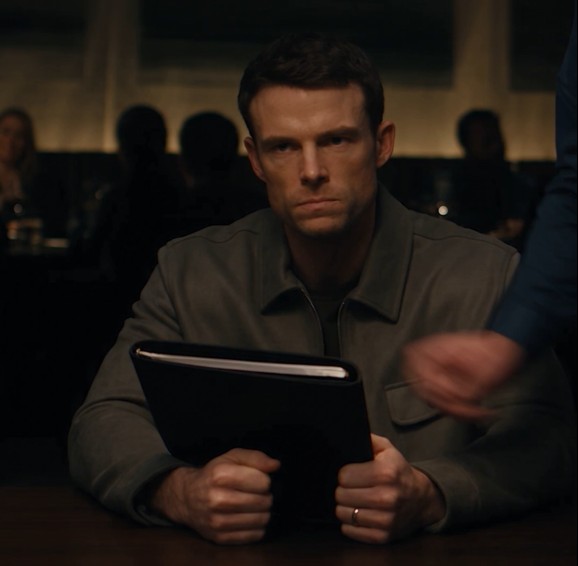
“What’s that?” Marcus asked.
“Your grandmother’s recipe cards.”
I opened the lid. Inside were handwritten cards stained with flour and age. I remembered Grandma keeping them in a kitchen drawer, wrapped in a blue cloth. After her house had been sold, I thought the cards were gone.
Mom looked at me. “Your father had them.”
“Why?”
“He said they were worthless.”
Marcus picked up the top card. Grandma’s handwriting filled the paper in slanted blue ink.
Mom’s voice became unsteady. “I took them before the house was emptied. I should have given them to you years ago.”
I looked at the box, then at her.
“Why didn’t you?”
“Because I was afraid every gift would become another conversation about what I owed you. I thought keeping quiet was kindness.”
“It wasn’t,” I said.
“No,” she agreed. “It was another form of control.”
She left the box with us.
That night, Marcus and I made Grandma’s lemon cake. We misread the instructions, used too much sugar, and burned the edges. Mom ate two slices anyway.
For a while, the three of us sat around the kitchen island while rain tapped against the windows.
No one mentioned Dad.
We did not need to.
His absence filled the room, but it no longer ruled it.
Months later, I received a letter from the court. Dad had accepted a plea agreement after the financial records became impossible to dispute. He would serve several years in prison and repay what assets remained. The forged contract had been included among the charges. The attorney who helped him lost his license.
I read the letter once, then put it in a drawer.
I expected to feel relief.
Instead I felt something quieter.
An ending did not always arrive as satisfaction. Sometimes it was simply the moment when a person who had occupied every room in your mind became unable to enter.
That evening, Marcus came by with groceries. Mom was already in the kitchen, arguing with the oven timer.
“Your mother thinks the cake needs another ten minutes,” he said.
“It does,” Mom replied.
“It’s already black.”
“It has character.”
We laughed.
The city outside the windows glowed beneath a clear sky. The penthouse stood exactly where it had always stood, high above the streets, its glass reflecting the last light of day. For years, I had thought ownership meant having a place nobody could take from me.
I understood it differently now.
A home was not the walls, the deed, or the view. It was the first place where people stopped performing and told the truth. It was the room where an apology could exist without demanding immediate forgiveness. It was the table where no one had to earn a seat by surrendering something precious.
Marcus set the groceries down.
“Mom brought another recipe box,” he said.
Mom looked guilty. “There may be more.”
“Where?”
“In the storage unit.”
“How many?”
She thought about it. “Six.”
Marcus groaned. “Grandma had six recipe boxes?”
“No,” Mom said. “Your father kept moving things whenever he was angry.”
We stared at her.
Then Marcus started laughing, and Mom followed, and soon I was laughing too.
The truth was still painful. It would remain painful in places. But it had stopped being a weapon.
Later, after Mom left and Marcus washed the dishes, he stood at the kitchen window with the spare key hanging from his fingers.
“I used to think you were the strong one,” he said.
“I’m not.”
“I know.”
He turned toward me.
“I think you were just the first one who got tired of pretending.”
I looked at the letter resting beside the recipe cards.
“Maybe we both got tired at the same time. We just didn’t know it.”
Marcus placed the key on the counter.
“Thank you for letting me come through the door as myself.”
“You’re welcome.”
He picked up the pie dish. “Do you want me to take this home?”
“No. Leave it.”
“Why?”
“Because you’re coming back tomorrow.”
