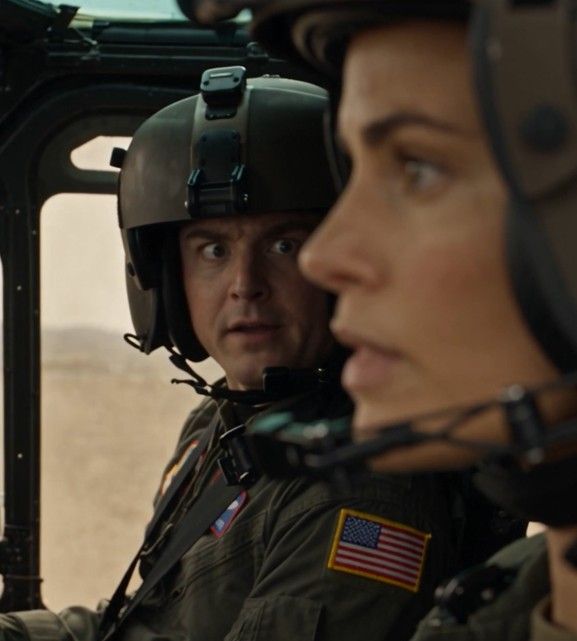
Reed frowned. “Who is that?”
Collins stood. “We will identify every person on the net. Captain Bennett, your flight suspension remains in effect until the investigation is complete. Do you understand?”
Ava’s stomach tightened. “Yes, sir.”
“That is not a judgment. It is procedure.”
She believed him this time.
The wounded soldier survived surgery. His name was Staff Sergeant Marcus Vale. The surgeon later told investigators that the rapid evacuation materially improved his chance of survival, but no physician was willing to say with certainty what would have happened after another twenty-five minutes. Ava was grateful for that caution. She did not want her career decided by a heroic story nobody could prove.
The flight-safety review examined three separate questions: whether Ava violated a lawful order, whether the decision was reasonable under emergency conditions, and whether the command’s evacuation process had provided her crew accurate information in time.
The first answer was easy. She had violated the hold order.
The second was harder.
The third became the largest problem.
Radio recordings, system logs, and Marcus’s device showed that the ground team reported a secure immediate landing area before Ava turned toward it. The operations desk did not update the status because one required confirmation from a separate security element was still pending. Instead of telling Ava that ground forces reported the area locally secure but the formal hazard check was incomplete, the controller summarized the situation as “landing zone not cleared.”
That phrase was technically accurate and operationally incomplete.
Investigators also found that the duty operations officer, Captain Rourke, had refused a request to elevate the evacuation decision to the on-call commander because he believed the replacement aircraft would arrive within the standard window. He had not falsified a record or tried to harm anyone. He had made a rigid decision under pressure and then presented uncertainty as a simpler prohibition.
The recording from Marcus’s vest made the timeline impossible to blur.
Rourke sat for an interview and admitted he had heard the ground leader’s assessment.
“Why did you not pass that to Eagle Two?” the investigator asked.
“Because it was not the clearance authority.”
“Did you think the aircrew might consider it relevant while deciding whether to declare an emergency?”
Rourke looked down. “Yes.”
“Then why not say it?”
He had no answer that satisfied even himself.
The review did not turn Ava into an unquestioned hero or Rourke into a cartoon villain. That disappointed people who wanted a simple story. The command’s findings were more uncomfortable: multiple professionals had each held only part of the truth, and the system encouraged them to speak in binary terms—cleared or uncleared—when the real situation was changing by the minute.
Ava’s own decision was criticized too. She held for only ninety seconds before turning toward the site and did not explicitly declare an emergency before departing the holding point. The board found she should have stated more clearly that she was exercising emergency judgment and forced the command to acknowledge that decision in real time.
“Would you do it again?” Collins asked during her final interview.
Ava hated the question because the honest answer depended on details.
“If I had exactly the information I had that day, with a patient reported to be deteriorating and no timely alternative, I would still consider landing. But I would declare the emergency, make the risk decision explicit, and demand every available piece of the ground assessment before committing.”
Collins studied her. “That is a better answer than yes.”
Ava almost smiled.
Her suspension lasted eighteen days. The final report concluded that her deviation from orders was justified by the medical emergency but that her crew coordination and radio procedures required corrective training. She received no career-ending punishment. She completed additional emergency decision-making training and returned to flight status.
Rourke was removed from duty on the operations desk and received formal administrative action for failing to elevate the medical urgency and for withholding relevant situational information from the aircrew. He later completed retraining in emergency escalation before being assigned elsewhere.
