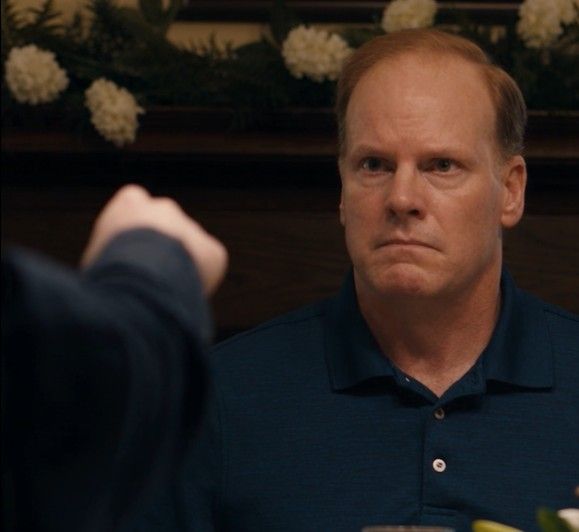
“Mark Ellison, you are under arrest for the murder of Janice Ellison,” she said, her voice flat and professional, but her eyes were hard. “You have the right to remain silent.”
Mark started to cry while they cuffed him. It was an ugly, snotty, gasping cry, nothing like grief. He kept looking at Jeremy as they walked him toward the door.
“Jeremy, buddy, tell them I didn’t mean it,” he begged. “Tell them it was an accident. Tell them, Jeremy—”
Jeremy didn’t answer. He stared at his father’s hands as the cuffs closed. Silver, catching the light, just like the watch that day at the lake.
The door closed behind them. The police car outside flashed red and blue through the lace curtains for a minute, then pulled away. The house was quiet except for the ticking clock and Lisa’s uneven breathing.
For a long time no one moved.
Then Jeremy’s grandfather walked to the mantel and straightened Janice’s photograph with a careful, shaking hand. His own tears were falling freely now, into his mustache.
“I’m sorry,” he said to the picture, to Lisa, to Jeremy, to no one in particular. His voice was ruined. “I was the police. I should have known. That day at the lake, he said he turned his back for a second. I told Lisa that drownings happen fast. I told her to stop asking questions. I let him— God help me, I let him come to dinner every year.”
Jeremy’s grandmother went to him and put her hand on his back. She was crying too, silently.
Lisa sank back into her chair and pulled Jeremy to her again. She held his face in both her hands and looked at him like she was seeing him for the first time since he was five.
“You are so brave,” she whispered, her forehead touching his. “You are so brave, my love. I’m so sorry I didn’t hear you. I’m here now. I’m here.”
Jeremy closed his eyes and finally let himself be held. His shoulders, which had been up near his ears for eight years, dropped. He sobbed once, hard, and then breathed.
His grandmother knelt on his other side and took his hand. His grandfather put a heavy hand on his head.
They stayed like that for a long while, a tight circle in the middle of the ruined dinner, holding the boy who had carried the truth alone for most of his life.
Eventually, Lisa wiped her face and looked at Jeremy with a strange, hesitant softness.
“There’s something I need to show you,” she said quietly, glancing at her parents. “We were going to wait until tomorrow. But after tonight— you should know tonight.”
Jeremy frowned, confused, his eyes red.
Lisa stood and went to the sideboard. She opened the top drawer and pulled out a folded piece of light blue paper, worn at the creases from being opened and refolded many times.
She handed it to him.
Jeremy unfolded it. It was a crayon drawing. Two stick figures holding hands beside a lake, with wobbly yellow suns and blue water. At the bottom, in a child’s handwriting, it said JANICE + JEREMY.
Underneath, in an adult’s neat cursive, someone had written: Janice – Age 6 – Sunny Hills Center – 11/02
Jeremy’s breath stopped.
“What is this?” he whispered, his new voice barely there.
Lisa knelt again, and now she was smiling through her tears, a real smile that shook.
“She didn’t die,” she said.
The words didn’t make sense at first. Jeremy stared at her, then at his grandparents, who were both nodding, crying harder.
“Detective Ruiz didn’t just come because I called yesterday,” Lisa said quickly, the words tumbling out. “She called me three weeks ago. The lake— they drained part of it this summer because of the drought. They do surveys when the water is low. A fisherman who was there that day eight years ago saw the news and came forward. He said he saw a man drive away fast with a little boy crying in the truck, and he heard splashing. He went to the reeds and found her.”
Jeremy’s hands started to shake so badly the paper rattled.
“She was alive,” Lisa said, and a sob broke her smile. “Barely. She had water in her lungs, she had hit her head. He did CPR until the ambulance came. She was in a coma for months. Brain injury. She couldn’t remember her name at first. The hospital listed her as Jane Doe because there was no ID and your father’s report said she’d been lost in the current and swept away. They thought no one was looking for her. The state placed her in a long-term care home when she woke up but couldn’t speak or walk right.”
Jeremy pressed the drawing to his chest like he couldn’t get air.
