“Yes.”
“Good.”
I wrote exactly what happened.
No adjectives.
No speculation.
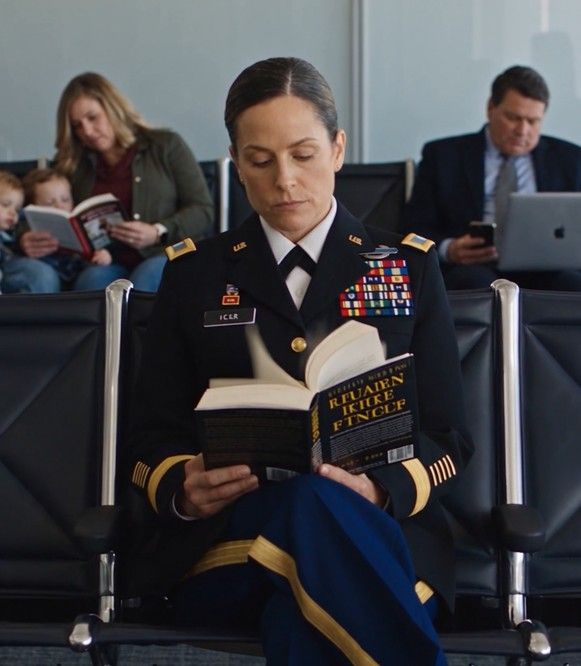
Carter mocked the uniform, questioned my authenticity, moved into the seat beside me, and touched my sleeve after I declined to engage.
Mason laughed initially and then stopped.
Lewis did not participate.
General Shaw heard the exchange and intervened.
Facts.
The next morning, I assumed command.
The room contained soldiers, Marines, sailors, airmen, civilian specialists, and families. General Shaw spoke about readiness, trust, and the invisible work required to move people safely.
I took the colors and gave a short speech.
I did not mention the airport.
Afterward, an aide approached.
“Ma’am, there is a Marine staff sergeant asking if he can speak with you.”
I frowned.
“Name?”
“Staff Sergeant Ortiz.”
I recognized the unit Carter had given me.
“Send him in.”
Ortiz entered, came to attention, and introduced himself as Carter’s platoon sergeant.
“I am not here to ask you to withdraw anything,” he said immediately.
“Good.”
“I wanted you to know we are addressing it.”
I nodded.
“He is not a bad Marine,” Ortiz said. “But yesterday he acted like one.”
“That distinction matters.”
“Yes, ma’am.”
He explained the command was using formal counseling and corrective training. Carter would prepare a class for his section on rank identification, professional conduct, and intervention when peers crossed a line. The command would decide any additional administrative consequence.
I appreciated the response because it was neither theatrical nor dismissive.
“Make sure the class is not about recognizing lieutenant colonels,” I said.
Ortiz looked at me.
“It should be about respect before recognition.”
He nodded. “Understood.”
Three weeks later, a letter arrived through official channels.
Carter had written it himself.
The first paragraph apologized again.
The second mattered more.
He wrote that during the corrective class, Mason had challenged him in front of the section.
You keep saying you did not know who she was, Mason told him. Why did you need her to be somebody before you treated her like a person?
Carter wrote that the question embarrassed him more than the airport had.
Good, I thought.
Embarrassment can be useful when it is pointed at the right thing.
He did not ask me to forgive him.
He ended by saying he had begun noticing how often jokes in his group depended on someone else being too tired or junior to object.
I filed the letter and moved on.
Six months later, our joint group supported a major readiness exercise that included Carter’s unit.
I did not know until the planning conference.
Names appeared on a roster. His was one of them.
