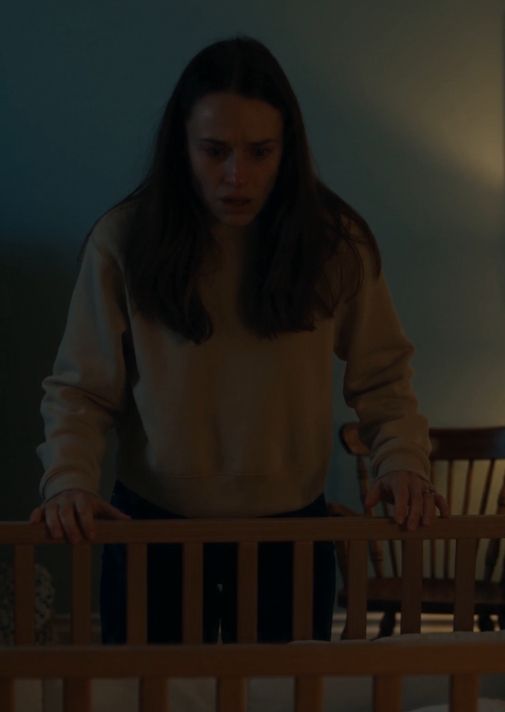
“I’m going up,” Lena said.
“Then take the card and don’t use my name.”
“I’m going to use your name.”
Marisol almost smiled, and it was the saddest almost-smile Lena had ever seen. “I know,” she said. “That’s the trouble with you.”
The stairwell was black until her card hit the reader and the light above her head snapped on, a hard white buzzing tube that made her blink. She climbed with the blanket under one arm and the rattle in her fist and her phone in her apron pocket, which she took out and, because her hands needed something to do, held in front of her with her thumb on the record button.
The fourth floor was carpet. No smell of food up here, only old paper and wax and something faintly medicinal. A hall of dark doors, closed, identical, and at the far end one open a hand’s width with a strip of gold light falling across the carpet like a threshold in a story where the hero is warned twice.
Inside, four monitors showed the restaurant from every angle.
Lena saw the dining room from above, the silver blur of the pass, the corridors, and then her own stomach dropped through the floor: the third camera showed the supply closet, the tablecloth, the blanket, the exact square of floor where her daughter had been sleeping. Small. Clear. In frame.
Dominic Rusk sat behind the desk with his sleeves rolled to the elbow, not looking at her, doing something patient with a pen.
Ellie was on the leather couch in her carrier, awake, entirely calm, chewing on her own fist.
She was fine. That was almost worse.
“Close it,” Rusk said, without turning around. “It doesn’t shut right if you slam it.”
Lena closed the door. The sound it made was very small.
He gestured at the chair across the desk, then at the couch where Ellie lay, as if he were a doctor delivering a diagnosis he expected her to be grateful for.
“Sit down, Lena. We’re going to have a very short conversation about forty-two thousand dollars and a baby in a closet.”
“Give me my daughter.”
“She’s not going anywhere. Neither are you, for about ninety seconds.” He slid a folded paper across the polished surface. “That’s a statement. It says you brought the child in against policy, that you removed items from the office level, and that the cash found in the bag by your feet belongs to you and to no one here. You sign it, and tomorrow you’re a waitress who made a mistake on a bad day. You don’t, and tomorrow you’re a woman who sold her daughter’s bottle for grocery money. I’ll let the paper say whatever you want it to say. I’ve always loved giving people choices.”
The bag sat on the corner of his desk, zipped crooked, heavy at the base in a way it had not been heavy that morning.
Lena looked at it for a long moment. Then she looked at the paper, and at him, and she put her phone face-down on the arm of the chair with the lens pointing steadily at his chest, because her hands were shaking and she needed something to do with them.
“Yolanda called me at eleven,” she said. “From a number I didn’t know.”
Rusk’s pen stopped.
“She said she was sorry, family thing, she gave me another number to try. That was the number I rang four times before I put my daughter in that closet.” Lena’s voice came out flat and strange and completely steady, the way it used to get when the landlord called at seven in the morning. “Family thing. She’s your cousin, isn’t she.”
“You’re very tired.”
“She didn’t cancel because she was sick. She canceled because I was supposed to end up doing exactly what I’m doing right now, standing in front of you, signing something.” Lena nodded at the paper. “The money’s in the bag. It’s been in the bag since this afternoon. You put it in there so that when it’s found, it’s found with me.”
Rusk set the pen down and laced his fingers, and the room got quieter.
“You know what your problem is,” he said, “is that you think being unseen makes somebody weak. I have been the one people hear when they’re called for fifteen years. Fifteen years I have carried that name down those stairs and done what needed doing with it, and in all that time not one person ever asked me a question. Because they don’t want an answer. They want to be left alone, and I let them, right up until the moment they cost me something.”
“And the owner? All those calls with his name on them.”
“I call who I need to call.” Something moved at the corner of his mouth. “He comes down once a year, if that. He sees numbers. He doesn’t see rooms.”
He stood up and reached across the desk toward the carrier, and the movement was so smooth and so practiced that Lena was out of the chair before she heard herself move.
Ellie made a sound — not a cry, the thin rising keen that comes just before one — and Lena’s hand closed on the strap of the bag and she swung it, not at him, at the desk, and forty-two thousand dollars burst out of the zip like something alive, banded and green, scattering across the leather and the carpet and into the folds of the blanket on the couch.
