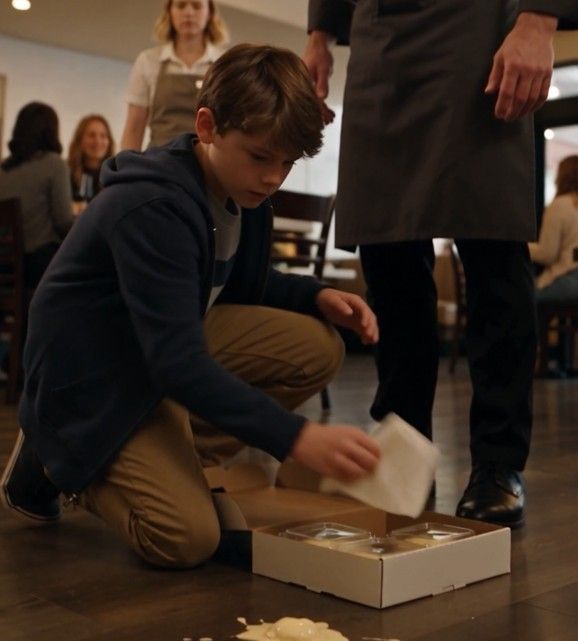
Lucy, meanwhile, struggled with returning to the restaurant. Her first shift back, she froze outside Kent’s old office. Daniel had already changed the lock and boxed Kent’s personal items, but the desk remained. Lucy asked whether she could avoid the room.
“Yes,” Daniel said.
A week later she chose to enter with another manager. She stood beside the desk where she had taken the photograph and realized the room looked ordinary. That angered her at first. Places where bad decisions are made rarely announce themselves. They have staplers, schedules, coffee cups, and fluorescent lights.
She opened the drawer where Kent kept vendor forms. It was empty. Daniel told her the records had been secured for investigators.
“Good,” she said, and closed it.
The produce vendor later organized a meeting among several small suppliers. Claire almost skipped it because she was tired of talking about Kent. She went when she realized the purpose was not to relive the fraud but to compare business practices. They agreed to stop accepting vague claims from large customers simply because the account felt too important to risk.
One older vendor told Claire, “He counted on each of us thinking we were the only one having trouble with him.”
The sentence sounded painfully familiar. It was the business version of what Owen had experienced on the restaurant floor: isolate the person, make them doubt themselves, then call resistance unprofessional.
Claire went home and told Owen.
“So everybody needed a Lucy?” he asked.
“Maybe everybody needed to compare notes sooner.”
Owen considered that. “Still glad we had Lucy.”
“Me too.”
School became easier after that, though the story spread among Owen’s friends because local reporters covered Kent’s charges. Some kids treated Owen as if he had uncovered a criminal scheme. He corrected them.
“Lucy did,” he said. “I dropped a bag.”
His best friend grinned. “Historic bag drop.”
Owen rolled his eyes. The joke helped. It turned the worst five minutes of his summer into something he could mention without hearing Kent’s voice in his head.
Claire stopped asking Owen to make restaurant deliveries for a while. He eventually complained.
“You said I am not incompetent.”
“You are not.”
“Then why can I not deliver?”
Claire realized she had swung from trusting him too much with an adult conflict to protecting him from an ordinary task.
“Fair point. Want to do the library order with me?”
“Yes.”
They carried the boxes together. Claire drove. Owen handled the receipt. Nothing happened. That was the whole point.
Weeks later, Lucy visited the bakery on her day off. She brought a framed photograph. Owen groaned when he saw it.
“Please tell me that is not the floor.”
It was not.
The photograph showed a tray of Claire’s desserts plated at the restaurant during a charity dinner. A small card beside them listed the bakery by name. For years Kent had demanded discounts while complaining about quality, then served Claire’s food without crediting where it came from. Daniel had changed that. Vendors were now named on event menus when their products were featured.
Claire stared at the image. “He told me customers did not care where desserts came from.”
Lucy smiled. “Turns out they do.”
The new relationship between bakery and restaurant was cautious. Claire did not automatically resume regular deliveries. She negotiated written terms, clear acceptance procedures, and a rule that any damaged product claim required a photograph before food was served or discarded. Daniel agreed.
Owen watched his mother negotiate and realized something had changed in her too. She no longer treated keeping a customer as more important than being treated fairly by one.
That fall, the bakery hired a part-time adult driver for large deliveries. Owen was relieved and slightly offended. Claire told him both feelings were allowed. He still helped after school sometimes, mostly boxing cookies and labeling orders.
One afternoon a new employee dropped an entire tray of muffins. The crash made everyone freeze. Twelve muffins rolled across the clean floor.
The employee went pale. “I am so sorry.”
Owen looked at Claire.
She looked at him.
For half a second both remembered Kent standing over Owen and demanding that he move faster.
Then Claire picked up a broom. “Nobody died. Let’s clean it up.”
Owen started laughing.
The employee looked confused. “What?”
“Nothing,” Owen said, kneeling to gather the paper liners. “It is just a really good floor for learning things.”
By winter, Owen was asked to speak briefly in a middle-school career class because the teacher knew his family owned a bakery. He almost refused. The class was supposed to be about small business, but he worried someone would bring up Kent. His mother told him he could say no.
He went.
When a student asked what the hardest part of working with customers was, Owen expected himself to talk about the restaurant. Instead he said, “Knowing when a customer is actually giving feedback and when they are trying to make you feel small.”
The teacher asked how you tell the difference.
Owen thought of Claire’s new forms, Lucy’s photographs, and the day one dropped container turned into a public humiliation. “You check facts. And you ask other people what they saw.”
It was not a dramatic answer. That was why he liked it. The lesson he carried forward was not that every angry manager was secretly committing fraud. It was that someone else’s authority did not cancel evidence, witnesses, or his own right to be treated with basic respect.
After class, a student admitted his boss at a weekend job often yelled at him in front of customers. Owen did not give legal advice or tell him to quit. He said, “Tell an adult you trust exactly what happens, not just that the job is bad. Details help.”
