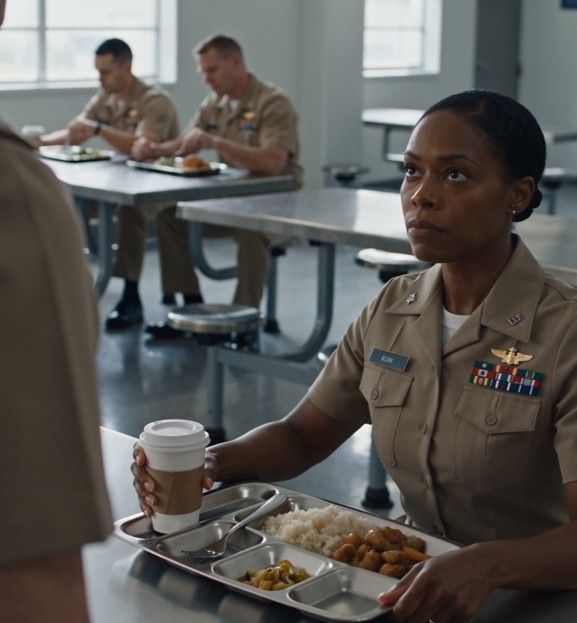
Maya looked at the signature block.
Vanessa had signed it.
The counseling meant to protect her authority had documented the exact claim that could now be checked.
“Are you going to rebut this?”
Sarah hesitated.
“I don’t know.”
“Why not?”
“Because formal rebuttal turns lunch into a command issue.”
“She already did that.”
Sarah looked at Maya.
There was fear there now, plain and unhidden.
“I have an evaluation due in six weeks. She has input.”
Maya understood.
This was why the cafeteria had gone quiet.
Not because everyone agreed with Vanessa.
Because rank could reach beyond the moment.
A chair could become a report.
A sentence could become a rating.
A disagreement could follow someone long after lunch ended.
Maya took a breath.
“Then my statement goes with your rebuttal.”
Sarah frowned.
“You don’t owe me that.”
“You stood up because of what happened to me. I’m not going to let the official record pretend you invented the situation.”
That afternoon, Maya wrote exactly what she remembered.
She described Vanessa moving her tray before she had finished pulling out the chair. She described the claim that the area was reserved for senior officers. She described the empty seats, Sarah’s offer, Vanessa’s questions, and Sarah’s answer about discipline.
No adjectives about Vanessa’s character.
No guesses about motive.
Only behavior.
The two majors submitted statements too.
The captain near the window did not.
Not at first.
He came to Maya three days later.
“I saw everything.”
“Then write it.”
He looked toward the hallway.
“Cross signs part of my next assignment recommendation.”
Maya said nothing.
He laughed without humor.
“That’s the whole problem, isn’t it?”
“Yes.”
He submitted his statement that evening.
Sarah’s rebuttal went up the chain.
Vanessa responded by insisting the issue had been mischaracterized. She said the table was not formally reserved but had long been understood as an informal senior-officer space intended to facilitate leadership discussion.
That explanation created a larger problem.
If the practice was unofficial, why was a captain being formally counseled for questioning it?
If it was official enough to discipline people over, where was it authorized?
The review expanded.
Nobody launched an investigation because Maya Bennett had secretly been someone important.
She wasn’t.
