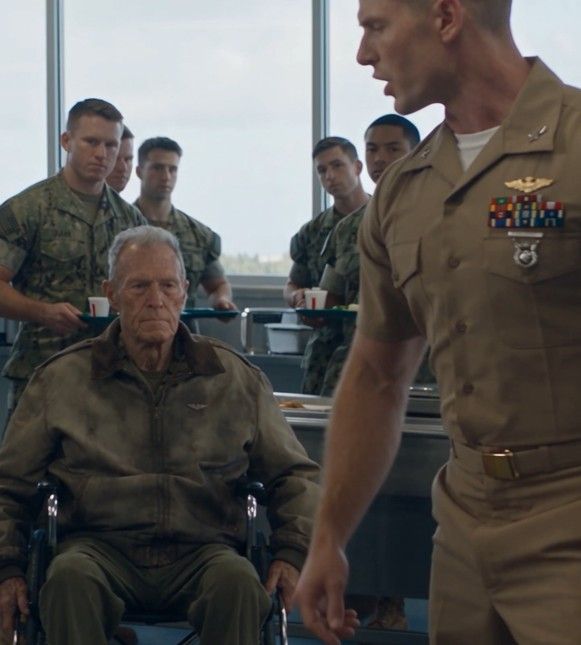
Blake turned to him. “With respect, Chief, you do not know what I believed.”
“No,” Michael replied. “But I know what you said.”
The commander looked across the room. “Who else heard it?”
Silence returned.
It was different this time. Before, silence had protected Blake. Now it was forcing everyone to decide what kind of men they were when the room no longer belonged to the loudest person in it.
Harris raised his hand.
Then the young lieutenant stood straighter. “I heard him tell Mr. Carter this facility was not a place for people looking for sympathy.”
Another operator spoke. “He moved the table away from him, sir.”
A third swallowed. “He took the insignia off his jacket.”
Blake stared at each of them as though betrayal had occurred.
Michael watched the same faces with something closer to sadness.
The commander said, “Captain Morgan, report to my office after lunch. Senior Chief, remain with him until then.”
Blake’s jaw flexed. “Sir, if I may-”
“You may not.”
The answer was not loud. It did not need to be.
The commander turned to Michael. “We can still move the ceremony upstairs.”
Michael looked at the empty space where his table had been.
“No,” he said. “Keep it here.”
The commander hesitated. “Here?”
“If the subject is leadership, this seems like the right room.”
For the first time, several operators looked genuinely uncomfortable.
Blake did not speak again. The senior chief guided him toward a side wall while two sailors returned the table to the window. A young operator reached for Michael’s chair.
Michael lifted one hand. “I have it.”
The operator froze. “Yes, Chief.”
Michael rolled himself forward.
Then he looked back. “But you can carry my tray.”
A few soft laughs moved through the room. Not at anyone. With relief.
The operator picked up the tray as if he had been given something important to do.
The ceremony had been scheduled as a small anniversary observance for a leadership program that had begun decades earlier. Michael had helped build its first version after the accident Harris mentioned, when his injuries ended his operational career but not his usefulness. He had spent the next twelve years training men who were stronger, faster, and younger than he was, insisting that technical skill without judgment was only another way to create danger.
The program had changed names. Buildings had been renovated. Photographs had been moved into archives. Michael had disappeared into civilian life after his wife became ill.
The principles had remained.
The commander stood beside the table and introduced him without embellishment.
“Michael Carter served this community for more than three decades. Some of you were trained by people he trained. Today we planned to thank him for helping establish the leadership standards we still teach.”
Michael shook his head.
“That introduction is too long.”
A few smiles appeared.
He rested both hands on the rims of his wheelchair and looked at the room.
“I was asked to say something about standards,” he began. “I had notes. I do not think I need them anymore.”
Several eyes moved toward Blake.
Michael did not look at him.
“Skill matters. Strength matters. Discipline matters. But none of those things tell me what you will do when humiliating somebody is easy and defending them is inconvenient.”
Daniel, the operator who had been laughing earlier, lowered his eyes.
Michael continued.
“There are moments when the person testing you will not be an instructor. There will be no whistle. No scorecard. No warning that this is the moment people will remember. Sometimes the test is an old man in a chair. Sometimes it is a new teammate who does not know the room yet. Sometimes it is the person everybody else has decided is safe to ignore.”
He let the words settle.
“Rank can make a room quiet. Character determines what that silence means.”
Harris looked down at his hands.
Michael saw him and smiled faintly. “Tom taught me that one.”
Harris blinked. “Pretty sure it was the other way around.”
“Memory gets generous with age.”
