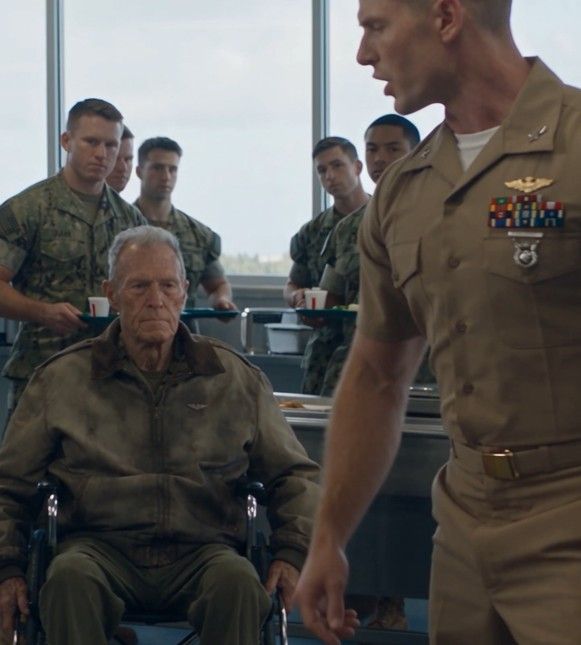
The table scraped across the polished cafeteria floor just before Michael Carter could reach it. Captain Blake Morgan had grabbed the edge and pulled it away from the old wheelchair, leaving Michael sitting alone in the open while several younger SEAL operators watched. “You should understand where you belong.” Moments earlier, Blake’s voice had cut through the Coronado cafeteria with enough force to silence nearly every conversation. “Sir, this is a military facility, not a place for people looking for sympathy.” Michael had stopped pushing his wheelchair. Fluorescent lights hummed overhead. Trays clattered behind the serving counter. Then even those sounds seemed distant as people waited to see whether the elderly man would react. Michael looked up at Blake, taking in the spotless uniform, the confident posture, and the younger operators gathered around him with curious smiles. He didn’t argue. He simply rested one hand on the wheel and continued toward the empty table near the window. That was when Blake moved it. A few soldiers laughed beneath their breath. Michael looked at the empty space, then back at the captain. “Funny,” he said quietly. “Forty years ago, I heard almost the exact same words from people who confused strength with arrogance.” Blake’s smile weakened. His gaze dropped to the wheelchair, then to the faded military jacket covering Michael’s shoulders. The fabric had clearly survived decades. Its color had washed almost gray, and the small insignia near Michael’s chest was scratched and worn. To Blake, it seemed like another relic belonging to a life that no longer mattered. “You still think that old patch means something?” Michael lowered his eyes toward it. “It means enough.” Blake shook his head. “No offense, but this is where active operators train, eat, and prepare.” His eyes moved deliberately toward Michael’s chair. “You’re not exactly what people expect to see here.” Several young SEALs looked away. Some were uncomfortable. Others stayed quiet because challenging their captain carried a price none of them wanted to pay. Michael noticed every reaction. The men avoiding his eyes. The ones who smiled because someone with authority had smiled first. He had seen that kind of silence before—not in cafeterias, not during peaceful afternoons, but in moments when people decided another person’s value before learning anything about them. Blake reached toward Michael’s chest. His fingers closed around the old insignia. “This?” He removed it from the jacket and held it up. “This is what you came here to show everyone?” The room grew even quieter. Michael stared at the metal in Blake’s hand. There was no anger in his face. No fear. Only disappointment. Then, from somewhere behind the captain, an older staff member whispered, “Put that back.” Blake heard him and ignored him. “Why?” He placed the insignia on the table he had just dragged away. “Because you think a piece of metal makes someone important?” Michael looked directly at him. “No.” His voice remained calm. “I think what someone does when nobody is watching tells you who they really are.” Blake gave a short smile. “You’re giving me a lecture about character?” Michael slowly looked around the cafeteria—the uniforms, the young operators, the people who had spent years learning discipline and control. “Maybe someone needs to.” The words settled across the room. Blake stepped closer, expecting Michael to retreat into silence. He didn’t. Behind the captain, the older staff member was still staring at the insignia on the table. His expression had changed completely. The younger operators noticed. One by one, their eyes moved from the old man in the wheelchair to that scratched piece of metal. Blake noticed the shift too, but not yet the reason for it. He looked down at Michael as if the confrontation still belonged entirely to him. It didn’t. And whatever that older staff member had recognized, nobody in the cafeteria was laughing anymore. 👇
The older staff member took one step forward, then stopped as if he had walked into a memory.
His name tag read HARRIS. He had been working the Coronado cafeteria long enough that most operators knew him only as the man who arrived before dawn and remembered who took coffee black. Very few knew he had once worn a uniform himself. Fewer still had ever seen his hands shake.
They were shaking now.
“Captain,” Harris said, louder this time. “Put the insignia back in his hand.”
Blake turned. “You want to explain why?”
Harris did not look at him. He was looking at Michael. “Chief Carter?”
The title moved through the room like a change in air pressure.
Michael’s expression barely shifted. “Been a long time, Tom.”
A tray clattered somewhere near the serving line. One of the younger operators who had laughed first stopped smiling so quickly it was almost painful to watch.
Blake glanced from Harris to Michael. “You know him?”
Harris finally looked at the captain. “I know exactly who he is.”
Michael rolled his chair closer to the table. He reached for the scratched insignia, but Blake’s hand came down over it first, not because he wanted it now, but because surrendering it in front of the room would mean admitting that he had misjudged the man beneath him.
“No,” Blake said. “We’re not doing this. One retired staff member recognizes another retired man and suddenly everybody is supposed to stand at attention?”
Michael’s eyes dropped to Blake’s hand.
“I did not ask anybody to stand.”
“Then why are you here?”
The question was sharper than the others, but underneath it was something new. Unease.
Before Michael could answer, Harris crossed the space between them. He did not touch Blake. He simply stood beside the wheelchair.
“He is here because Command invited him.”
That did it.
A young lieutenant at the far table rose. Another operator followed. Blake looked around and saw the room changing without his permission.
“Sit down,” he ordered.
Nobody moved.
Michael looked at the men standing, then at the ones still seated. “Please. Finish your lunch.”
The gentleness of it made Blake’s posture look even harder.
Harris pointed to the insignia. “That was on his uniform the day he carried two men out of a burning aircraft after a training crash at North Island. It was on him when he came back with a shattered hip and still refused evacuation until everybody else was accounted for. And it was on him for the years he spent teaching young operators that the first thing rank gives you is responsibility, not permission.”
Michael exhaled slowly. “Tom.”
Harris stopped. He understood the warning. Michael had not come to have old stories turned into weapons.
Blake did not.
“Those are nice stories,” he said. “They do not explain why he is in my cafeteria.”
Michael’s gaze sharpened for the first time. “Your cafeteria?”
The question was quiet, but Blake heard what everyone else heard. Not anger. Correction.
The main doors opened before he could answer.
A commander entered with a civilian aide and a senior chief. The commander was in his fifties, broad shouldered, gray at the temples. He took three steps into the room, saw Michael in the open, saw the table dragged away, saw the insignia under Blake’s hand, and stopped.
“Captain Morgan,” he said.
Blake straightened automatically. “Sir.”
The commander looked at Michael. “Mr. Carter, I apologize. We were told you had already been escorted to the conference room.”
Michael glanced toward the cafeteria. “I took a detour.”
The senior chief’s eyes settled on the insignia.
“Sir,” he said carefully to Blake, “why are you holding Chief Carter’s Trident?”
No one laughed now.
Blake removed his hand as if the metal had become hot.
Michael picked it up. For a moment he did not pin it back onto the faded jacket. He held it in his palm, thumb passing over the scratches.
“It is not a museum piece,” he said. “And it is not proof that I am more important than anybody in this room. It is a reminder of people who trusted one another when trust was expensive.”
The commander stepped closer. “Captain, I asked you a question.”
Blake’s face tightened. “Sir, I believed there was an unauthorized civilian in a restricted area.”
Daniel, a young operator near the wall, looked toward the floor.
Michael saw it.
“That is not what happened,” he said.
