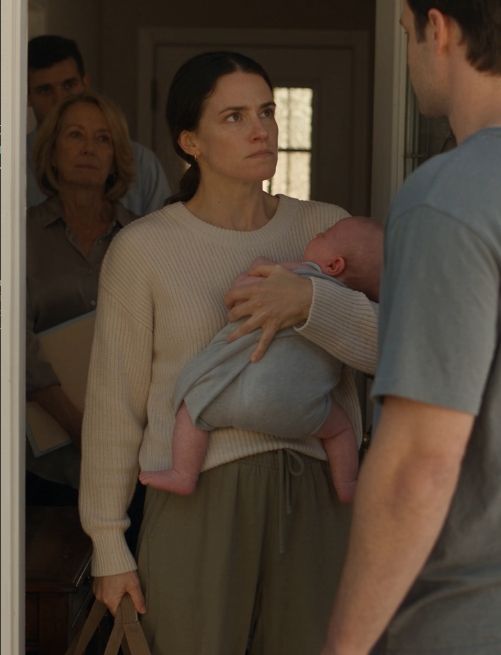
Frank stepped forward and held up the trust document and the folder from Carlos. He didn’t raise his voice. He didn’t need to.
“Brenda, Derek, Mason,” he said calmly. “I’m Frank Delaney, counsel for the Whitaker Family Trust. This quitclaim deed is void. The trust owns this property, not Gaby individually, so she couldn’t transfer it even if she wanted to. Mason, your notary commission expired in November. Forging a notary seal is a felony in Arizona. And Carlos here has provided texts and video showing conspiracy to create false evidence of parental unfitness, plus wage theft of a hundred and eighty thousand dollars. We’re prepared to file all of this with the court Monday morning, along with a motion for emergency return of property and a report to the State Bar and the County Attorney.”
The silence that followed was complete. Even the cicadas seemed to stop. Mason’s mug shook in his hand.
Brenda recovered first. Her face twisted. “You think anyone will believe a disgruntled worker and a girl who begs on the street? We have photos. We have bank records. We have a doctor who will say—”
“You paid a kid to photograph her begging after you forced her to beg,” I said. My voice was low and even, but I felt every year of holding back break open. “You told her to stand in traffic with my grandson so you could take pictures to steal him. That’s what you did.”
For the first time, Brenda’s composure cracked. She glanced at Derek, who was staring at Carlos with pure panic.
“Mason,” Frank said quietly, looking at the youngest Miller. “You’re twenty-four. You have no record. Your brother and mother are looking at fraud, forgery, extortion, and attempted custodial interference. You can be a witness or a defendant. That’s your choice in the next ten seconds.”
Mason set the mug down so hard coffee sloshed onto the entry table. His hands were trembling violently now.
“It was their idea,” he blurted, his voice cracking. “All of it. Derek said Gaby would sign anything if Leo was crying. Brenda said we needed the house to cover the debts on the other flips. She said Gaby was weak, she wouldn’t fight. I didn’t want to do it. I told them the notary thing was expired but Brenda said no one checks.”
Derek lunged at him. “Shut up! Shut your mouth!”
Carlos moved between them without even thinking, his broad shoulders blocking Derek. Brenda grabbed Derek’s arm.
“You idiot,” she hissed at Mason. Then she turned to Frank, her face now blotchy and furious. “You can’t prove any of this. It’s his word against ours.”
Frank tapped the folder. “We have the texts, Brenda. We have the video where you say ‘make her look unstable.’ We have the photo timestamps that show systematic surveillance. And we have Gaby.”
Gaby stepped forward then, into the doorway of the house that was supposed to be her safe place. She was crying openly now, but her voice was clear.
“You took my truck so I couldn’t leave,” she said, looking at Derek. “You took my money so I couldn’t eat. You told me I was a bad mother so I would believe you. I slept on the ground with my baby because of you. And I will never let you near him again.”
Derek’s face went red, then white. He opened his mouth, closed it. For a second I saw the boy she must have fallen in love with, scared and small behind the cruelty Brenda had taught him. Then it was gone, replaced by something ugly.
“You’ll regret this,” he said to Gaby, but it sounded hollow, like a line he’d rehearsed that didn’t work anymore.
“No,” Gaby said. “I won’t.”
Brenda tried one last thing. She turned to me, her voice turning syrupy. “George, be reasonable. Families fight. Let’s not get lawyers and police involved. Derek loves Gaby. He loves that baby.”
I looked at her, at the house, at my daughter holding my grandson on the porch where she should have been safe for months.
“Get out of my daughter’s house,” I said. “You have an hour to get your things. After that, I’m changing the locks. Frank will be filing a restraining order that says you can’t come within five hundred feet of Gaby or Leo. If you file anything on Monday, we’ll be there with everything we have.”
Mason was already moving, grabbing his keys, not looking at his mother or brother. Derek hesitated, his eyes on Leo, and for a moment I thought he would try to grab him. Carlos shifted his weight and Derek thought better of it. Brenda stood there a second longer, her perfect composure shattered, her mouth tight, realizing that the power she’d wielded for months with threats about CPS and judges was gone because someone had finally written it all down and someone else was willing to show it.
They left in the Tacoma and Brenda’s SUV, peeling out of the driveway too fast. We stood on the porch and watched them go, the heat rising in waves off the asphalt. Gaby was shaking so hard Leo started to cry, and she sank down onto the top step and held him against her shoulder, sobbing into his little blanket.
I sat next to her and put my arm around her. Frank put a hand on her other shoulder. Carlos stood a respectful distance away, his folder closed now, his job done.
“It’s over,” Gaby whispered into Leo’s hair. “Is it over?”
“Almost,” Frank said gently. “We still have to file to make it official, but yes. The house is yours. The truck will be back by tonight. The bank will freeze that account. They can’t touch you now.”
We went inside after that. The house smelled like Brenda’s perfume and stale fast food. The crib Gaby had picked out with her mother before she died was still in the nursery, but it was covered in boxes. Gaby walked through every room slowly, touching the walls, as if she couldn’t quite believe they were still hers. In the kitchen, there were dishes in the sink that weren’t hers.
She stopped in the doorway of the nursery and finally let out a sound that was half laugh, half sob, and leaned against me. I held her and Leo together, my daughter and my grandson, in the house I had bought to keep them safe, and I felt my wife’s absence and presence all at once.
We didn’t stay there that night. Frank said to let the locks be changed first. We went back to the motel, and for the first time Gaby slept without the light on, Leo in the little bassinet the shelter manager Marisol had lent us when she heard where we were. Marisol had cried when Gaby called her to say we had the house back. She said she’d been keeping her own notes for weeks, worried about Brenda’s donations and the way Derek hovered at pickup.
The next morning, Carlos got a cashier’s check for forty thousand as a first payment. He texted me a photo of his crew, two men grinning in front of a truck, with the caption: Tell Gaby thank you for being braver than me.
On Monday, Frank filed everything at 8 a.m., an hour before Brenda’s petition was supposed to be slipped to Judge Harrell. The judge’s clerk called Frank by 10 a.m. to say the Miller filing had been withdrawn. By noon, the bank had frozen Derek’s access and flagged the eighty-six thousand for return. By evening, the Tacoma was back in Gaby’s driveway, vacuumed and with a full tank, Mason having driven it over with his head down and an apology mumbled to the pavement that Gaby accepted with a nod but not a hug.
It should have felt like victory. And it did, in the way that finally breathing after holding your breath feels like victory. But that night, after Leo was asleep in the motel, Gaby sat on the bed with her hands in her lap and said something that changed everything I thought I understood.
“I need to tell you something,” she said, not looking at me. The lamp was low again. Outside, the same ice machine hummed. “About Grand Avenue. About you finding me.”
I sat down across from her. “What about it?”
Her fingers picked at a loose thread on the bedspread. Her voice was so quiet I had to lean in.
“I stood there on purpose,” she whispered. “On Grand Avenue. I knew you drive Grand every Thursday to check the shops. You always have. Since I was little. You take 19th Avenue to Grand, past the AutoZone, at four o’clock. I remembered.”
My breath caught.
“I was at the shelter for two weeks,” she went on, tears running silently now. “I didn’t know what to do. Brenda said if I called you, you’d think I was crazy too. But one of the women at the shelter, Elena, she said, ‘Your dad owns those shops, right? He still drives that route?’ And I thought… maybe if I just stood where you would see me… maybe you would stop. I stood there three days, Dad. Three days from two to five. With that cup. Leo was so hot. I felt so ashamed. But I didn’t know how else to make you see me without Derek seeing me first.”
The photo on her phone. The video Brenda made. All of it, I had thought it was their trap. That they had put her there to be seen, to be judged. And they had, in a way. But Gaby had taken the very street they used to humiliate her and turned it into a signal flare.
“You were begging,” I said, my voice breaking, “because they made you. But you chose where to beg so I would find you.”
She nodded, finally looking at me, her face wet and open and terrified that I would be angry.
“I was so scared you would just drive by,” she sobbed. “When you said my name… I wanted to run. I thought you’d be ashamed of me.”
I didn’t answer with words. I couldn’t. I slid off the chair onto my knees again and pulled her into me, and we both shook. Leo slept through it, his little chest rising and falling in the bassinet. I held my daughter and felt the full weight of what she had done, how much courage it had taken to stand in traffic with her baby and hold a plastic cup and hope that her old father would still take the same road at the same time, that he would still look.
“You were so brave,” I whispered into her hair, the way I had when she was four and fell off her bike. “You were so, so brave, my girl. I’m so sorry it took me three days to find you.”
She cried harder then, but it was a different kind of crying, the kind that lets go.
We moved her back into the townhouse on a Tuesday. I brought my crew from the shops, not to work on cars but to carry boxes, to fix the lock on the back door that Brenda had broken, to repaint the nursery a soft green that Gaby chose. Marisol came with a bag of baby clothes donated from the shelter and stayed for coffee. Frank brought the final papers that said the trust was secure and the protective order was granted. Carlos stopped by with his sister, who hugged Gaby for a long time and said, “You did it.”
Gaby didn’t frame the quitclaim deed or the photos. She shredded them in the office shredder Frank lent us, Leo watching the paper disappear with wide eyes, and then she vacuumed up the shreds herself.
A week later, I found her in the kitchen at the townhouse on a Sunday morning. The light was coming in through the window over the sink, warm and gold, catching dust motes and the steam from the coffee. Leo was in his high chair, banging a soft spoon against the tray, giggling every time it made a noise. Gaby was barefoot, in a clean shirt that was finally her own, her hair still damp from a shower she could take as long as she wanted.
She was making pancakes. The radio was on low, an old song her mother used to hum while she did the same thing.
I stood in the doorway and watched them. My daughter, safe in her own kitchen. My grandson, fed and warm and laughing. The house quiet except for the spoon and the radio and the soft sound of Gaby singing under her breath, off-key and unashamed.
