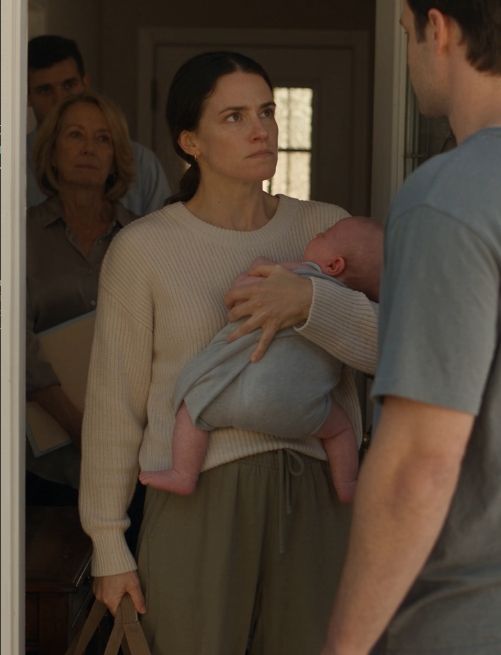
A man stood outside. Young. Broad-shouldered.
“Mr. Whitaker. I’m here on behalf of Derek Miller. He wants his wife home tomorrow.”
I closed the door.
Then my phone buzzed.
Unknown number.
The message made my blood run cold:
*I’ve worked for the Miller family for three years. They owe me $180,000 and they’re refusing to pay. If you want to know what they’re planning to do to your daughter, tomorrow at 9. Come alone.*
But that wasn’t the worst part.
At 12:17 a.m., someone sent Gaby a photograph.
It showed her outside the shelter weeks earlier. Leo in her arms.
Taken from across the street.
Someone had been watching her long before I found her between the cars.
And suddenly I realized: what if finding her in traffic wasn’t an accident at all?
The phone was still glowing in her hand and she wasn’t breathing.
Gaby sat on the edge of the motel bed with Leo curled against her chest, his little mouth open, his cheek damp where it had pressed into her shirt. The blue light from her screen lit the underside of her chin. Her thumb hovered over the photo and then pulled away like it had burned her. Outside, the ice machine down the walkway hummed and clunked, and the air conditioner rattled in the window, pushing cold air that smelled faintly of cleaner and old carpet.
I knelt in front of her so I wasn’t standing over her. My knees popped. I didn’t care.
“Give it to me, honey.”
She didn’t move at first. Then slowly, like she was handing over something that could detonate, she placed the phone in my palm. The photo was grainy, zoomed in from a distance. Gaby on the concrete steps of the downtown shelter, the one on Jefferson with the chipped yellow doors. Leo wrapped in a thin blanket that wasn’t thick enough for March nights. Her hair pulled back, her eyes down. In the corner was a timestamp. Three weeks ago. 6:42 p.m.
Someone had stood across the street and watched her long enough to frame the shot.
Leo made a small sound in his sleep and rooted against her. Gaby’s hand went automatically to his back, rubbing in slow circles. Her other hand was gripping the bedspread so tight her knuckles were white.
“They followed me,” she whispered. Her voice was raw, barely there. “Even when I thought I was safe. Even at the shelter.”
I turned her phone face down on the bed. I put both of my hands over hers. They were cold.
“Look at me,” I said. “No one is getting through that door tonight. Okay? No one.”
She nodded but her eyes kept flicking to the window, to the thin curtain that didn’t quite close, to the slice of parking lot light cutting across the floor. The man who had knocked at 8:30 was gone, but his words were still in the room. He wants his wife home tomorrow. As if she were a borrowed tool. As if Leo were luggage.
My own phone buzzed again on the nightstand. Same unknown number.
*9 AM. Diner on 7th and McDowell. Booth in the back. Don’t bring her. They are filing on Monday.*
Filing. My stomach dropped. Brenda’s threat about family court hadn’t been empty talk.
Gaby saw my face change. “What is it? What did they say?”
I didn’t want to show her. I did anyway. She read it with Leo’s head tucked under her chin, and I watched her shoulders cave in.
“They’re going to try to take him,” she said. It wasn’t a question. “That’s what Brenda meant. She said she had a judge who owed her a favor. She said no court would give a baby to a homeless girl who begs in traffic.”
The way she said homeless girl, like she was quoting someone, like she’d heard it enough times to believe it, made something hot and sharp rise up my throat.
“You’re not homeless,” I said. “You have a house. They stole it. There’s a difference.”
She shook her head, tears finally spilling over. “It doesn’t matter what the truth is. It matters what they can make it look like. That’s what Derek always says.”
I stood up and locked the deadbolt again and checked the chain even though I knew it was locked. Then I pulled the curtain closed the last inch and turned off the overhead light so only the lamp by the bathroom stayed on, low and yellow. Leo sighed in his sleep.
“We’re going to that diner,” I said quietly. “Not we. I am. At nine. And then we’re going to call Frank.”
Gaby’s head snapped up. “Frank Delaney?”
“Your mom and I used him for everything. He did the townhouse. He keeps copies of everything.”
“Dad, you can’t go alone. What if it’s them? What if it’s a trap?”
I sat next to her on the bed. The mattress dipped under our weight. I put my arm around her and felt how thin she’d gotten under that oversized shirt. My daughter used to run track. She used to eat two plates of her mother’s enchiladas and steal the last piece of pie when she thought I wasn’t looking.
“If it’s a trap, then they already know where we are,” I said. “If it’s real, that person is scared enough to risk this. Either way, I need to hear it.”
She leaned into me then, just for a second, her forehead against my shoulder. She hadn’t done that since she was fifteen. I felt her shaking.
“Don’t leave us here alone,” she whispered.
“I’m not going anywhere without you knowing exactly where I am,” I said. “I’ll be fifteen minutes away. I’ll keep my phone on. You lock this door and don’t open it for anyone but me. Not the maid. Not anyone.”
She nodded against my shoulder. Leo’s tiny hand had found her shirt and twisted it.
We didn’t sleep. We sat with the lamp on, listening to the trucks on Grand Avenue a few blocks over, watching Leo breathe. At 5:30 the sky started to turn gray behind the curtain. At 6:00 Gaby fed Leo with a bottle we had bought at the gas station, her hands steadier when she was holding him. At 7:45 I kissed the top of her head and the top of his and left the motel with the spare key in my pocket and my old work jacket on, the one with Whitaker Auto stitched over the heart.
The diner on 7th and McDowell hadn’t changed in twenty years. Same cracked vinyl booths, same smell of grease and coffee that had been on the grill since 6 a.m. I was there at 8:40 and took a booth where I could see both doors. At 8:58 a man walked in who didn’t look like the broad-shouldered messenger from last night.
He was older than Derek, maybe forty, with a shaved head and a mechanic’s hands and a folder under his arm that had seen better days. He wore a clean but faded work shirt that said Miller Custom Builds on the back. He saw me and his face did something complicated, relief and shame at once.
“Mr. Whitaker?” He slid in across from me without waiting for an invite. He kept his hands on the folder. “I’m Carlos Reyes. I ran Derek’s crew for three years. Framing, drywall, the flip houses Brenda finds at auction.”
I studied him. His eyes were red like he hadn’t slept either.
“You sent the message.”
