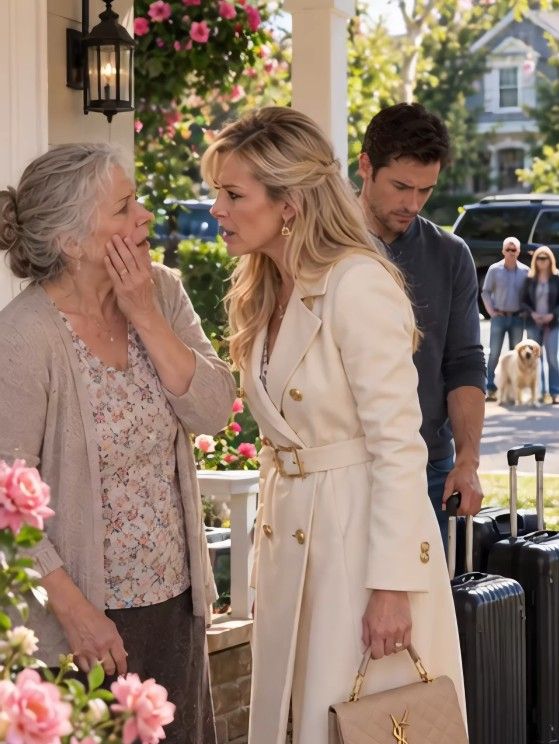
The final repair was social rather than legal or financial. People who had heard only fragments of the conflict began reaching out. Bessie refused to campaign for sympathy and refused to supply private details merely to win public approval. A short truthful explanation was enough. Some people understood immediately. Others preferred the simpler old explanation. Bessie let them keep their distance. That restraint protected dignity. It also deprived Lennox’s hidden spending of another arena in which to force a performance. Over time, reputation settled around behavior rather than gossip. The people who mattered most had seen the truth directly and were now watching what everyone did with it. That was sufficient.
The next boundary test came sooner than Bessie expected. A request arrived in the familiar urgent tone, asking for an exception because the situation was supposedly different this time. Bessie read it twice before answering. In the past, the word urgent would have erased every other consideration. Now it triggered a question: urgent for whom? The answer made the decision clearer. Bessie responded with one calm sentence that preserved the boundary and offered only the help that could be given freely. There was disappointment on the other end, but no catastrophe followed. The world did not collapse because Bessie said no. That ordinary discovery became one of the clearest signs that healing had begun. Later, someone in Bessie’s support circle asked whether guilt had appeared. It had. The difference was that guilt no longer received decision-making authority. They talked about how strange it felt to let an uncomfortable feeling exist without immediately paying money, changing plans, surrendering space, or apologizing for having needs. The conversation ended with both of them laughing softly at how revolutionary something so basic could feel.
Much later, after the central conflict was truly over, something unexpected arrived, and it felt like a gift rather than another complication. On Bessie’s next birthday, Terrence gave her no expensive gift. He handed her a printed copy of his first six-month emergency fund statement and said, almost embarrassed, that he finally had somewhere to go in a crisis that was not her house. Bessie hugged him harder than she would have hugged any present. At first Bessie did not understand what was being offered. Then the connection to the subpoena for records from the $620,000 Maple Street sale became clear. Something that had carried fear, humiliation, or uncertainty earlier in the crisis now carried a different meaning. The change did not rewrite the painful past. It completed it. Bessie laughed once through tears, the surprised kind of laugh that escapes before a person decides whether it is appropriate. Someone nearby laughed too. The moment was human, small enough to be believable and large enough to loosen the last tight place in Bessie’s chest. There was no new enemy behind it, no hidden bill, no condition waiting to be discovered. It was simply a sign that the care Bessie had given the world had not disappeared. Some of it had found its way back.
Peace returned in increments. A full night’s sleep. A meal eaten while it was still warm. A key turned in a lock without anxiety about who might be on the other side. A holiday planned around joy instead of obligation. Bessie noticed these things because crisis had once made them invisible. In Bessie’s house, the rooms slowly collected new memories that did not erase the old ones but outnumbered them. The people who belonged there asked before rearranging anything. They brought food without bringing demands. They stayed because they wanted company, not because they expected service. When difficult anniversaries came, Bessie did not pretend they were ordinary days. There were tears, sometimes anger, sometimes the strange grief of missing people who were still alive but no longer safe to keep close. The grief was allowed. It did not reopen the door. Bessie set Terrence’s small savings statement beside a family photograph, then opened the curtains of the house she had refused to lose and let the morning in. In that final image, there was no applause and no audience. Only warmth, a familiar room, and the quiet certainty that nobody present needed to earn the right to feel safe.
