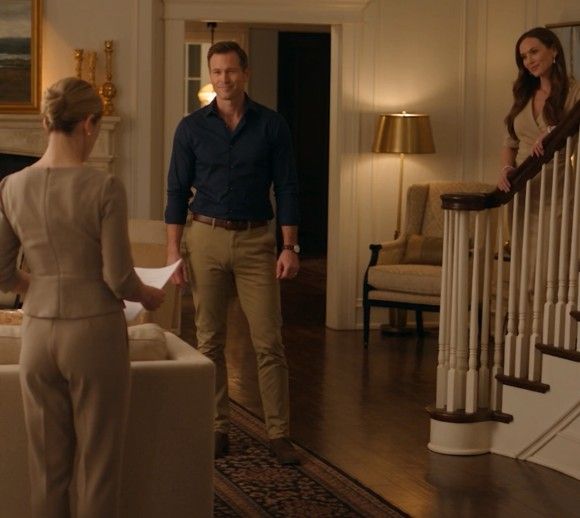
He looked at the front steps. “I mean today.”
“I know.”
That was the last conversation I wanted to have in that house: his concern about how the ending appeared, my exhaustion with explaining how it felt. I handed him the agreed keys, kept the copy of the inventory, and walked outside.
The truck carried my possessions to a rented apartment across town, with most of the furniture going to secure storage until I had time to decide what fit. My new rooms were modest and bright. A kitchen window looked toward a sycamore tree, and the radiator clicked when it warmed.
I had measured carefully. One cream sofa fitted beside the window. The other would wait in storage. The restored runner filled almost the entire hallway, which made the space look slightly ridiculous and wonderfully mine.
When the movers left, I sat on the floor because I had not decided where the reading chair should go. The room smelled of cardboard, fresh paint, and the lemon soap the previous tenant had left beneath the sink.
I cried then. Not because the house was still beautiful without me, or because I wondered whether Evan regretted anything. I cried because seven years had taken energy I could not move in a truck. The objects were evidence of my work, but they could not return the mornings I had spent trying to make him notice it.
My friend Leah arrived with soup and a screwdriver. She did not tell me I had won. She set the soup on the counter and asked where I wanted the lamp.
“I’m not sure yet.”
“Then we’ll try somewhere.”
We moved it twice. The second position put warm light across the sofa instead of against the ceiling. I felt a small, unexpected pleasure. There was no need to defend the first choice or pretend I had always known the answer.
For the next few weeks, the legal work continued in ordinary increments. The lawyers resolved the sideboard’s description, and a mover collected it at an agreed time. The property transfer and other settlement steps followed their scheduled process. I kept copies and answered questions rather than assuming a signed judgment meant every administrative task was complete.
Evan sent several messages about things he could not find. The extension lead, a particular vase, the spare lamp. I replied only when an item was actually covered by the inventory. Once I gave him the name of a store where he could buy what he needed. I did not go back to arrange his rooms.
That refusal was harder than the dramatic departure. I was accustomed to seeing an unfinished space and solving it. For years, usefulness had been the fastest way to feel secure. Now I had to tolerate being unnecessary to the man who had dismissed me.
Leah helped me understand that no further explanation would transform him into somebody who valued what he had taken for granted. When I caught myself drafting another message about the rug or the table, she asked what answer I was hoping to receive.
I could never quite name it. An acknowledgment large enough to cover seven years, perhaps. No message could reliably obtain that. I deleted the drafts and went back to arranging my own apartment.
I took photographs of the furniture in storage, then chose which pieces would stay with me. The second sofa went to a couple furnishing their first home. They arrived with careful measurements and an old blanket in the back of their van.
The woman ran a hand over the fabric and asked whether I would mind if they changed the cushions. I laughed, surprised by the tenderness of her question.
“Make it yours,” I told her.
Watching them carry it away felt different from watching the movers remove it from my marriage. That sofa was going toward a life rather than away from one. I could keep the money, the memory, and none of the responsibility for how they used it.
The walnut table was too large for my apartment. For a while I considered keeping it indefinitely because selling it seemed like surrender. Then I measured the cost of storage and admitted that preserving an object could become another way of postponing a decision.
I found a neighborhood workshop that taught furniture restoration. Its director wanted a sturdy table for group projects. We negotiated a fair sale and arranged delivery. The first time I visited afterward, four students were working around it, concentrating on a damaged chair.
One of them thanked me for the table. I told him I was glad it had work to do. The thought pleased me more than any compliment it had received beneath the Italian chandelier.
The workshop director asked whether I wanted to attend a course. I said I had done restoration for years, though I had never studied it formally. She asked to see photographs and suggested I help with a Saturday session instead.
I almost refused. Teaching felt presumptuous when so much of my work had been described as luck. Then I remembered the rug’s repaired edges and the hours nobody else had counted. I could show a student how to make one careful repair. I did not need a grand title to begin.
The evening after that first session, I wrote down what I had taught while it was still clear in my mind. The page filled with measurements, warnings, and small practical tricks I had learned through mistakes. Seeing them together made the work visible in a new way. It was knowledge, not merely taste. I put the notebook beside my tools, ready for another student to ask a question.
Saturday mornings gave me a new kind of room to enter. There were paint stains on the floor and daylight through dusty windows. People asked questions because they wanted answers, not because they were preparing to discount what I said.
I taught a woman named Grace how to test a hidden patch before stripping a finish. She rushed, damaged a small area, and looked frightened that I would be angry. I showed her how we could repair it.
“We can take our time,” I said.
The words surprised me after I spoke them. I had rarely said them to myself. I began using them at home, when the boxes took longer to unpack or a meal came out badly. My life did not need to look finished before I could live in it.
News about Evan reached me occasionally through friends. He and Claire had bought new furniture. He complained about the expense and the time it took to make the rooms feel right. I asked people not to bring me updates unless something affected the settlement.
His disappointment was not the foundation of my recovery. If his house became beautiful again, it would still not mean I had been wrong to leave. I wanted my days to hold possibilities that had nothing to do with whether he understood the loss.
One afternoon he asked to meet for coffee. I considered refusing, then agreed to thirty minutes in a public place. There were a few final practical matters, and I wanted to see whether I could sit across from him without feeling that I needed to make the conversation pleasant.
He arrived early. Without the rooms around him, he looked less certain of his own success.
“I didn’t realize how much of the house was you,” he said.
I watched him turn his cup. It was the acknowledgment I had once imagined wanting. Hearing it did not rearrange the past.
“You could have noticed while I was there.”
“I know.”
He said Claire had expected everything to be settled and comfortable. They were finding that their expectations differed. I stopped him before he described their arguments.
“I’m not the person to help you with that.”
