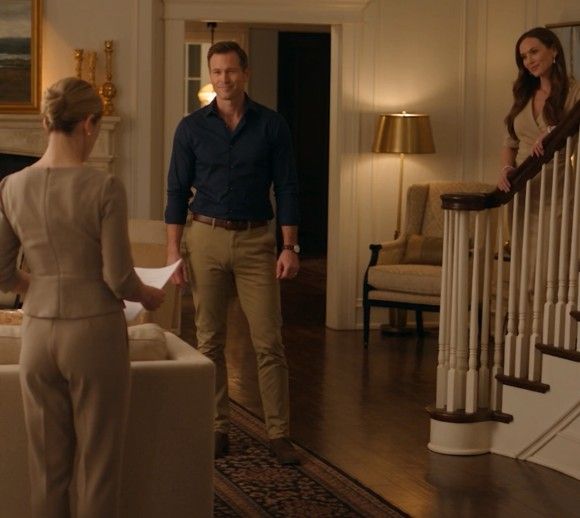
“This is everything,” he said.
“No. It’s the things we agreed were mine.”
The difference was important. I had not ordered the crew to dismantle the house. Floors, built-in cupboards, and fixtures excluded from the schedule would stay. The Italian dining-room light remained where it was because the settlement treated it as part of the house. I would not invent a right to remove it simply because I had selected it.
Claire looked upward at the fixture, then back at the table beneath it. For the first time, she seemed to understand that a room could contain things with separate histories.
Evan pointed to a paragraph. “I didn’t realize you meant all this.”
“You had the inventory before we signed.”
“I thought it was standard language.”
“My belongings are not standard language.”
One of the movers asked where he should begin. I led him to the living room and identified the sofas. They photographed the condition before lifting anything. The process was deliberate, almost boring, and that was its strength. Nothing depended on whether Evan approved of my tone.
He called his lawyer. I asked the crew to pause while the question was clarified. They stood on the covered floor, checking their straps. I did not want a disputed item loaded simply because he had underestimated what the papers meant.
On the phone, Evan described the furniture as if I had arrived to steal it. Then he listened. His lawyer’s answer was too quiet for me to hear, but I watched his mouth tighten.
“No, I signed it. But the house was supposed to include—”
He stopped. The sentence had reached a place where his assumptions could not follow the document.
My lawyer answered when I called her and spoke with his. Within half an hour, they confirmed that the undisputed listed items could leave. One sideboard required clarification because its description differed slightly between the inventory and a photograph. I told the movers to leave that one in place for now.
Letting one piece wait cost me nothing important. I wanted a clean departure, not the satisfaction of taking every inch I could argue about.
When the first sofa moved, a pale rectangle appeared on the floor beneath it. Claire watched as though a piece of scenery had slid away from a stage. The room still had its high windows and fine molding, but its warmth was being carried through the front door by two men in work gloves.
Evan turned toward me. “You’re doing this to humiliate me.”
“I’m collecting what belongs to me under the agreement. You can furnish your house.”
He looked toward the Italian fixture again. “You’re leaving that?”
“Yes.”
The answer seemed to annoy him more than a threat would have. It left him no useful picture of me as a woman tearing the building apart. I was following the same terms that had allowed him to keep the address he wanted.
Claire tried a different approach. “You can’t really use all this in a smaller place.”
“Some will go into storage. Some I’ll sell. Some I’ll keep. Those decisions are mine.”
She glanced toward the open suitcase. I wondered whether she was remembering her remark about my fresh start. I did not ask. Her understanding could arrive at its own speed, without assistance from me.
The movers rolled the runner carefully around a cardboard tube. As its pattern disappeared, I remembered the weeks I had spent repairing it at the kitchen table. Evan had complained that the work looked messy. Later, guests had admired the rug, and he had called it one of our lucky finds.
I had mistaken his willingness to enjoy my work for appreciation of the person doing it. The distinction was sharper now, but not crueler. It was simply something I needed to understand before choosing another home.
In the dining room, the walnut table required four men and a careful turn through the doorway. Evan asked whether the room had always been so large. Nobody answered. It had not changed size; the object that gave it proportion was leaving.
The artwork came down next. I filled no holes, because the settlement addressed ordinary removal and repair separately. The crew labeled every wrapping. I checked each label against the list and signed only when I had seen the item packed.
At the staircase, Claire touched my arm. I stepped back automatically, and she let her hand fall.
“I didn’t know you’d paid for these things before the marriage,” she said.
“Some before. Some during, under the arrangements we documented. We settled the division rather than leaving it to assumptions.”
Her eyes moved toward Evan. I had no interest in using her surprise to begin a separate confrontation. She knew he had been married when they began seeing each other. That was enough knowledge to make her own choices relevant. But the paperwork did not require a speech about betrayal.
I went upstairs for the last boxes from my wardrobe. In the bedroom, my half of the shelves was already empty. Evan’s shirts hung in rows, and I saw a new dress bag pushed against the far wall. I did not need to open it to understand its place.
For a moment, I sat on the edge of the bed. The room was quiet above the scrape of moving equipment downstairs. I had been calm so long that I could feel the strain beneath my ribs, like holding a heavy object with both arms locked.
I let myself breathe. Leaving did not have to look effortless to be the right decision.
There was one small box in the bottom drawer: ticket stubs, postcards, a chipped ornament from our first year together. I had planned to discard it. Instead I carried it to the suitcase. The fact that a marriage ended badly did not require making every early memory false.
Downstairs, the crew had reached the console. I removed the divorce papers before they wrapped it. Its empty place against the wall was narrow, but it changed the whole entrance. There was nowhere now for Evan to lay his keys without choosing a new object himself.
He stood near the fireplace and watched me sign the final inventory. His anger had become quieter. Claire had retreated to the kitchen.
“We could have done this differently,” he said.
“We had many chances to.”
