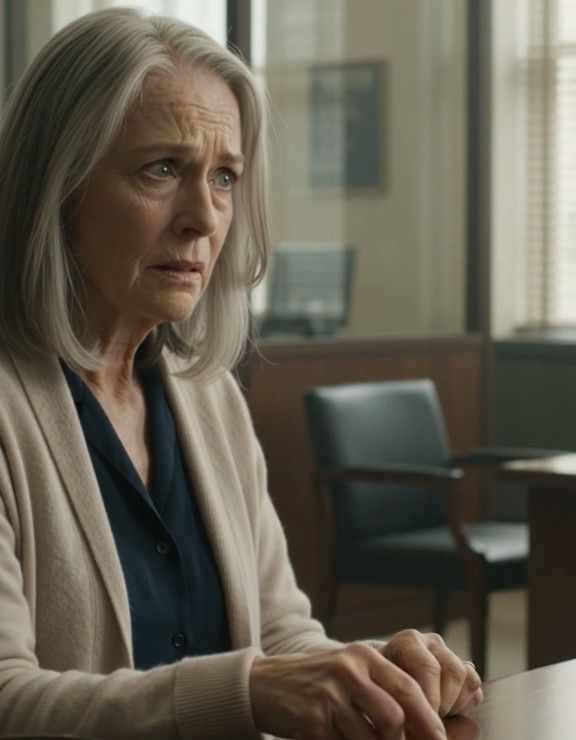
Daniel looked at Vanessa. “You told me Mom signed everything willingly.” She turned on him, furious. “She did sign! I was protecting our future.” The word future hung between us, ugly and revealing. Andrew explained that neither of them had acquired the trust’s title and that their attempted deed would be challenged. He also noted that unauthorized use of a notarial seal could carry consequences beyond the property dispute. Vanessa pushed back her chair. “You’re choosing a stranger’s paperwork over your wife?” she demanded of Daniel. He answered, “I’m looking at what you wrote.”
I did not gloat when she left. I thought of the family dinners I’d spent trying to be gentle with her, wondering what I could say differently to earn her kindness. There had been no perfect sentence. She had wanted control, and I had mistaken her disapproval for a problem I was required to solve. Daniel stayed behind. He admitted that he had debt he’d concealed from both his father and me and that Vanessa had told him they could fix everything by taking the house. “I knew it wasn’t right,” he whispered. “I just thought it would stop the fighting.”
“Not for me,” I said. He bowed his head. I told him I would help him find a financial counselor if he wanted to begin repairing his life, but I would not pay his debts or allow him into my accounts. There would be no private agreement and no secret rescue. He would have to acknowledge what he had signed, cooperate with the investigation, and accept whatever consequences followed. He asked whether that meant I would stop being his mother. “It means I’ll stop being the cushion between you and every hard surface,” I said. “The rest is your choice.”
Exactly three months after I carried my suitcase out of the house, a courier delivered a formal legal notice to Daniel and Vanessa’s front door. The notice demanded correction of the false deed, preservation of records, and an accounting of every attempt to use the property. Daniel later told me he’d stood in the hallway reading it while Vanessa argued that I was bluffing. But the letter carried the names of independent trustees and attorneys, not an angry widow pleading to be heard. That was the day he finally understood why I hadn’t begged for shelter: the home they’d tried to take was never theirs to give away, and I had stopped asking them for permission to be safe.
During the months that followed, the deed was set aside, and the property records were corrected. Vanessa entered a settlement of the civil claims that required her to abandon any claim to the house, repay documented legal expenses, and provide complete records of her communications. The authorities pursued the false notarization separately, and she eventually accepted a plea arrangement that left a permanent record and required community service. Daniel cooperated, received a lesser sanction for his role, and moved out of the house. He and Vanessa divorced. Nothing about those outcomes gave me my husband back.
I went to Maple Avenue one damp morning with Andrew and a locksmith. The yellow sticky notes were gone, but faint squares of adhesive remained on the dining table. Someone had moved the grandfather clock, leaving a pale rectangle on the wall. I found our wedding photograph in a box behind the television and set it on the mantel again. The rooms smelled of fresh paint and unfamiliar cleaning spray. For an hour I wandered from doorway to doorway, remembering the lives we had lived inside them. Then I understood that being able to reclaim a place did not mean I had to live there forever.
I decided to sell the house through the trust and use part of the proceeds to support a home-care program for older patients returning from hospital stays. I had watched too many people leave Saint Vincent’s with discharge instructions and no one to help them carry groceries. Andrew made sure the program had an independent board and clear safeguards. I chose a smaller apartment with a view of trees, closer to the hospital where I’d worked. The penthouse remained available for visits, but I was happiest where I could hear children on the sidewalk and neighbors calling good morning.
Daniel began rebuilding slowly. He took a second job, made regular payments against his debts, and saw a counselor who did not let him explain away his decisions as Vanessa’s influence. He wrote me a letter admitting exactly what he’d done, without asking me to shorten the list. I read it beside the window, noticing the spots where his pen had pressed hard into the paper. It was the first apology he’d given that did not contain the words but you have to understand. I called him and asked whether he’d like to have lunch the following week.
At lunch he brought a plain paper bag. Inside was the old wooden frame that had held our wedding photograph before Vanessa removed it. He had repaired the cracked corner himself. “I was afraid you wouldn’t want it,” he said. “I was afraid you wouldn’t want me.” I told him I hadn’t known what I wanted for a long time. Then I asked about his work, his counseling, and the people he was learning to trust. We spoke for two hours. We did not pretend one lunch could repair the day he let me walk out carrying everything I owned.
On the anniversary of my husband’s death, Andrew returned a final packet from the deposit compartment. We had reviewed the financial records long before, but this envelope was marked For Margaret, when the house is quiet again. Inside was a list of names written by my husband over many years: nurses, aides, custodians, and patients who had changed his life. Beside each name was a memory. He had already pledged a portion of the trust’s future income to create scholarships for nurses who cared for older patients without family support.
At the bottom he had written my name. Margaret taught me that nobody should be left alone simply because caring for them is inconvenient. I sat motionless with that page in my hands. I had wondered whether the hidden fortune meant he’d lived a second life without me. Instead, much of his private planning had been about preserving the kind of care he’d watched me give without expecting recognition. His secrecy had hurt, and I would always wish we had been able to talk about it. But the final gift wasn’t the penthouse or the millions. It was the knowledge that he had seen me clearly.
I invited Daniel to help choose the first scholarship recipients. He asked whether he deserved a place in the room. “It’s work, not a reward,” I said. “If you come, you’ll read applications, set up chairs, and listen.” He did. The first recipient was a nursing assistant who had been saving for classes while caring for her own father. When she spoke about exhaustion and guilt, Daniel listened with his hands folded tightly together. Afterward he said, “I never thought about how much of your life you gave up for people like that.” I answered, “I didn’t give it up. I chose it. But it shouldn’t have meant I had to disappear.”
That spring we gathered at a small garden behind the hospital. The nurses wore comfortable shoes. The coffee came in paper cups, and the flowers were planted by volunteers who got dirt under their fingernails. Daniel helped an older man carry a folding chair across the path. I recognized the reflex in his movement, the way he reached out before being asked. Perhaps goodness had not vanished from him; perhaps it had been buried beneath too many years of choosing the easier thing. I knew now that unburying it was his responsibility.
I kept the brass key on a chain in the drawer beside my bed. It no longer opened anything I needed to visit regularly. Sometimes I took it out just to feel its familiar weight, remembering the hospital room where my husband pressed it into my palm. He had believed that security meant knowing I would be all right when life turned upside down. He’d been right, though not entirely because of the money. I had learned to say no, to accept help, and to stop mistaking abandonment for an obligation to become more generous.
One evening Daniel came over carrying groceries. He rang the bell and waited until I invited him in. That detail mattered. He set bread on the counter, found two cups, and asked me to tell him a story about his father that he hadn’t heard before. I told him about the man who once repaired a broken hospital wheelchair in the rain because the patient using it wanted to see the first snowfall. We laughed until my eyes watered. Then we ate supper beneath a window full of soft evening light. My home was mine, my life was mine, and the people who wished to share it were finally learning how to knock.
