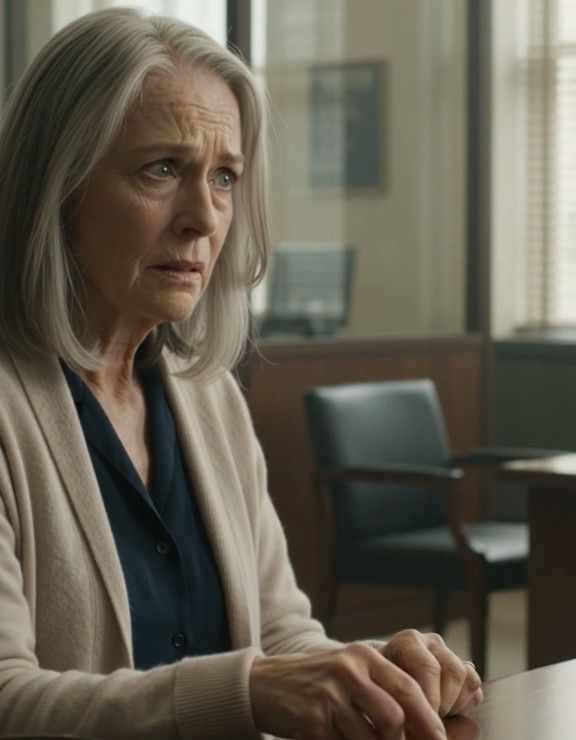
The woman stood so abruptly that her chair rolled backward.
“”May I have your full name?””
“”Margaret.””
Her expression changed completely.
She reached for the telephone on her desk.
And for the first time since I entered, she stopped calling me “”ma’am.””
Her voice dropped almost to a whisper.
Then she spoke four words into the receiver.
Four words that made everyone in that office suddenly stand at attention.
And as I watched the bank manager hurry toward the door, I realized something extraordinary.
Whatever my husband had left behind…
It was far bigger than anything Daniel or Vanessa could possibly imagine.
The bank manager’s hand remained on the telephone as she spoke into it. “The beneficiary has arrived.” The four words traveled across the office with the quiet authority of a bell. Beyond the glass door, two employees stood, and a man in a charcoal suit hurried down the corridor carrying a leather case. I looked at the brass key on the desk. Only yesterday it had seemed like another strange thing my husband had left behind. Now everyone appeared to recognize it except me.
The manager introduced herself as Evelyn Marsh. She asked whether I wanted a glass of water. I shook my head. My mouth was so dry I could hardly speak, but I wanted facts more than comfort. “My husband is dead,” I told her. “I have a suitcase downstairs and no house to return to. Please tell me why that key matters.” Evelyn’s expression softened. She closed the office door and placed the key between us on a clean white cloth.
“It opens a private deposit compartment,” she said, “but the compartment isn’t the inheritance. It’s how your husband chose to verify that you came here freely.” The man in the charcoal suit entered and introduced himself as Andrew Hale, the estate attorney whose card I had found in my purse. He pulled up a chair rather than sitting behind Evelyn’s desk. That small kindness nearly made me cry. I had spent five days being spoken to as though I had become a problem to be disposed of.
Andrew explained that my husband had quietly built an investment business with a former hospital patient who had become a property developer. The partnership began with one modest commercial building and grew over decades. My husband never used our household savings to take reckless risks; the investments were kept in a separate company and managed by professionals. When the holdings were sold, he directed most of the proceeds into a trust for my benefit. The current valuation was approximately twenty-eight million dollars. There was also a penthouse in Manhattan, owned outright by the trust.
I stared at him, waiting for the words to rearrange themselves into something familiar. Twenty-eight million dollars belonged to television advertisements and people who wore jewelry to breakfast. I was a retired nurse who had spent forty years cutting coupons and keeping extra buttons in an old tin. “He would have told me,” I whispered. Andrew didn’t argue. He opened a small envelope and slid out a letter in handwriting I recognized more deeply than my own name. My husband’s letters leaned to the right, as if they were always hurrying home.
Margaret, it began. I have been afraid of making our family look at money instead of each other. I should have trusted you sooner. The page blurred. I read it slowly, stopping each time the ache in my chest made the words disappear. He wrote that he’d wanted to protect me from relatives who might regard my savings as a family account, and that he had increasingly worried about Daniel’s dependence on Vanessa’s decisions. He apologized for keeping so much secret. He did not ask me to forgive our son or to punish him. He asked me to choose a life I actually wanted.
The key opened a compartment containing the original trust records, a photograph from our wedding, and a small recording device. Andrew asked if I wanted to listen. My husband’s voice came through thin and wavering, strained by illness but unmistakably his. He described how I had always worked the hardest shift because somebody else’s family needed care. “If you hear this,” he said, “I couldn’t stay long enough to tell you in person. Whatever happens next, the money is not a debt you owe our son. It is a way for you to be safe.”
I pressed the recording device to my heart. For several minutes neither Andrew nor Evelyn spoke. Then I asked about the house on Maple Avenue. I told them about Vanessa’s sticky notes and the papers I’d signed in my bedroom. I told them how Daniel had watched me leave with one suitcase. Andrew’s face tightened. He asked to see any copies I had. I had none. I could only describe the heading and the small boxes where I’d written my name. He explained that the bank could not decide whether a property transfer was valid, but his team could investigate the deed and the authority to sign it.
They arranged a room for me in the penthouse that afternoon. I refused a driver until Evelyn reminded me that the car belonged to the trust, not to a stranger offering a favor with conditions attached. The building rose above the city, all glass and quiet stone. From the windows I could see rooftops stretching toward the water. The living room had furniture so carefully arranged I was afraid to touch it. On the kitchen counter sat a chipped blue mug, the one my husband had always used for tea. I sat beside it and cried harder than I had in the motel.
The penthouse did not feel like home. It felt like a place he had prepared while knowing he might not live to share it with me. In the bedroom closet, there was a row of expensive coats with their tags still attached and a space left for my own belongings. I unpacked the two sweaters and my nursing shoes. I hung the quilt my mother made over the back of a chair. When I finished, I opened the refrigerator and found a note from him tucked beneath a magnet shaped like a little ambulance: Remember to eat, Margaret. You always forget when someone needs you.
By morning Andrew had called with troubling news. The property records showed that Vanessa and Daniel had attempted to record a deed transferring the White Plains house into their names. The instrument claimed I’d signed in the presence of a notary on the afternoon I left. But I had signed alone upstairs, and nobody had checked my identification or witnessed anything. Worse, my husband had placed the house in a revocable trust years earlier. At his death, it transferred under that trust to a separate property trustee for my lifetime benefit. I had no unilateral authority to give away the title.
The transfer was not a harmless family misunderstanding. Someone had submitted a document containing a false acknowledgment and an incorrect statement of ownership. Andrew told me we would challenge the recording and preserve all available evidence. I thought of Daniel sitting on the couch while I carried my suitcase toward the door. I had wanted him to stand up and say one kind thing. Instead, he had let his wife put papers on our bed and told himself that was practical. My grief gained a sharp new edge.
A week later I received a text from him. Mom, are you all right? Vanessa says the house paperwork needs another signature. Please call. I read it three times. He had not asked where I slept, whether I had money for food, or whether the March wind had made my joints ache. He wanted another signature. I handed the message to Andrew and asked him to respond through counsel. For once, I did not try to make things easier for my son by answering a question he had no right to ask.
Andrew obtained the email trail after our attorneys sent preservation notices and legal requests. Vanessa had arranged the documents before the funeral was over. She had told a preparer that I was a confused widow who wanted to transfer everything quickly. Daniel had forwarded a scan of my driver’s license without asking me. In one exchange, Vanessa wrote that if they moved fast enough, I would be too upset to read the papers. When I saw that sentence, I had to put the pages down. The cruelty wasn’t spontaneous. It had been scheduled around my husband’s death.
Daniel called again that evening. I answered because I needed to hear his voice without Vanessa’s words inside it. “Mom, where are you?” he asked. I told him I was safe. He said Vanessa was worried and that the bank had contacted their lawyer. “We thought you wanted a smaller place,” he insisted. I asked what smaller place they had arranged when they told me to live on the streets. There was a long silence. Finally he said he hadn’t believed Vanessa meant it literally. “You watched me carry a suitcase out,” I told him. “What did you think I meant?”
He began crying. The sound frightened me because I remembered holding him through fevers and nightmares. My body wanted to hurry to him, to make the sound stop. But I had spent forty years being the person who soothed everyone while nobody noticed I was bleeding. “I love you,” I said. “That doesn’t mean I can pretend you didn’t do this.” He asked whether we could meet. I told him we could, but only with Andrew present. For the first time in our relationship, my love had a boundary he couldn’t negotiate away.
The meeting took place in a modest conference room, not in the penthouse. Daniel arrived looking older than he had at the funeral. Vanessa came with him in a cream coat and dark sunglasses, scanning the room as if trying to identify the person in charge. She saw Andrew’s folders and stopped smiling. “Margaret,” she said brightly, “we’ve all had a stressful few weeks. There’s no reason to make this adversarial.” I looked at the woman who had told me to live on the streets. “You made it adversarial when you prepared a deed behind my back.”
Vanessa said she had merely followed my wishes. Andrew placed a copy of the notarized deed on the table and asked her to identify the notary. She claimed she couldn’t remember. He produced the notary’s written statement that the seal had been used without authorization. Daniel stared at the page. Then Andrew displayed the email describing me as too upset to read. Vanessa’s face changed. She reached toward the folder, but Andrew moved it back. “Our next step is to submit the evidence to the proper authorities,” he said. “Any false statements should be corrected through your own lawyer.”
