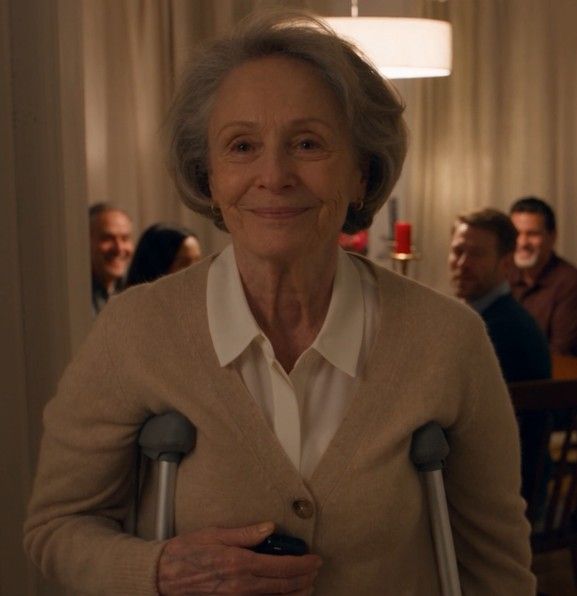
“You could have just confronted us,” Jeffrey said, and his voice broke on the last word, cracked right down the middle like a plate hit with a hammer. “You could have just — Mom, I’m your son.”
“You are my son,” Sophia said. “And I loved you enough to let you move in. I loved you enough to write those checks. I loved you enough to believe you when you said you were worried about me. But I will not love you enough to let you plan my death at my own kitchen table and then carve me up like a Christmas turkey.” Her voice held steady, but her left hand, the one gripping the crutch, was trembling. She pressed it flatter against the rubber handle until it stopped. “Your father would have been ashamed of you, Jeffrey. Not of me. Of you.”
Jeffrey’s face contorted. He opened his mouth, closed it, opened it again. No sound came out. The officer gently took his arm and began leading him toward the door, and he went, his legs moving mechanically, his eyes fixed on his mother until the angle of the hallway broke the line of sight and he disappeared.
The dining room was quiet.
Carol looked up from the table. Her eyes were wet. “Sophia,” she said. “I didn’t know.”
“I know you didn’t, Carol.”
“The money she mentioned — the fifty thousand — Jeffrey told me that was for my surgery. He said you wanted to help.”
Sophia absorbed this. She had suspected as much but hearing it confirmed still landed with a dull, heavy impact somewhere beneath her ribs. Jeffrey had used his aunt’s illness — Carol’s actual cancer, her actual surgery, her actual fear — as cover for stealing from his mother. He had weaponized his family’s love for each other.
“I know,” Sophia said again, more softly.
“What are you going to do?” Carol asked.
“I’m going to go to the police station. I’m going to give my statement. I’m going to let Diane handle the rest. And then I’m going to go home.”
“This is your home.”
Sophia looked around the dining room. At the Christmas tree. At the table set with the good china Richard had bought her on their twentieth anniversary. At the paintings on the wall that she and Richard had chosen together from a gallery in Park Slope thirty years ago. At the kitchen doorway where she had stood on Sunday mornings making coffee, listening to her son discuss the optimal timeline for her death.
“No,” she said. “It isn’t. Not anymore.”
The police station was bright and cold and smelled like coffee and industrial cleaner. Sophia sat in a small room with a metal table and gave her statement for three hours. Diane sat beside her, steady and quiet, occasionally placing a hand on Sophia’s forearm when the questioning became repetitive or when a particular detail — the conversation about the timeline, Jeffrey’s calculation of how many years Sophia might live, Melanie’s suggestion that they not wait — threatened to undo the careful composure Sophia had built for herself over the past three months.
At ten forty-seven that night, a detective named Ray Vasquez, who had grey at his temples and kind eyes and a wedding ring he kept touching as Sophia spoke, told her that both Jeffrey and Melanie had been formally charged. Financial exploitation of a vulnerable adult. Grand larceny. Conspiracy. The evidence was substantial.
“Mrs. Reynolds, I want you to know,” he said, leaning forward with his forearms on the table, “what you did — gathering that evidence, building that case, staying calm — that took extraordinary courage. I’ve seen cases like this where the victim couldn’t act. Where the shame was too much. Where they loved the person too much to stop them.”
“Both,” Sophia said. “Shame and love. But I was tired of being the woman my own family planned to bury.”
Ray Vasquez nodded slowly. He slid a tissue box across the table without being asked.
The next six weeks were the hardest of Sophia’s life — harder than Richard’s death, harder than the funeral, harder than the first night in the empty house when she’d sat on the kitchen floor at two in the morning eating cold pasta from a container because she couldn’t face the idea of setting a table for one.
The legal process moved with a grinding, impersonal momentum. Diane handled everything she could, but there were hearings and depositions and documents to sign and a forensic accountant who needed to trace every dollar that had been moved from Sophia’s accounts to Jeffrey and Melanie’s. The accountant found more than Sophia had known about — a third bank account Jeffrey had opened in her name, a credit card she’d never seen with twelve thousand dollars in charges, a life insurance policy on her life worth five hundred thousand dollars that had been taken out eight months ago without her knowledge.
When Diane told her about the insurance policy, Sophia sat in Diane’s office and stared at the wall for a long time. The wall had a watercolor of a Japanese garden — quiet, orderly, nothing out of place. She focused on it until her breathing slowed.
“He took out a life insurance policy on me,” she said.
“Yes.”
“While he was living in my house. Eating my food. Calling me every morning to ask how I slept.”
“Yes.”
Sophia nodded. She folded her hands in her lap. “Add it to the file.”
Jeffrey called her four times during those six weeks. She didn’t answer. Melanie’s lawyer sent a letter suggesting that Sophia had been “manipulated by external parties into pursuing a vindictive and exaggerated course of action.” Diane framed it.
In late January, the case was presented to a grand jury. Jeffrey and Melanie were indicted on all counts. Bail was set. Jeffrey’s was posted by his mother-in-law, who apparently had not been told the full story and who, when she eventually heard it, called Sophia at eleven at night and wept for twenty minutes while Sophia sat in bed and listened and said nothing because there was nothing to say that would make any of it less terrible.
In February, Jeffrey’s lawyer requested a meeting. Sophia agreed. Not because she wanted to see her son but because Diane advised her that cooperating with the process would look favorable and because Sophia, despite everything, needed to hear something from Jeffrey’s mouth that she could not get from a courtroom transcript or a police report or a recording made on her dead husband’s voice recorder.
