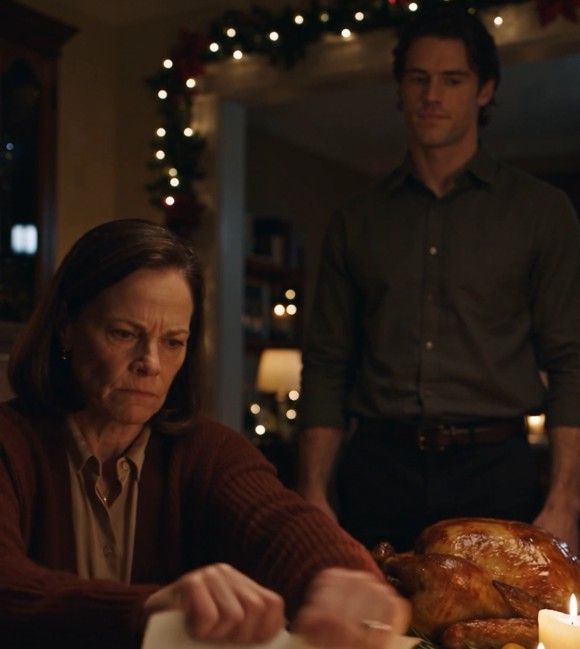
Then he took the folder from my hands.
“I’ll give this to the lawyer.”
“You will give me everything,” I said.
He nodded.
We went back downstairs.
By then the children were gathered beside the Christmas tree, frightened and confused. Vanessa’s daughter, Lily, held a broken candy cane in both hands. Nathan’s younger son stood behind Helen’s chair.
I crouched in front of Lily.
“Your mother and father are having an argument,” I said gently. “You did nothing wrong.”
“Are we leaving?” she asked.
“Yes,” I said. “Tonight you will stay with your grandmother.”
Vanessa’s expression flickered.
“My mother cannot take them.”
“She already agreed,” Helen said. “I called her.”
Vanessa stared at Helen with open hatred.
“You had no right.”
“I had every right to make sure the children were safe.”
Nathan knelt beside his son.
“I’m sorry,” he whispered.
The boy looked at him. “Are we in trouble?”
“No.”
“Did Grandma make us leave?”
Nathan’s face crumpled.
“No. I did.”
The boy began to cry.
Nathan pulled him close, and for a few seconds the house held only the sound of the child’s sobbing. Vanessa stood rigidly beside the tree, watching them. Her eyes were dry.
My attorney, Miriam Cole, arrived forty minutes later with a junior associate and a locksmith. She had been Richard’s attorney before his illness and had helped administer the trust. She read the documents at the kitchen counter while the relatives waited in the living room.
Miriam’s expression hardened as she reached the forged deed.
“This is enough to seek an emergency protective order,” she said. “The financial records will support a civil claim. The forged signature may also be criminal.”
Vanessa leaned against the wall.
“You’re threatening me?”
“No,” Miriam said. “I’m explaining what your conduct has created.”
Nathan handed Miriam his phone.
“I have messages,” he said. “From Vanessa. About Mom’s memory. About getting the signature. She told me to make Mom think the bills were overdue.”
Miriam looked at him.
“Did you participate knowingly?”
Nathan swallowed. “At first, I believed we were preparing for a future transfer. Then I knew she was pressuring my mother. I still let it happen.”
“That distinction may matter legally,” Miriam said. “It matters morally too.”
Nathan nodded.
“I’ll tell the truth.”
Vanessa pushed away from the wall.
“You think confessing makes you noble?”
“No,” Nathan said. “I think it makes me late.”
Police arrived shortly after midnight to take a report. Vanessa insisted she had done nothing wrong. She said the trust was invalid, the deed was a draft, and the signature was an honest mistake made by a staff member.
Then Miriam opened the email chain.
Vanessa had written to the attorney:
Margaret will sign once Nathan tells her the house is being assessed for unpaid family expenses. If she refuses, we will have the doctor document her confusion.
The next message was from Vanessa to Nathan:
Do not let her speak to anyone alone. She will become emotional and forget what she agreed to.
The room went silent.
Nathan stood by the window, his back to everyone.
Vanessa looked at him.
“You sent those messages.”
“I did not.”
“You did.”
“I forwarded them.”
Miriam turned her laptop toward the officers.
The email account belonged to Vanessa. The metadata showed that the messages had been sent from her phone inside the house.
The police took photographs of the forged deed, collected the laptop, and served Vanessa with notice that she could not remove property from the house except clothing and personal necessities.
Her downfall did not come from a dramatic confession. It came from her own records, her own words, and the certainty that nobody would ever question her because she had spent so long making us question ourselves.
At three in the morning, Vanessa left with one suitcase.
