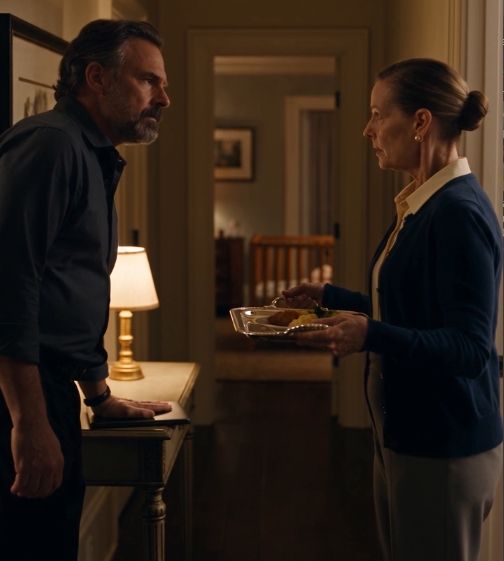
“Grandma,” she said, soft and certain, like she had said it every night.
Clara choked on a sob. “Hi, my little bird.”
Rosalyn slid out of bed, unsteady, and padded to the window. She didn’t go to me. She went to the bars, to Clara’s hands reaching through, to Mara and the container. I watched my three-year-old daughter take a spoonful of plain rice from her sister’s hand and chew with her eyes closed, like it was the best thing she had ever tasted.
And I understood, finally, what Elena had tried to tell me about love — that it isn’t a fortress. It’s a table. It’s someone staying to feed your children when you have forgotten how.
Headlights swept the driveway. Dr. Albright’s car, then, minutes later, the quieter arrival I had also called — Detective Ruiz, who had handled Elena’s estate and who I trusted more than any security firm.
Hilda didn’t run. When Ruiz stepped into the hallway and asked her to stand, she stood. When he asked if the financial records were in her office, she nodded and said, “Top drawer, locked, key is under the tray.” When he read her rights, her voice was steady for the first time all night.
“My son had nothing to do with it,” she said to me as Ruiz guided her toward the front hall, his hand light on her elbow. “He doesn’t know where the money came from. Please don’t —”
“I won’t,” I said. And I meant it. “But you don’t get to decide what happens next anymore.”
She stopped and looked back at the nursery door, at the light spilling out, at Clara still half-through the window holding Rosalyn’s hand.
“They’re good girls,” she whispered. “They never cried when I took the trays away. They just waited. They knew she would come.”
Ruiz led her away. The front door closed with a soft click that felt louder than the tablet slamming.
Silence rushed back in.
Dr. Albright knelt on the nursery floor with her bag open, her stethoscope warm in her hands before she placed it on Rosalyn’s thin chest. She didn’t lecture. She just worked, her jaw tight, her eyes flicking to me and to Clara, who had finally been let in through the proper door and was sitting on the floor now with Mara curled against her side.
“They’re dehydrated, undernourished, but stable,” Albright said quietly after a long examination, her hand smoothing Rosalyn’s hair. “No acute emergency tonight, but we need labs in the morning, a refeeding plan, very gentle. And —” she looked at me directly, her expression softening, “they’re going to be okay. Because someone was feeding them. Inadequate, but enough to keep them safe until now.”
Clara covered her face with both hands and wept silently. Mara reached up and patted her cheek with a solemn, practiced tenderness that told me exactly how many nights this woman had comforted my children while I slept down the hall.
When Albright left with promises to return at eight, and Ruiz left with Hilda’s files and a statement from Clara, the house was impossibly quiet.
I sat on the floor of the nursery with my back against the wall. The iron bars threw striped shadows across the carpet. Rosalyn crawled into my lap for the first time in months without being lifted. She was so light. Her head tucked under my chin, her breath warm against my neck. Mara leaned against Clara, but her eyes never left me, watchful, waiting to see who I would be now that the truth was in the room.
“I’m sorry,” I said. The words were too small. I said them again, to each of them. “I’m so sorry. I was here and I wasn’t here. I thought if I kept you safe behind walls, I was doing what your mom wanted. I wasn’t. I missed it. I missed you.”
Mara’s lip trembled. She had Elena’s stubborn chin.
“You didn’t see,” she said, not accusing, just stating a fact in her small, clear voice. “We didn’t want to make you sad.”
That sentence — that terrible, generous sentence from a four-year-old who had learned to manage her father’s grief by starving quietly — undid me completely. I bent forward, my shoulders shaking, my hands flat on the floor, and I sobbed without sound for a long time while my daughters watched and Clara watched, and no one looked away.
After a while, Mara crawled across the carpet and put her small hand on my arm. Rosalyn put her hand over mine. Clara didn’t speak. She just let the moment be.
Later, when the girls had finally drifted into exhausted sleep in their beds — both of them, for the first time, with the window closed and the bars unlocked from the inside because I had found the key Hilda left on the sill and turned it — Clara and I stood in the kitchen that had been staged for so many fake meals.
The real pantry was almost empty. The refrigerator held only condiments and the elaborate platters Hilda had kept for photos. On the counter, Clara’s worn canvas bag sat open, and inside it were two thermoses, a folded cloth, and a small, creased photograph.
I picked it up.
It was Elena, younger, laughing in this same kitchen, her hands covered in flour, with a baby Mara on her hip. On the back, in Elena’s looping handwriting: *For Mom — so you remember the recipe when I forget to write it down. — E*
Clara touched the edge of the photo with one fingertip.
“She taught me that rice,” Clara said softly. “The way they like it. With just a little salt, no butter. Rosalyn can’t have dairy. Hilda never read the allergy report Elena filed before she died. I did. When I fed them, I fed them what wouldn’t hurt them.”
Another piece clicked into place, another quiet horror — not just starvation, but the wrong food entirely, the expensive trays that would have made Rosalyn sick even if she had eaten them.
“Elena left more than a recipe,” Clara said, and pulled a folded envelope from the bottom of her bag. The paper was old, the seal broken. “She left this for you. With her will. Your lawyer was supposed to give it to you. Hilda was intercepting your mail. I found it in her office when I confronted her. I’ve been carrying it every night, hoping I’d get to give it to you in person.”
