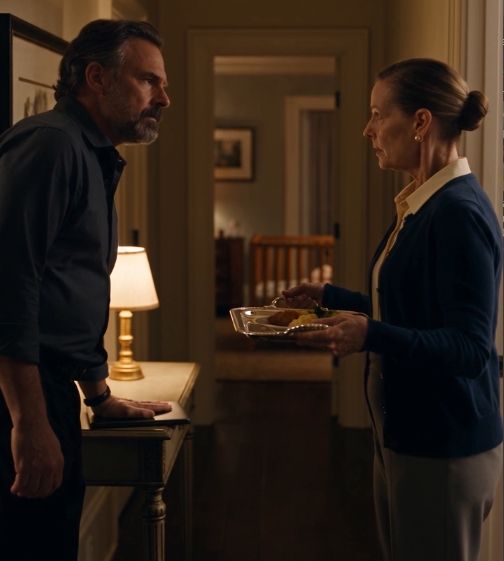
My stomach dropped. I turned before I could think, my hand already on the nursery door handle, shoving it open.
The nursery was dim, lit only by the amber glow of the nightlight Elena had chosen two years before she died. Two small beds. Rosalyn curled on her side, her dark hair damp against her cheek, her collarbone too sharp under her nightgown. Her older sister, Mara, sat upright in the other bed, wide awake, her knees pulled to her chest, her eyes fixed on the iron-barred window that faced the trees.
She wasn’t looking at me.
She was looking past me, toward the hallway, toward Hilda, with an expression that wasn’t fear. It was warning.
Mara put a finger to her lips.
Outside the window, a shadow detached itself from the tree line.
The woman in the canvas bag was back. Closer this time. Close enough that I could see the gray at her temples, the careful way she moved, like someone who had done this hundreds of times and knew exactly where the motion sensor lights wouldn’t hit. She crouched, pulled the metal container from her bag, and reached for the bars.
I crossed the room in three steps and tore the window latch open. Cold night air rushed in, sharp with pine and damp earth.
The woman froze, her hand on the container, her eyes flying up to mine.
We stared at each other through the iron.
She was older than I’d thought on camera. Sixty, maybe. Her face lined, her coat mended at the elbows. And her eyes — Elena’s eyes. The same hazel, the same shape.
My knees almost gave out.
“Clara?” I said.
My mother-in-law flinched as if I’d struck her.
Behind me, Hilda spoke from the doorway, her voice hollow. “I told her you’d never look through that window at night. I told her you hadn’t looked in months.”
Clara Jensen — Elena’s mother — the woman I had cut out of our lives the week after the funeral because her grief was too loud and mine was too silent. The woman I had told security to turn away if she ever came to the gate. The woman whose calls I had stopped answering.
She was holding food for my children.
Clara’s hand shook on the container. “Don’t call the police,” she said quickly, her voice raw. “Please. They’re hungry. Let me just—”
“Let you what?” I cut in, and my voice cracked so hard Rosalyn stirred in her bed. I forced it down to a whisper. “Let you feed my daughters through bars like animals because my household manager has been starving them?”
“No,” Clara said, tears now running openly. “Because she’s been letting me.”
The room tilted.
I turned to look at Hilda. She stood in the doorway with her hands clasped in front of her, not defending herself, not running, tears finally spilling over her perfect makeup.
“Say it,” I said to her. “Say it plainly so I understand.”
Hilda swallowed. When she spoke, each word seemed to cost her.
“Seven months ago, your accountant flagged the household spending. I was forging the supplier invoices. The organic produce, the seafood, the nutrition products — none of it was being delivered. I was printing the photographs myself. Stock photos. I kept the money.”
The admission landed like a physical blow. I had to grip the windowsill to stay upright.
“How much?” I asked.
“Just under eighty thousand dollars,” she said without hesitation. She had been waiting to say the number. “In a separate account.”
“Eighty thousand,” I repeated. My voice sounded like someone else’s. “While Rosalyn lost three pounds. While Mara learned not to ask for seconds.”
“I know,” Hilda whispered.
