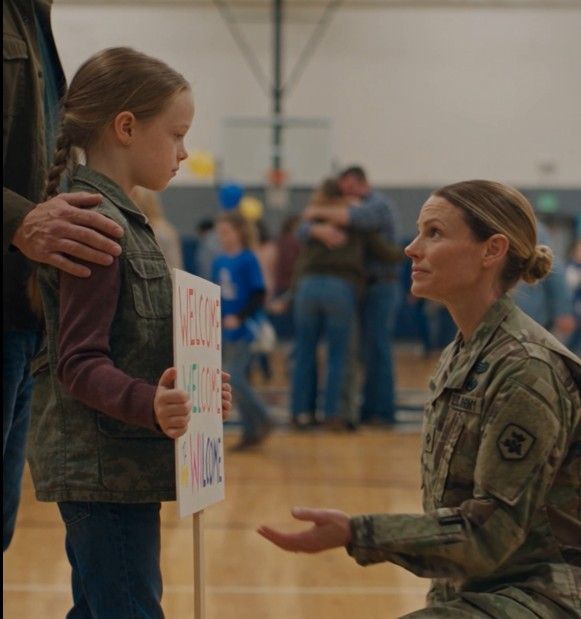
Natalie crouched, but did not move closer. “Do you want to know what time?”
“Yes.”
“About six. If it changes, I call you.”
“What if they make you go somewhere?”
The old answer would have tried to erase the possibility. Natalie refused to build safety out of promises she could not own.
“Then we talk about it together. You won’t find out because my chair is empty.”
Emma’s shoulders lowered.
That evening Natalie pulled into the driveway at 5:43. Emma was on the porch swing with the dog. She did not run to the car, but she waited until Natalie reached the steps and then shifted to make room beside her.
The porch swing creaked under their combined weight.
“Daddy fixed it,” Emma said.
“I saw.”
“It used to lean.”
“I remember.”
Emma pushed with her toes, starting a slow rhythm. “Some things got fixed while you were gone.”
Natalie looked at her. “I’m glad.”
“Some things didn’t.”
“I know.”
Emma looked toward the front door. “We’re fixing those now.”
Natalie had to blink before answering. “Yeah. We are.”
The conversation with Daniel took longer.
He had become so practiced at carrying the house that he did not know how to put responsibility down without feeling irresponsible. Natalie had become so sensitive to being unnecessary that every competence of his sometimes felt like evidence against her. They began meeting with a counselor through a family support program, not because their marriage had collapsed, but because both were tired of turning love into a test of endurance.
In one session, Daniel admitted that before Natalie’s return he had sometimes resented the photographs she sent because they showed her smiling.
“I knew you were supposed to smile,” he said. “I knew one picture didn’t mean you were having an easy time. But I’d be cleaning throw-up at two in the morning, and then a photo would come in where everyone looked fine. I hated myself for being angry at it.”
Natalie understood immediately because she had done the reverse. She had seen photos of Emma at the school fair with Daniel and felt replaced by the fact that they could still laugh.
The counselor asked them what each had done with those feelings.
“Edited them,” Daniel said.
Natalie thought of the sign.
That became the word they used when one of them started making the truth prettier than it was. No more editing.
By autumn, Emma’s eighth birthday was approaching.
Natalie wanted to plan something elaborate. Daniel wanted to keep it simple. Emma wanted pancakes for dinner and permission to sleep in a blanket fort in the living room.
