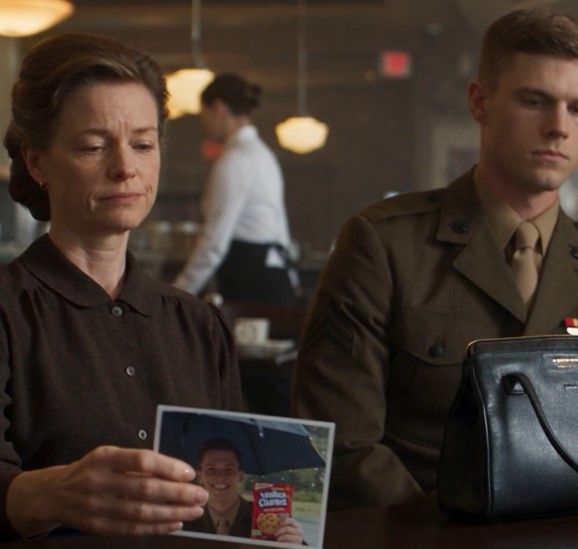
The dead soldier’s father pushed the spare chair away with his boot. “He was supposed to come home with you.”
Corporal Adam Reed remained standing beside the restaurant table, still holding the coat he hadn’t decided where to put. Across from him, an untouched cup of coffee trembled in Mr. Callahan’s hand.
Adam had accepted the dinner invitation because the message came from Michael’s mother. She said they wanted to hear ordinary stories, the ones that never appeared in formal condolences.
He brought a photograph from a miserable rainy afternoon. Michael was laughing beneath a leaking awning, holding a packet of cookies he had guarded for three days before sharing every one.
Now the photograph lay face down beside the menus. Michael’s father stared at Adam’s uninjured hands as though survival ought to have left a visible explanation.
“Peter,” his wife said softly. He looked away, ashamed of the cruelty but not ready to take it back.
Adam sat only when she moved the chair toward him again. A server appeared, sensed the table, and left without asking for their order.
For months, Adam had rehearsed speaking to them. Each version began with their son smiling and ended before the part that woke him at night.
Michael had died during an attack while they were deployed together. Adam had been nearby, close enough to remember the sound of his friend’s voice and too far away to make the ending different.
That was the simplest truthful account. It was also the account that left out what Adam had asked of him beforehand.
Mrs. Callahan turned over the photograph. Her finger stopped at the cookies, and she smiled for a moment without appearing to notice she was doing it.
“He always saved the good things,” she said. “Even when he was little.”
Adam nodded. Under the table, he pressed his heel against the floor until the pressure gave him something definite to feel.
Peter asked whether Michael had been frightened. His wife closed her eyes, but she didn’t stop the question.
“Sometimes,” Adam answered. He could not offer them a son who never felt fear; Michael would have hated being turned into somebody that distant.
Peter looked at him for the first time as a person. “And you?”
“Yes.” The single word shifted something at the table, but Adam knew tenderness could become another way of postponing the truth.
Mrs. Callahan took an envelope from her handbag. Michael’s last letter had arrived after the news, folded inside a package containing socks he wanted her to stop sending.
“He mentioned you,” she said. Adam felt the room narrow around the envelope.
She explained that Michael wrote about changing an ordinary duty arrangement so Adam could make a scheduled call home. Adam’s younger brother had been having a difficult week, and Michael knew how much those calls mattered.
Peter’s gaze returned to Adam. The coffee cup stopped trembling because he had set it down.
“Was that the day?” he asked. Adam looked at the photograph, at the friend who would have hated seeing kindness turned into a weapon against someone he loved.
He had come prepared to talk about cookies and rain. Instead, he placed both hands on the table where Michael’s parents could see them.
Mrs. Callahan held the letter without unfolding it. Adam drew breath, knowing that whatever he said next would belong to their grief as well as his own. 👇
Adam looked at Peter first.
“Yes,” he said. “That was the day.”
Mrs. Callahan’s fingers tightened around the unopened letter. Peter did not move at all. The restaurant around them seemed to continue at a distance: silverware touching plates, a coffee grinder starting behind the counter, someone laughing near the door and then lowering their voice when they noticed the table.
Adam forced himself not to fill the silence.
“I asked Michael to switch with me,” he said. “My brother had called twice that week. He wasn’t doing well. I was supposed to be on that duty, and I asked Mike if he’d take it so I could make the call we had scheduled. He said yes.”
Peter’s chair scraped the floor.
