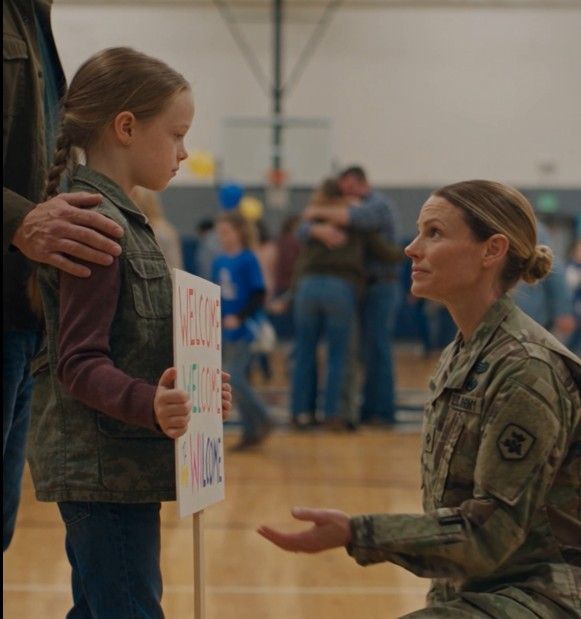
Instead of saying, “That’s not how we do it,” Daniel tried, “This is what changed while you were gone.”
Instead of saying, “I know my own daughter,” Natalie tried, “Show me what works now.”
The difference was not magical. It was practical. It gave them somewhere to stand.
Emma remained the hardest and most honest part.
At first she tested Natalie with ordinary disappointments. She asked whether Natalie would pick her up from school on Thursday, then asked again at breakfast, again before leaving the house, and once more from the front steps. Natalie wanted to promise so firmly that doubt would sound ridiculous. Instead she checked the time, checked the appointment she had that afternoon, and said, “Yes. If something changes, I will tell you as soon as I know. I won’t make you guess.”
Nothing changed. Natalie was waiting outside the school twelve minutes early.
Emma saw her and stopped walking.
For one frightening second Natalie thought her daughter might turn toward Daniel’s truck out of habit. Then Emma lifted one hand. Not a run. Not an embrace. A wave.
Natalie waved back.
The next week Emma had a classroom reading afternoon that families could attend. Daniel put the paper on the refrigerator without mentioning it. Natalie saw the date and felt the old instinct rise immediately: make it a promise, turn attendance into proof.
Instead she asked Emma whether she wanted her there.
Emma shrugged. “You can come if you want.”
Natalie recognized the protection in the answer. “I want to.”
Emma nodded without looking up.
The morning of the reading, Natalie’s phone rang with a request to come in early for a reintegration appointment that had been moved. The time overlapped by twenty minutes. Her first reaction was panic so sharp it felt like anger. She imagined Emma’s empty glance at a classroom door and the sign turned backward all over again.
Then she stopped treating every conflict as a test she had to pass alone.
She called the office, explained she had a scheduled family commitment, and asked for the next available slot. The appointment moved to the following morning.
It was that simple.
The simplicity made her sit in the parked car and cry for five minutes.
Not every missed event had ever been avoidable. She knew that. She would not rewrite her deployment into a series of choices she could have made differently. But she also understood something she had not allowed herself to examine: after enough uncontrollable absence, she had begun treating all absence as uncontrollable. It protected her from guilt. It did not protect Emma from disappointment.
At the classroom, Emma read three paragraphs from a book about a girl who built a tree house. Her voice shook on the first sentence. Natalie stayed in the back row beside Daniel and did not lift her phone to record until Emma looked directly at her and smiled.
Afterward, Emma walked over carrying the book against her chest.
“You came.”
Natalie swallowed. “I said I would.”
Emma considered that. “Sometimes people say things and then stuff happens.”
“That’s true.”
“But you came.”
“I did.”
Emma leaned against her side for perhaps three seconds. Natalie did not move. When Emma stepped away, Natalie let the moment end without trying to make it bigger.
The first real setback came two weeks later.
