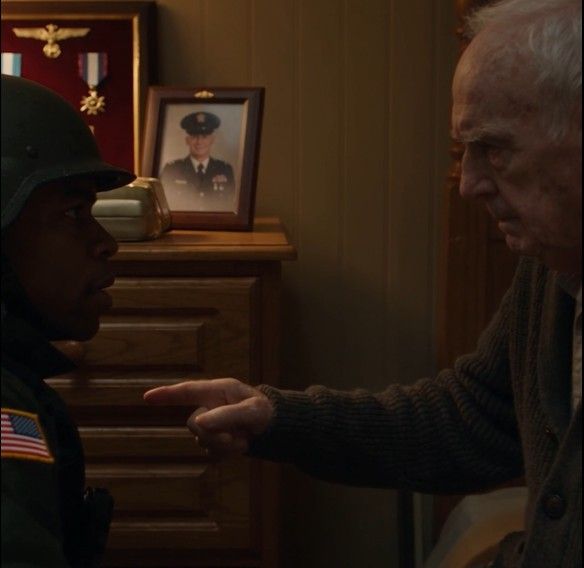
The word landed harder.
Jonah thought of his own father after surgery, the nurse answering a question before he could finish, Jonah accepting the shortcut because everyone was tired.
He nodded.
“Yeah,” he said. “We waited.”
The flood worsened overnight.
Jonah’s team returned to the neighborhood twice, rescuing people from porches and upper windows. By dawn, the street where Frank and Margaret lived had become a brown channel broken by rooftops, mailboxes, and floating branches.
Jonah did not know whether their house was still standing.
He also knew better than to make promises about what might be recovered.
When he returned to the shelter the next afternoon, Margaret was asleep in a folding chair. Frank was awake. The baby photograph stood on a table beside him. The blue blanket, still sealed in plastic, rested on his lap.
Frank pointed toward Jonah’s radio, then the door.
“House?” Jonah guessed.
Frank nodded.
“I don’t know. Water is still too high in that block.”
The disappointment was immediate, but Frank did not argue.
Jonah sat beside him for a minute.
“I left the medals,” he said.
Frank raised one eyebrow.
“I know you know. I just don’t want you thinking I forgot them.”
Frank looked at the photograph, then the blanket.
After a long effort, he said, “Good.”
Jonah laughed.
“Good?”
Frank nodded.
Margaret woke at the sound. “He means you chose the right thing.”
Frank gave her another look.
“Sorry,” she said automatically, then stopped herself. “You tell him.”
Frank took his time.
“Enough,” he said.
It was not a complete sentence, but Jonah understood. What they had carried out was enough.
Three days later, the water began to recede.
