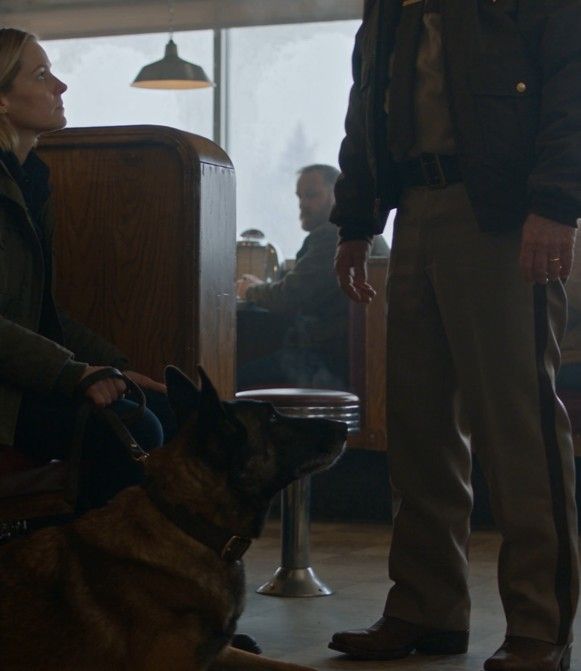
Before Brianna stepped away from the investigation, she had one more conversation with the former teammate who received Kodiak’s live stream.
He had called within minutes of the diner incident, but she had been inside the veterinary clinic and ignored the phone. When they finally spoke that night, his first sentence was not about Rusk.
“How’s the dog?”
Brianna looked across the cabin at Kodiak sleeping on a folded blanket.
“Bruised. Angry at the medication. Alive.”
Her teammate exhaled.
“And you?”
That question took longer.
“Same answer, minus the medication.”
He told her the backup had worked exactly as designed. The file reached him before Rusk tried to grab the harness. He had saved a second copy and recorded the timestamp so nobody could later claim the footage had been edited after the fact.
Brianna thanked him.
Then he asked why she had installed the system in the first place.
She almost gave him the practical answer about Kodiak noticing doors, shadows, and repeat vehicles. Instead she told the truth.
“Because I didn’t trust myself to know whether I was seeing danger or remembering it.”
Silence settled on the line.
Years of special operations had left her highly attentive to pattern, but retirement had made every pattern harder to interpret. A truck passing twice could be surveillance or a lost tourist. A door left open could be negligence or intent. Kodiak’s camera gave her something outside her own nervous system to review later.
Her teammate understood.
“Then don’t let Rusk turn that into another reason to stay on watch forever,” he said.
Brianna looked at the dark windows.
That was the danger she had not named. Winning against Rusk could easily become proof that vigilance must never end. She had come to the mountains because she wanted a life that did not require constant readiness.
So she made herself a rule.
The camera would remain for walks and public places where documentation had a purpose. At home, it came off. No recording the porch. No reviewing every vehicle. No turning the cabin into another operations room.
The first night she followed that rule, Brianna slept badly.
The second night, a little better.
By the end of the week, Kodiak stopped lifting his head every time she crossed the room to check a window.
She had thought she was calming him.
He had been waiting for her to calm too.
The change was small enough to miss from outside. She stopped sleeping with boots beside the bed. She let mail sit unopened until morning. When a car slowed near the cabin, she noticed it without automatically reaching for a notebook. Kodiak noticed those changes too. His job, finally, was becoming companionship instead of constant readiness.
That mattered to Brianna more than the county headlines ever would. She had spent enough of her life measuring success by threats stopped. Learning to measure it by ordinary mornings took longer, but it felt more like coming home.
Kodiak healed first.
