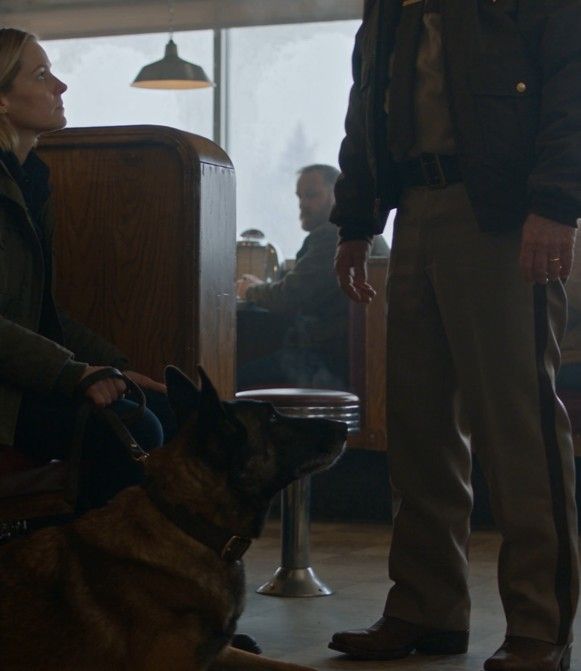
“Let people save their own statements.”
So they did.
The county arranged neutral locations for interviews outside the sheriff’s office. Residents could submit documents without walking past Rusk’s deputies. Outside investigators handled the review. Good deputies were separated from the conduct being examined instead of being treated as guilty by association.
That last part mattered to Brianna.
Her threat in the diner had said the whole department would go down on camera.
Anger had made the sentence bigger than the truth.
The footage did not show a whole department kicking Kodiak.
It showed Rusk.
The investigation had to stay just as precise.
One deputy, Elena Ruiz, became important because she chose to be.
She provided copies of reports she had kept after Rusk ordered wording changed in several cases. She admitted she had complied with some reassignments she believed were retaliatory because she feared losing her career.
“I kept telling myself I’d push back when I had something undeniable,” Ruiz said during a public county meeting weeks later.
She looked toward Brianna.
“Turns out undeniable doesn’t matter if nobody is willing to say it out loud.”
The room stayed silent for one second.
Then the waitress from Miller’s Diner stood.
She gave her statement publicly.
The bartender followed.
Then the older man who had first claimed he saw nothing.
Rusk attended with counsel and denied abusing his office. He argued that critics were combining unrelated complaints because of one controversial incident with a dog.
That argument might have worked if his own records had been clean.
They were not.
The outside review documented a pattern of retaliatory use of discretionary enforcement, inaccurate incident descriptions, and pressure on subordinates to soften or alter language that reflected badly on him. Kodiak’s video did not prove every allegation.
It did something more useful.
It made people willing to preserve evidence for each allegation separately.
Rusk’s downfall came from his own record.
The county removed him from authority while formal proceedings continued. He eventually lost the office he had treated like personal territory. Several matters were referred for additional review, but Brianna stopped following every detail once the outcome no longer depended on her.
She had not moved to Ashford Ridge to become an investigator.
She had moved there to learn how to live quietly.
That turned out to be possible only after the town learned quiet did not have to mean silent.
