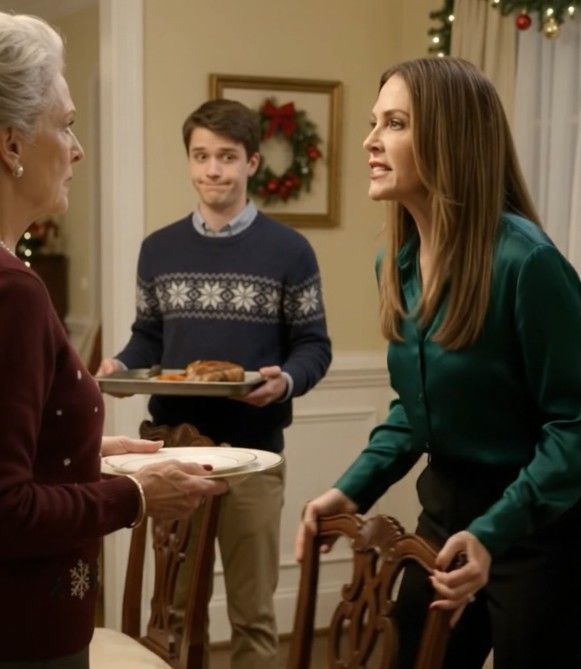
“Missing him is not incompetence,” I said. My voice was so steady it surprised me. “And you had no right to turn his death into a business plan.” Peter pressed both hands over his face. Aaron wrote down Melissa’s admissions and asked whether she had opened any accounts with my details. She said no. He asked her to answer once more while looking at me. She stared at the cracked platter. That was the first admission I believed.
We found the second account the following morning. The bank’s branch manager showed me a copy of the application after verifying my identity and taking the fraud report. The signature was an awkward imitation of mine, and the listed contact number belonged to Melissa. The account was not mine, but it used a name close enough to the apartment’s registered rental account to deceive someone reading quickly. No rent had arrived there yet. A small transfer from another source had been used to activate it.
A fraud specialist explained what records to preserve and how to dispute the application. I submitted the notice sent to Nora, the scanned agenda, and the messages forwarded by Melissa’s former partner. I changed passwords, notified the tenant in writing, and called the property insurance company to make certain no authorized contact had changed. Each call required me to say my husband’s name and explain that he was dead. By lunchtime my throat ached, but something inside me had stopped shaking. I was not powerless because I was tired.
Peter drove me home. He offered to carry my shopping bag, although it held only photocopies. I let him. At the front steps he said, “I thought helping you meant deciding things before you had to worry.” I told him that help began with a question and ended with respecting the answer. He leaned against the railing Thomas had repaired three summers ago. “I knew she needed money,” he admitted. “I didn’t know about the account. But I knew enough to ask.” There it was: the part of the truth no forged signature could cover.
That evening, my granddaughter came to the door with her father’s permission. Her name was Sophie, and she carried a folded drawing of a Christmas tree. She asked whether she’d done something wrong by giving me the envelope. I knelt carefully, so we were eye to eye. “You told the truth when an adult wanted you to keep a secret,” I said. “You did exactly the right thing.” She wanted to know whether her mother would go away. I said adults were responsible for the choices they made, and that everyone was trying to keep her safe. I did not make promises I couldn’t keep.
When Sophie went upstairs to retrieve the knitted scarf she’d left behind, Peter found me staring at the place where Thomas’s coat used to hang. He apologized again. I asked him to stop repeating apologies and start giving me facts. Together we listed every key, password, file, and document Melissa might have accessed. He surrendered his copies of the rental records without being asked. He also agreed, in writing, not to act on my financial affairs without a specific request from me. I wasn’t punishing him. I was drawing the border he had allowed someone else to erase.
Melissa sent eleven messages before midnight. Some were angry. Some were pleading. One said Peter would lose his marriage if I continued. I saved them without replying. In the morning her former business partner sent the promised emails, including one in which she wrote that my apartment was “basically ours once Evelyn settles down.” I read those four words three times. Thomas and I had worked extra shifts and postponed vacations to buy the little place. No amount of grief had turned it into a prize waiting for the next generation to claim.
The following week was colder than Christmas. Rain glazed the pavement outside the bank and hardened into ice at dusk. An investigator took our statements. Because false documents had been submitted, the case went beyond family disagreement. I could not control the investigation or promise an outcome. Melissa tried to persuade Peter to say he’d acted as my representative. He refused. The moment he told her he would not lie, she accused him of choosing his mother over his family. He replied, “Mom is part of our family. Sophie is part of it, too. What are we teaching her?”
Peter moved into a small rental while they separated. He took Sophie to school on his assigned mornings and learned to prepare breakfast without rushing her. I heard about the separation from him, not from the rest of the family. I told him I wouldn’t take satisfaction in his pain. I also wouldn’t apologize for protecting myself. Both things could be true. He nodded and stayed for dinner, but when he reached automatically for Thomas’s chair, he paused and asked where I’d like him to sit.
Melissa’s cousin returned to my house in January. Aaron carried a folder of ordinary financial advice, carefully labeled as advice. He helped me build a one-page record of when rent was due, which bills were automatic, and which documents Nora should receive. Then he asked whether I wanted a professional property manager. I considered it. I decided instead to hire a bookkeeper for quarterly reviews while continuing to handle the tenant myself. Aaron smiled. “That’s what a real decision looks like,” he said. I had not known how badly I needed someone to say it.
The official process moved slowly. Nora supplied the original notice with its email header. The bank provided application records to investigators. Melissa’s partner supplied evidence of the debt and demands for payment. The evidence showed that Melissa had arranged the account and falsified the purported authorization without my consent. She eventually entered a plea over the fraudulent application and accepted restitution obligations and a sentence that included supervised probation, community service, and restrictions on handling other people’s accounts. The court also ordered payment to the affected lender. Her financial troubles did not vanish; neither did the record of what she’d done. The important thing was that her claimed authority over me was finished.
At the hearing, Melissa looked smaller than she had across my Christmas table. She read an apology from a page, but the first version still described her conduct as “trying too hard to help.” The judge asked whom she’d helped by opening an account under another person’s identity. Melissa set down the paper and began again. This time she named the lies. She did not ask me to forgive her. I was grateful for that small restraint. Forgiveness might come someday, but it could not be scheduled for the convenience of the person who needed it.
Outside the courthouse Peter walked beside me without speaking. He had attended every meeting and answered uncomfortable questions truthfully. It didn’t erase his willingness to believe the worst of me when believing it made his life easier. Still, I saw how much effort it cost him to stop hiding behind his wife’s confidence. At the crossing he asked if I would ever trust him again. “In small things first,” I said. “Trust isn’t a switch, Peter. It’s a garden.” Thomas used to say that about friendships, and hearing myself borrow his words made my eyes fill.
The apartment tenant invited me for tea in March. Nora lived above a bakery, and her rooms smelled of cinnamon and laundry soap. She told me that when the payment notice arrived she’d almost obeyed because it looked professional. What stopped her was the absence of the small handwritten message I always included when rent instructions changed. “Your husband put that in the first lease,” she said. “He wrote that no important change should arrive without your own words.” I had forgotten the detail. Thomas hadn’t.
Back home I searched through the filing cabinet where he kept property papers. Behind the old lease was a yellow envelope addressed in his unmistakable careful script: EVELYN—FOR WHEN THE APARTMENT FEELS TOO HEAVY. My hands went cold. I sat at the breakfast table, the same small place where I’d eaten alone on Christmas while other people pretended to vote away my independence, and opened it with the butter knife that had belonged to his mother.
Inside was a short letter, dated a year before Thomas became ill. He wrote that he hoped the apartment would never become a burden. If the paperwork made me tired, I should sell it, hire someone, or give myself permission to stop. Then came a sentence that undid me: “I did not spend our life building things so anyone could use them to keep you small. We built them so you could choose.” Beneath it was a second sheet, a plain list of trusted professionals and the location of our original documents. Not a secret fortune. Not a trick. A map back to my own authority.
I called Peter after reading it twice. He came over with Sophie and found me crying at the kitchen table. I let him read the letter. For a long time he said nothing. Then he remembered an evening, years ago, when Thomas had told him never to confuse taking care of someone with taking charge of them. “I thought he was talking about raising children,” Peter said. “Maybe he was talking about all of us.” Sophie traced the edge of the envelope with one finger. “Grandpa knew you were brave,” she whispered.
Spring arrived unevenly. Peter repaired the loose hinge on the pantry door, but only after asking whether I wanted it fixed. He accompanied me to a meeting with a lawyer when I revised my will and named an independent executor. When he offered to hold the documents, I thanked him and put them in my own safe. Neither of us pretended these ordinary moments were dramatic. That was why they mattered. The old pattern had consisted of countless small assumptions. A better one would have to be built with countless small permissions.
I saw Melissa once at Sophie’s school concert. We stood on opposite sides of the crowded auditorium, each holding a program. She approached during intermission and said she had begun counseling and taken extra work to repay what she owed. I said I hoped she continued. She asked whether Sophie could visit me as before. I answered that I would coordinate with Peter and follow their agreed parenting schedule. Melissa looked as though she expected either a cruel remark or an instant embrace. I gave her neither. She nodded, and for the first time our conversation ended without her trying to direct it.
Sophie sang in the second row, her face serious with concentration. When the last note ended, she searched the audience until she found all three of us. She smiled at each of us separately. I understood then that keeping adult accountability clear was also a gift to her. She did not have to choose one lie to protect one person. She could love people who had made mistakes while seeing those mistakes named. I clapped until my hands hurt, and when Peter joined me at the exit, we let the silence be gentle.
In early December I asked Sophie whether she wanted to help plan Christmas dinner. She frowned, remembering the previous year. I told her this Christmas would have no printed decisions under the plates. “Unless we vote on dessert,” I added. She laughed, and then grew solemn. “Can we sit at Grandpa’s table?” she asked. “All of us who are coming?” I said yes. She helped me write invitations that named the time, the number of chairs, and one simple request: everyone must treat the host and the other guests with kindness.
Peter came early on Christmas morning. He brought groceries and a new platter, though I had already bought one to replace the broken dish. He admitted that he’d chosen it because he could still hear the old one breaking. I told him objects could be replaced more easily than trust, but a meal was a good place to practice. We cooked together. He chopped vegetables while I seasoned the turkey. When Sophie arrived she tied an apron around her waist and asked for the story of how Grandpa had built the kitchen. Peter and I told it together, correcting each other’s details and laughing for the first time without guilt.
Before dinner I brought out Thomas’s letter. I didn’t read it aloud. I tucked it into the drawer beside his recipes, where I could find it whenever I needed reminding. Then I set the table with our old dishes, warmed by candlelight and the glow from the window. The guest list was smaller. The room felt larger. When Peter reached for my chair, he stopped. “Where would you like to sit, Mom?” he asked. “Right here,” I said, taking my place at the head of the table.
Sophie had made place cards herself. Under mine she had drawn a small green house and written, in her careful handwriting, GRANDMA DECIDES. I thought of the anonymous agenda hidden beneath last year’s plates, of the rent notice, the icy courthouse steps, and Thomas’s gentle insistence that love must leave room for choice. I put the card where everyone could see it, not as a warning, but as a promise. Then I lifted the lid from the potatoes, called everyone to dinner, and began again in a house that was still, unmistakably, my own.
