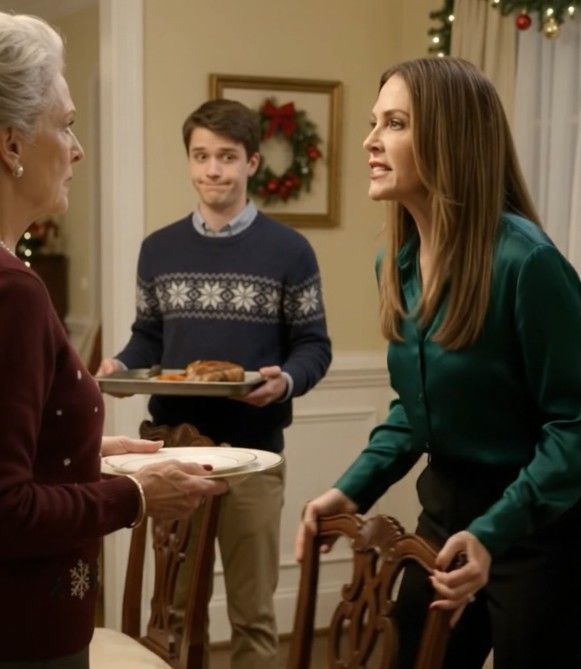
“Mom said you were going to thank everybody.”
I read further.
One item concerned selecting a person to handle the rental income from a small apartment my husband had owned.
Another proposed changing where payments from that apartment were deposited.
Peter entered the kitchen and saw the envelope.
He went pale and told me Melissa had promised the meeting was only informational.
I asked whether he had given her access to the rental paperwork.
He admitted he had.
I thought of the tenant who’d recently asked why she should send rent to a different bank.
I’d assumed it was an ordinary question.
Now it felt like a warning.
I called the tenant while Peter waited beside the door.
She said she’d received a notice with a new payment account, signed by the property manager.
There was no property manager.
Only me.
Melissa appeared with the Christmas dishes stacked in her arms.
When she realized who I was talking to, she dropped a platter into the sink.
Then she demanded to know whether I’d already spoken to the bank.
The platter cracked against the porcelain sink, and everyone in the dining room stopped talking. Melissa held one hand above the broken pieces as if she might still catch them. On my phone, the tenant, Nora, was asking whether I was all right. I watched my daughter-in-law’s eyes move from the phone to the envelope in Peter’s hand. Until that moment, I had been frightened of what I might discover. Now I was frightened of how thoroughly she had expected me not to look.
“Please don’t send another payment to the new account,” I told Nora. “Keep the rent aside until I send you written instructions from the address you’ve always used. I’ll call you tomorrow.” Nora said she had not sent the next payment. She sounded relieved. Behind me, a child laughed in the dining room, then went abruptly quiet when no adult joined in. Melissa reached for the phone, but I put it in my pocket.
“You’ve made a terrible misunderstanding public,” she said. Her voice was controlled again, almost gentle. “It was meant to protect you.” Peter asked why the notice carried a signature that didn’t belong to me. She said he was exaggerating. He unfolded the paper she’d kept beneath her placemat, and I saw a printed heading: FAMILY AUTHORIZATION. Beside my name there was a little box marked UNABLE TO MANAGE ACCOUNTS. Someone had checked it. The ink was blue, the same precise blue as the pen tucked into Melissa’s sweater.
I asked our guests to take the children into the sitting room. Melissa protested that they were family and should hear everything. Her cousin, Aaron, the adviser, said quietly that children should not be voting on an adult’s legal capacity, nor should anyone else at this table. The oldest guests rose first. Chairs dragged across the floor my husband, Thomas, had sanded by hand. My granddaughter stayed in the doorway, holding the empty envelope, until Peter promised he would speak to her afterward.
The moment the room emptied, Melissa accused me of turning a holiday into a trial. I placed the notice from Nora beside the authorization card. “Did you send this?” I asked. She answered with a story about modern banking, missed bills, and how stressful it had been to organize Christmas. I asked again. Her eyes brightened with anger. “I had it prepared,” she said. “Prepared isn’t the same as sent.” Aaron held up his own copy of the agenda. “Then why does it say the payment change took effect Monday?”
Peter lowered himself into Thomas’s chair. I recognized his expression from childhood: the look he wore when a window broke and he was calculating how much truth to tell. But this was not a broken window. “I gave her the rental folder,” he said. “I told her you wanted help sorting receipts.” I hadn’t. Melissa gave a sharp little laugh. “And you were perfectly happy about it until she called that tenant.” Peter looked at her. “You told me Mom had signed.”
I took photographs of every page while Aaron watched. The family authorization was not a legal instrument, he explained; even if everyone present endorsed it, the votes would give them no authority over my property. But the notice to Nora could be something more serious if its instructions impersonated me. Aaron suggested that I contact my bank’s fraud department that evening. Melissa called him disloyal. He replied, with evident strain, “I’m loyal to the difference between advice and a lie.”
I didn’t know whether a bank would answer on Christmas, but I knew an emergency card number would. I found mine in the kitchen drawer beside a bundle of Thomas’s old recipes. The representative could not tell me about accounts I didn’t own. She could, however, open a case concerning possible misuse of my identity and place an additional verification instruction on my existing accounts. She asked me to visit a branch with identification the first business day. I wrote down the case number while Melissa stood motionless by the refrigerator.
Then Peter’s phone began ringing. He glanced at the screen and declined the call. It rang again. Melissa moved faster than I had seen her move all evening. “Don’t answer that,” she said. Peter answered. A man’s voice, loud enough for me to hear, said he had been promised repayment from the apartment rent by the end of the month. Peter walked into the hall to listen, then returned with a face ashen beneath the Christmas lights. “What repayment?” he asked her. Melissa told him to end the call. He did not.
The man was her former business partner. He said Melissa had borrowed money for a catering venture that never opened and had named a rental property as her anticipated source of repayment. He offered to email the messages. He sounded embarrassed when Peter explained that the property belonged to me. I had thought the strangest thing that night was the printed vote beneath my Christmas plates. Instead, I learned that my home and Thomas’s apartment had been described to strangers as resources already under Melissa’s control.
Melissa finally sat down. Her shoulders sagged, and for one foolish second I wanted to make her tea. It was a reflex born of decades spent calming upset people in that kitchen. Then I remembered Nora, who might have sent a month’s rent into an account she couldn’t recover, and my granddaughter, who had believed her mother was organizing a surprise to make Grandma grateful. I made myself remain standing. “Tell us exactly what you’ve done,” I said.
She said the catering venture had collapsed after a supplier withdrew. She had hidden invoices from Peter, borrowed from friends, and convinced herself that diverting one or two rent payments would buy time. She insisted she planned to put every dollar back. She said the private family meeting would reassure everyone that I was too overwhelmed to manage the apartment. “People already worry about you,” she whispered. “You cry when you talk about Thomas.” I felt the words land harder than the rest. She had made my grief the evidence she needed.
