I checked into my room alone. It had cream curtains, a desk near the window, and a balcony above the courtyard garden. I set my handbag on the chair and listened to the ocean beyond the buildings. For all the rooms I had built and renovated, I had been an infrequent guest in any of them. I usually arrived with notebooks, contractors’ estimates, or staff schedules. That afternoon I stood with no work to do. The room smelled faintly of clean cotton and salt air. It was more luxurious than the penthouse could have been for someone who had not been offered a place to sleep.
Mark knocked an hour later. His shoes were sandy because he had walked outside without noticing where he was going. He asked how long I had owned the resort. I told him five years, from the purchase through a difficult renovation and the patient work of employees who had stayed when the building needed more than money. He asked why I had never announced it. I said I talked about my work often, but he rarely asked questions and usually changed the subject to his own needs. He looked away, remembering conversations he had not considered important at the time.
“I didn’t think you were hiding anything,” he said. “I thought you didn’t have much.” I heard the embarrassment underneath his words. I told him he wasn’t wrong to believe I lived modestly. I chose that life. But even if I had been poor, Amber’s insult and his laughter would have been unacceptable. “Money doesn’t decide whether I deserve a bed,” I said. “And it certainly doesn’t decide whether you should defend your mother.” Mark sat on the balcony chair and stared at the trees below. He said he had been trying to avoid another argument with Amber.
We talked about that for a long time. He said Amber had become impatient with my visits because the children loved having me nearby and asked why their parents didn’t spend more time with them. She began calling me old-fashioned, then difficult, then useful only when I could babysit. Mark let each remark pass because disagreeing with her led to days of tension. Eventually he laughed at jokes he didn’t think were funny because laughter ended the argument. “Not for me,” I said. “For me it was the beginning.” He pressed his palms together and did not argue.
I did not demand that Mark leave his wife or force him to choose sides. Their marriage belonged to them. I did tell him I would no longer accept invitations that required me to provide childcare without discussion, and I would leave conversations where either of them insulted me. I wanted time with the grandchildren, but it would be arranged with everyone’s needs spoken aloud. Mark asked if that meant he could never ask for help. “You can ask,” I answered. “You have to be willing to hear no.” The sentence was so ordinary that it seemed absurd it had taken us decades to say it.
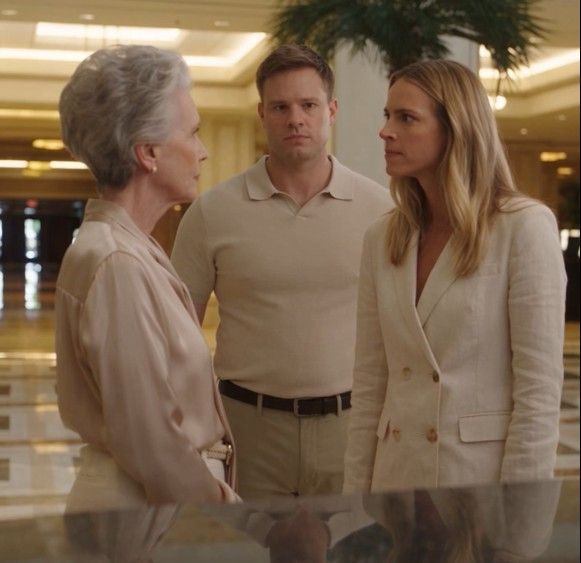
Amber came to my room that evening. She had changed into a linen dress and wore a carefully gentle expression. She began by saying it was wonderful that I had built such an impressive business. Then she asked whether a penthouse might become available for the rest of the week. I told her I wasn’t discussing upgrades. She blinked, gathered herself, and said she had felt disrespected by the front desk. I asked which part of Sarah’s behavior had been discourteous. Amber could not identify one. She had been told a valid booking would be honored, and she had interpreted the word no as an insult.
For once I did not explain away that confusion. I said she owed Sarah an apology for speaking to her aggressively and owed me an apology for calling me the help. Amber said she had spoken in anger, not meant it literally, and assumed family could joke. I replied that a joke required more than the amusement of the person making it. She left without apologizing. The next morning she was polite but distant at breakfast. It would have been easy to buy peace with an upgrade. I didn’t. Resort rooms could be purchased. Respect could not.
I spent the morning with the children on the beach after Mark and Amber agreed to a specific time and picked them up as promised. We built a crooked sandcastle, collected shells, and talked about how seabirds found food. The children were lively and affectionate. They had not caused the adult conflict, and I refused to recruit them as allies against their parents. When my grandson asked why I had a room of my own, I told him everyone needed a place to rest. He nodded and announced that his favorite place to rest was under a blanket fort. We spent the rest of the afternoon planning one.
I visited the staff room before lunch, as I often did when traveling between properties. Sarah was there, drinking water and trying to finish a sandwich before her shift. She stood when she saw me. I asked her to sit. She said she was sorry the check-in had become so uncomfortable. I told her there was nothing to apologize for. She had accurately explained the reservation and protected the guests already occupying the penthouse. She had also treated someone insulted in front of her desk with dignity. Those were the standards we asked of our staff. I was proud to see them practiced when the person being insulted happened to be me.
Sarah laughed a little at that. She said her grandmother had worked as a housekeeper and had taught her that job titles revealed very little about a person’s character. I told her mine had taught me the same lesson. We talked about the overnight team and a training concern she wanted to raise at the next management meeting. It felt good to discuss ordinary work again. I had spent forty years building a company where a receptionist should be able to tell a demanding guest no without fearing that courtesy would be mistaken for weakness.
Later I learned that the penthouse guests had come to celebrate the retirement of a nurse who had worked at a regional hospital for decades. Their booking had been made months earlier. I did not seek their names or interrupt their vacation; Richard mentioned only the event as part of a routine occupancy briefing. The fact made me think about how readily Amber had demanded that strangers be removed for her comfort. She had not known whom she wanted displaced, only that she believed she deserved their room. That was how privilege behaved when it forgot other people existed.
On the third day Mark asked to see the original inn. It was a long drive and not on their itinerary, so I showed him photographs from my tablet instead. There was a narrow porch, a gravel driveway, and a sign I had painted myself. In one picture I was carrying clean sheets while teenage Mark stood beside a wheelbarrow full of bedding. He laughed in surprise. “I remember that cart.” I said he had insisted on fixing its wheel after it broke. He had been patient with broken things then. Somewhere along the way he had decided patience belonged only to work, not to people.
Mark asked why I had never sold the inn after the business grew. I told him it was still operating, though the rooms were modernized and the old porch had been rebuilt. The first inn reminded me that hospitality began with giving tired people somewhere safe to sleep. It was an idea larger than luxury. A guest in a small room with clean sheets mattered as much as someone in a penthouse. Mark listened carefully. For the first time all week he seemed to be asking not what the company was worth but what it meant to me.
The vacation did not turn into a perfect family reunion. Amber remained prickly when plans changed. Mark caught himself laughing at a dismissive remark one afternoon and stopped, then corrected her in front of the children. The silence afterward was unpleasant. I was glad he stayed in it. He also asked me before arranging time with the grandchildren instead of handing me a schedule. Sometimes I said yes. Once I said no and spent the evening reading alone on my balcony. Nothing terrible happened. That small fact felt like progress.
After the trip Mark called more often without asking for favors. We talked about his work and my renovation projects. Some calls were awkward because we were both learning to speak without old assumptions. Amber eventually sent Sarah a written apology that acknowledged her demand to displace other guests and the way she spoke at reception. Sarah accepted it professionally. Amber also wrote to me, apologizing for describing me as a servant and arranging the trip around unpaid childcare. I thanked her for saying it directly. I did not promise that everything would be forgotten. We would have to see what she did next.
Several months later Mark visited the six-room inn with me. The manager brought out a box of archival guestbooks after hearing I wanted to update the display of the property’s history. Pages smelled faintly of dust and old paper. They held messages from traveling salespeople, families on road trips, and couples celebrating anniversaries when the inn was still new. Mark turned the pages slowly. Then he stopped at an entry written in thick, uneven letters. He recognized his own childhood handwriting before I did.
The message was dated the summer we opened. It said: Mom works so hard making rooms for everyone. One day I will give her a room where she can rest. Underneath, he had drawn a bed with an enormous pillow. I remembered that day. He was fifteen, helping me scrub the floors, and I had joked that someday he would become a wealthy hotel guest who didn’t know what a mop looked like. He had taken the remark seriously and written a promise in our first guestbook. I had forgotten the words, but not the little boy who wrote them.
Mark covered his mouth. He said he had no memory of the note. “I spent years acting like your work was nothing,” he whispered, “and apparently I understood it when I was fifteen.” I put my hand on the open page. A person can lose their way without losing every part of who they once were. I told him the promise had never been a debt. I had not built a business so my son would owe me a room. I had wanted him to know what it meant to treat people kindly, whether they made a bed or slept in one.
He asked permission to make a photograph of the page. Months later, on my birthday, he sent me a card with the drawing reproduced inside. He had booked a quiet weekend for us at a small seaside inn he had found independently, paying for my room with his own money. The card didn’t mention penthouses or upgrades. It said only that he hoped we could drink coffee, look at the water, and spend time together without anybody being assigned a job. I read it twice, surprised by how much the simple invitation meant.
I accepted after confirming the plans with him. The children made paper seashells for my suitcase. Amber came to say goodbye and asked whether I needed a ride to the station. It was not a grand transformation, but it was an ordinary courtesy offered without a price. I thanked her. On the journey I thought about our first inn, the sign I painted by hand, and the decades I had spent teaching strangers what welcome felt like. I had sometimes assumed my own family needed no instruction. I had been wrong. Love needed practice there, too.
At the little seaside inn, Mark handed me the room key before he touched his own luggage. The room was modest, full of afternoon light, with clean sheets and a chair beside the window. I placed my handbag on the bed and smiled. He asked whether it was suitable, suddenly nervous. I told him it was perfect. Not because the linens were expensive or the balcony overlooked an impressive view, but because he had thought about whether I would be comfortable. Forty years after he wrote his childhood promise, my son had finally given me a place to rest. And for once, no one had asked me to earn it.
