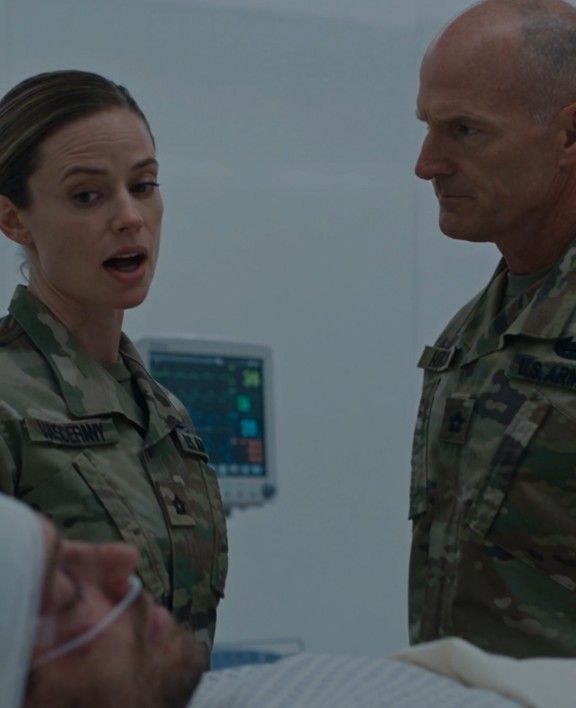
“That sounds like him.”
They sat together in silence.
At the memorial, Natalie stood behind Eli’s family and thought about the argument with Reeves. She had believed the hardest part of that day was choosing between a patient and an urgent question. It was not.
The hardest part had been refusing the false choice.
A person could be guilty of terrible things and still deserve medical care. A commander could be desperate for information and still be required to wait. A wounded young soldier could die and still leave behind an action that saved people he would never meet.
The hospital also changed in quieter ways. Natalie asked the nursing staff to review what had happened without turning it into a story about one captain standing up to one colonel. That version sounded satisfying and taught almost nothing.
At the review meeting, a junior nurse admitted she had been afraid to speak because Reeves outranked everyone in the immediate discussion.
“What would have helped?” Natalie asked.
“A phrase everybody recognized,” the nurse said. “Something that means we are not refusing the mission. We are saying the patient cannot safely move yet.”
The team developed one. A medical stability hold could be called by the responsible clinician, documented immediately, and reviewed within minutes by the physician on duty. Command could challenge it, but not simply override it at the bedside without medical responsibility transferring to another qualified clinician.
Natalie insisted on one more rule: the hold had to be reassessed, not treated as a shield that lasted forever.
“If the patient stabilizes, the answer can change,” she told them. “Safety is not the same thing as delay for its own sake.”
Reeves attended the final session.
When the junior nurse saw him, she stopped talking.
He noticed.
“That is part of the problem, isn’t it?” he said.
Nobody answered.
Reeves sat at the back of the room instead of the head of the table. “Continue.”
The nurse did.
Later, Natalie found him outside with a paper cup of coffee.
“You hated that,” she said.
“I hated several parts.”
“Which one most?”
“Learning that my presence can make useful people quiet.”
Natalie folded her arms. “What are you going to do with that?”
“Sit in the back more often.”
She smiled despite herself.
The surviving soldiers from the morning attack recovered at different speeds. One needed months of rehabilitation. Another returned to duty sooner than anyone expected. Natalie visited when her schedule allowed, but she never told them Samir’s information had somehow balanced what happened. Nothing balanced three deaths.
What it did was prevent additional names from joining them.
When the explosive cache was finally shown to her in a classified after-action briefing, Natalie felt no triumph. She looked at the photograph of the blue water tank Samir had described and thought of Eli struggling to write her name on waterproof paper while injured.
