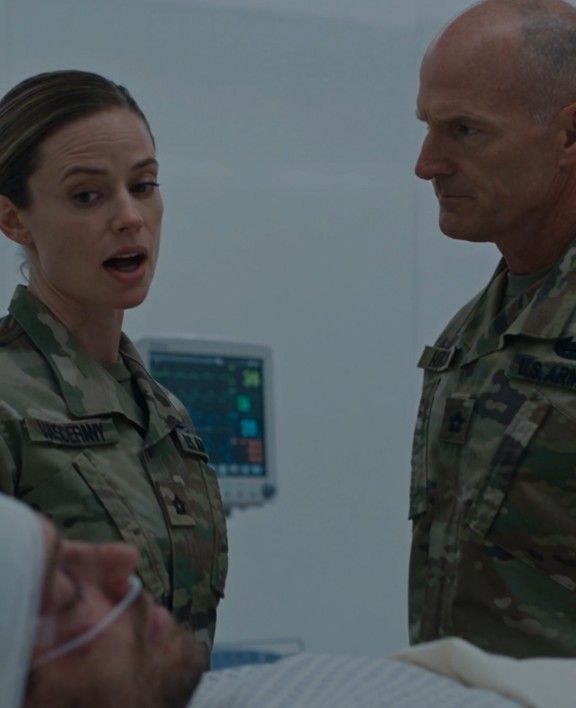
She dried her hands slowly.
Reeves leaned against the counter, suddenly looking older than his rank. “Three dead this morning. I kept seeing the next three.”
“So did I.”
“I thought waiting meant doing nothing.”
Natalie looked toward the ward. “Sometimes waiting is the thing that keeps the answer alive.”
He nodded.
Then she added, “And sometimes urgency is real. You moved the team as soon as he gave you the location.”
“I did.”
Neither of them needed the other to be completely wrong.
That was the part Natalie carried forward.
The military review that followed separated several questions people had tried to force together during the first hours. Samir had been an enemy fighter. That remained true. He had participated in armed activity before deciding to defect. That remained true too. His later attempt to prevent the attack did not erase what came before, but neither did his history make the warning false.
Medical staff had an obligation to treat him regardless of what investigators believed he had done. Investigators had an obligation to question him once his condition allowed it. Commanders had an obligation to act quickly on credible information. Those duties were not enemies, even when they collided in one hospital room.
The review found Natalie’s refusal to move him medically justified. His blood pressure at the time made transport unsafe. The hospital formalized a clearer process for conflicts between medical stability and investigative urgency, including a rapid consultation system so no single nurse or commander would be left fighting the entire argument alone at a bedside.
Reeves supported the change publicly.
That surprised several people.
It did not surprise Natalie anymore.
Samir recovered slowly. He remained under guard. He was questioned in short sessions over several weeks and provided information that helped identify the network responsible for the attack. None of that transformed him into a hero. He never asked for that story.
During one interview, Natalie passed the doorway and heard him say, “I was with them. I did things I cannot make clean.”
The investigator asked why he had changed course.
Samir answered, “Because one morning I understood there would never be a last body.”
Natalie kept walking.
Eli Brooks’s family arrived on the installation four days after the attack. His mother was small, direct, and composed until Natalie handed her the returned identification tag.
Then her hands broke into a tremble.
“He had this?” she asked.
“The man he tried to help had it.”
Natalie told her only what had been confirmed. Eli had listened to a warning while gravely wounded. He had given Samir the tag and Natalie’s name. The information eventually prevented another attack.
Eli’s mother pressed the metal against her palm.
“He always thought listening counted as doing something,” she said.
Natalie almost laughed through the sudden pressure in her throat.
“He once told me I listened different.”
