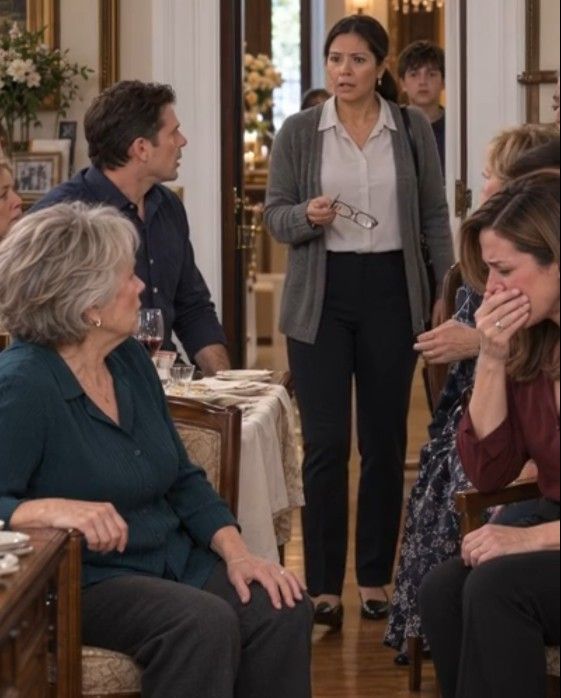
Lauren did not answer at once.
David asked her to unlock her phone.
The private rooms, the listing, and the pending status appeared on the screen.
Now Richard’s question about the signature left no room to hide behind a vague conversation about the future.
Richard’s question about the contract remained unanswered long enough for the silence to become specific.
Lauren could not resolve it by repeating that she had contacted a realtor.
Someone had provided information that allowed the transaction to progress, and the homeowner needed to know how that had been presented as authorization.
The listing was visible, but its status was not a substitute for consent.
She wanted to see the route by which her home had reached that point.
David held to the same need for an explanation.
He did not let the discussion dissolve into what Lauren believed the family would eventually want.
An expectation could be discussed later; a contract had to be addressed now.
The older woman felt the pressure of the relatives watching and wished briefly that the whole thing had emerged in private.
Then she recognized how difficult privacy might have made it to prevent the account from shifting.
People in the room had heard the original claim and David’s denial.
They had seen the listing.
She did not need them to guess what the signature meant or offer legal conclusions.
She needed the record preserved and examined.
That would require more than an argument beside the fireplace, and she was prepared to insist on the slower work necessary to find a reliable answer.
The answer required examining the electronic authorization and the communications with the realtor.
Lauren had used information available to her through family paperwork to submit an authorization the homeowner had neither signed nor approved.
The communication history showed her repeatedly presenting herself as someone entitled to speak for the owner.
A transaction had advanced on that representation.
The electronic authorization made the discovery particularly unsettling.
The information Lauren used had been accessible through family paperwork, material the homeowner had not treated as something a relative might use to speak in her place.
Familiarity with her details had been converted into an appearance of permission.
She went through the communications with attention to who had said what, rather than allowing the existence of a submitted authorization to settle the question of whether she had approved it.
The realtor’s history showed Lauren repeatedly presenting herself as entitled to speak for the owner.
The repeated nature of that representation mattered.
This was not simply a vague comment at a family gathering that someone outside it had overheard incorrectly.
