It contained emergency contacts and an authorization for me to seek medical treatment if needed.
The document was already signed, although nobody had asked me to review it.
When I held it up, Vanessa claimed Daniel had handled the details.
Daniel looked startled.
He said he’d signed only the school’s permission forms.
I asked why the date beside my signature was three weeks earlier.
On that day I had been visiting my sister in another state.
Vanessa told me I was becoming obsessive about paperwork.
I called the pediatrician’s office, not to accuse anyone but to make certain the medical information was current.
The nurse said they had recently received a request to change the children’s emergency contact hierarchy.
I asked whether my own phone number was still listed.
It wasn’t.
The primary contact number belonged to a woman I’d never heard of.
I read the name aloud.
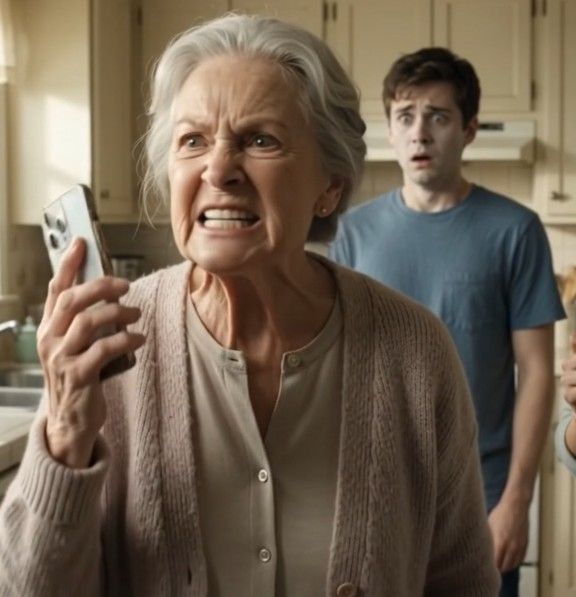
Daniel dropped onto a kitchen chair.
Vanessa whispered, “You promised you wouldn’t bring that up.”
He looked at her, then at the children playing in the next room.
“Mom,” he said, “Japan isn’t why we’re leaving.”
The red binder lay open between us. Its silver rings had cut a faint crescent into the wood of my kitchen counter, and the youngest child’s crying drifted from the living room. Daniel had said the words so quietly that I almost wished I had misheard him. “What do you mean, Japan isn’t why you’re leaving?” I asked. Vanessa moved toward the binder. I put my hand on it first. Daniel stared at the strange emergency contact number. “The tickets aren’t for a vacation,” he said. “They’re one-way. Vanessa says we have to be gone before the accountants find out what happened.”
Vanessa drew herself upright. “You promised you wouldn’t frighten your mother with business problems.” Daniel shook his head. “I promised I would help solve them. Then I found the school forms.” A car horn sounded from the street; the taxi driver had been waiting while they argued. Nobody moved. I asked Daniel to tell me whether the children were supposed to be picked up at the end of the two weeks. He nodded reluctantly. The woman listed as their primary contact, Leah Voss, was not a relative. She ran a relocation service Vanessa had paid to arrange their passage overseas. I had been told only that I would care for the children until their parents came back.
I asked for the children’s tickets. Vanessa said the reservations were private. “Their passports are ours to manage,” she snapped. Daniel reached into his coat and put three envelopes on the counter. The first held the adult itinerary. The second contained an agreement with Leah’s agency. The third was a letter supposedly written by me, authorizing a third party to collect the children from my home and arrange their onward travel. I saw my name at the bottom and felt the kitchen floor tilt. A woman had invented my consent twice: first to leave the children with me, then to remove them without asking. I realized that my ordinary habit of opening the door to trusted family had nearly become a plan others could use against us.
“Call the taxi,” I told Daniel. “Tell them they can leave.” He looked out the window, then picked up his phone. Vanessa tried to stop him. “If we miss that flight, everything comes down on us,” she said. Daniel answered that the children were not luggage to be moved around a crisis. For the first time that morning, his voice sounded like a father’s. The taxi pulled away a minute later. I heard the tires whisper over the road and nearly wept with relief. There were still three frightened children in my living room, but the clock had stopped driving the adults toward a decision they could not take back.
I went in to see the children. Nine-year-old Ben had built a wall from sofa cushions; seven-year-old Lucy stood behind him clutching a stuffed fox. Their older sister, eleven-year-old Ada, watched me with solemn eyes. I told them that their parents needed to talk and that nobody was leaving them without a plan. Lucy asked whether I was angry that they had come. I knelt beside her. “Not with you,” I said. “Never because you need someone.” She leaned her forehead against mine, and I felt her breathing slow. I asked Ada to choose a film and Ben to bring the fruit bowl to the coffee table. Giving them small, ordinary tasks helped make the next hour less terrifying.
Back in the kitchen, Vanessa had begun gathering the papers. I asked her to leave everything where it was. Daniel agreed. He had known about an audit of his small building-supply company, he explained, after several customers complained that their advance payments had not reached the projects they were funding. Vanessa had been running the bookkeeping while he supervised worksites. She assured him that a transfer from another account would cover the missing amounts. Then he found debts he couldn’t explain. The planned Japan trip had changed from a getaway into a way to avoid meeting the accountant and some very angry clients. “I should’ve checked sooner,” he admitted. “I signed forms I didn’t read.”
Vanessa insisted the debts were temporary and that she had used the money to keep the business alive. Daniel opened a statement showing payments to an account bearing Leah Voss’s business name. Vanessa said those fees were for relocation. I asked why any relocation needed my forged signature. Her face reddened. “Because you always say no at first.” I was too stunned to answer immediately. She had not seen consent as a necessary agreement. She had seen it as the moment before the pressure began. “You didn’t ask me,” I said. “You wrote my answer for me.” Daniel covered his face with his hands. The silence afterward was broken only by the cartoon beginning in the next room.
I phoned my sister and asked her to come sit with the children while we made calls. Then I contacted the pediatrician’s office to notify them that the emergency contact update was disputed and to ask how authorized parents could correct the records. Daniel called the school and requested an immediate hold on third-party pickup permissions until proper identity and authority checks were completed. I did not try to alter custody records on my own. Daniel remained their father and had to take responsibility for protecting them. We called a family-law attorney and agreed not to hand the children to anyone whose authority could not be independently verified. Every call felt awkward, frightening, and necessary.
When my sister Ruth arrived, she brought warm rolls and a jigsaw puzzle. The children flocked to her, grateful for someone who did not look as if the world were ending. She caught my eye over Lucy’s head and asked no questions. I had told her only enough to protect the children. In the study Daniel spoke with an attorney named Miriam Chen, who advised him to preserve the travel documents and contact the business’s independent accountant and appropriate authorities. Vanessa refused to participate. She accused us of building a case against her in front of her own children. Miriam, on speakerphone, reminded us that the children should be shielded from adult allegations and that any legal process needed evidence, not a shouting match.
I moved to the hallway while Daniel finished the call. There hung the small travel calendar I had made for my Portugal trip. I had circled the departure date in blue and marked Sofia’s birthday in a corner. We had met as young women, sharing a cramped office and too many bowls of late-night soup. Thirteen years had passed since our last visit, years of children, aging parents, funerals, and promises that one day we would sit together beside the Atlantic again. My ticket sat in my desk drawer, paid for from years of quiet saving. I realized how close I had come to tearing it up because someone had taught me that love could be measured by what I surrendered.
Daniel came to stand beside me. “You should still go,” he said. I turned toward him. “The children need stability right now.” “They do,” he answered, “and I’m their father. I made you the backup plan because I was afraid to be the main one.” I had heard apologies from him before, usually accompanied by a request that I do something inconvenient. This one was different. He did not ask me to watch the children while he fixed everything. He told me he had taken leave from work and would stay with them while legal and financial matters were addressed. I asked what would happen when the school called in the middle of the day. “I will answer,” he said.
Vanessa left the house that afternoon after Daniel declined to return the passport envelopes without legal advice. He did not physically restrain her or make threats. She chose to go to her sister’s apartment, telling the children she needed time to think. I watched their faces as she hugged them. Ben held back, confused by the quarrel. Lucy begged her not to miss bedtime. Vanessa said she loved them, then looked at me with resentment sharp enough to feel like heat. Love and accountability, I was discovering, could exist in the same person without canceling each other. The children deserved their mother’s care. They also deserved to be kept out of a plan built on secret documents.
