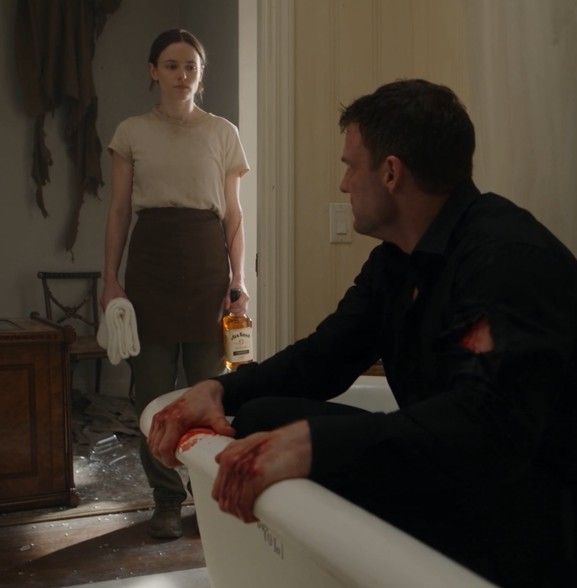
On the fourth night, I found an envelope tucked into my locker.
No name on it. No return address. Just thick cream paper with the weight of money.
Inside: a note, handwritten in a sharp, controlled script.
*The bottle was billed to the room. As requested.*
*You were never there. But I know you were.*
*—R.A.*
Beneath the note, a business card. Black. Minimal. Just a name and a phone number.
And on the back of the card, in that same handwriting:
*If you ever need to not be invisible.*
I put the card in my wallet and went back to work.
But something had shifted. Something small and tectonic. The walls I’d spent my life building—thick, invisible, efficient—had developed a hairline crack. Not from the outside. From the inside. From the memory of a man in a bathtub who had looked at me and seen not a kitchen worker, not a ghost, but someone who understood.
A week later, the crack widened.
I was closing up the kitchen—last one out, as always—when I heard the back door open. The security guard who’d warned me that night stepped into the light. He looked terrible. Dark circles. Shaking hands. The look of a man who’d seen what I’d seen and wished he hadn’t.
“Ellis,” he said.
“Marcus.”
He closed the door behind him. Leaned against it. I could hear him breathing.
“He asked about you,” Marcus said.
“Who?”
“Don’t.”
I wiped down the counter. Kept my hands moving. “What did he ask?”
“Same thing you’d expect. Whether you talked. Whether anyone heard. Whether—” He stopped. Swallowed. “Whether you could be trusted.”
I wrung out the cloth. Set it aside. “What did you tell him?”
Marcus looked at me for a long time. “I told him you were the quietest person I’d ever met. That you could disappear in a room full of people. That you wouldn’t talk because you never talk to anyone about anything.”
“That true?”
“You know it is.” He pushed off the door. “But Ellis—he’s not what you think. What you saw up there—that wasn’t him losing control. That was him after someone else tried to take it from him.”
“What do you mean?”
Marcus shook his head. “I mean that there are men who destroy rooms because they’re monsters. And there are men who destroy rooms because someone put them in a cage so long that the only way out was through the walls.” He paused at the door. “You figured out which one he is. That’s why he asked about you.”
He left.
I stood alone in the empty kitchen, the fluorescent lights buzzing overhead, the faint smell of garlic and butter still lingering in the air. And I realized that the crack in my walls wasn’t just about Reed Ashford. It was about me. About the choice I’d made to climb those stairs. About the fact that for the first time in my life, I had chosen to see someone—and be seen—and the world hadn’t ended.
It had just gotten more complicated.
