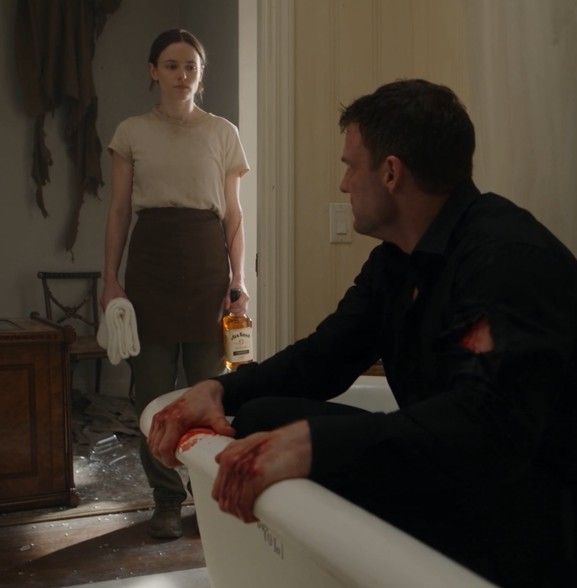
A man in a charcoal suit filled the frame. Behind him, two more. They moved with the choreography of people who handled problems for a living. Their eyes went to Reed, to the blood in the tub, to me, and I watched three separate threat assessments happen simultaneously.
“Mr. Ashford.” The man in charcoal. His voice was carefully controlled. “We’ve been looking for you.”
“I’m aware.”
“Senator Whitford has left the building. His associates are requesting—”
“I know what they’re requesting.” Reed stepped out of the bathtub. Even disheveled, even bleeding, even with the ghost of whatever catastrophe had just happened still clinging to him, he commanded the space. “Tell them the meeting is postponed indefinitely.”
“Indefinitely, sir?”
“That’s what I said.”
The man’s eyes flicked to me again. “Who is this?”
A pause. The kind of pause that determines whether someone lives or disappears.
“He’s no one,” Reed said. “Kitchen staff. He came to investigate the noise.”
“Should we—”
“He’s leaving. Now.” Reed turned to me. The coldness was back, but underneath it, I could still see the trembling. “Take the service stairs. Go home. Forget this floor exists.”
I picked up the whiskey bottle. It was half empty now, spent on his wounds. I held it up.
“This is a hundred-dollar bottle,” I said.
Something happened to his face that I couldn’t quite name. The corner of his mouth moved. Not a smile. An acknowledgment.
“Bill it to the room,” he said.
I walked past the men in suits. They parted for me without touching—Reed’s silence was its own permission. I descended the back stairs, the bottle swinging at my side, my heart hammering so hard I could feel it in my teeth.
I pushed out the service door into the alley. The night air hit me—cold, sharp, smelling of rain and garbage and exhaust. I stood there for a long time, breathing.
Then I went home.
My apartment was a single room above a laundromat on Dorchester Avenue. The window rattled when the big machines ran, which was always. I locked the door. Stood in the dark. Listened to the hum of dryers and tried to understand what had just happened to my life.
I had seen Reed Ashford—Boston’s shadow king, the man they whispered about in courthouses and boardrooms and the back corners of police stations—curled in a bathtub, bleeding, terrified that no one would stay.
And I had stayed.
I slept poorly. I dreamed of porcelain and blood and a voice that said my name like it was something worth remembering.
The next morning, I went to work. Because what else do you do when your ceiling is still broken and your rent is still due? You mop the broth off the floor and you start the next stockpot.
The kitchen was chaos. Two chefs arguing about structural repairs. The sous chef on the phone with the insurance company. A temporary ceiling patch already being installed by contractors who’d been called at six in the morning.
Nobody looked at me twice.
That was the gift of being invisible. It was also the prison.
Three days passed. The VIP room was sealed off—renovation, they said. The ceiling in the kitchen was repaired. Life at Pharaoh resumed its rhythm of controlled elegance and whispered power.
I said nothing to anyone.
Not because Reed had told me to, though he had. But because I understood something that most people don’t: the difference between a secret and a truth is permission. Without permission, a truth becomes a secret, and secrets are the currency of people like me. We trade in silence. We survive on it.
