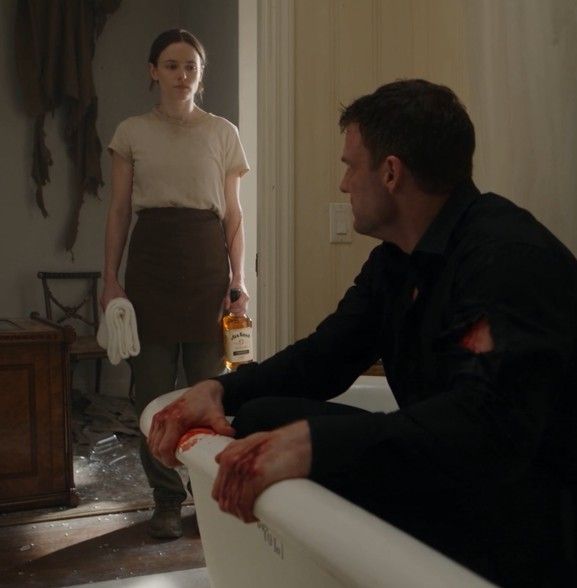
I watched from a distance, mostly. Reed would call me at night, not to update me on the case but to talk about nothing. Books he was reading. A recipe he’d tried. Whether it was going to rain. Small things. Human things. Each conversation was him practicing being a person instead of a fortress.
Marcus, the security guard, became an unexpected ally. He’d seen Whitford’s people threatening Reed that night—had watched the Senator’s enforcer back Reed into the VIP room like a dog into a corner. Marcus had been told to say nothing. He’d been paid for his silence. But when Reed’s attorneys called, Marcus talked. Every word.
“He’s been paying me off for years,” Marcus told me one night in the kitchen. “Small amounts. Enough to keep my mouth shut. Enough to make me feel like I was part of it.” He looked at his hands. “I’m done being part of it.”
The arrest happened on a Tuesday. I wasn’t there. But I heard about it from Marcus, who heard about it from the new security team Reed had hired—men and women who answered to the building, not to the Senator.
Whitford was taken from his office in the State House at nine in the morning. No cuffs, at first. But when his attorneys arrived and saw the evidence, they advised him not to resist. Three federal charges. Extortion. Coercion. Conspiracy. And a sealed indictment that Reed told me, in a quiet voice, contained the things he still couldn’t say out loud.
The silence after the arrest was enormous. It filled the news, the hallways of power, the spaces where Whitford’s name had been a currency. People who had praised him suddenly couldn’t remember his name. People who had feared him suddenly had the courage to speak. The machine he’d built didn’t just stop—it collapsed, all at once, like a house of cards in a wind.
I kept mopping floors. I kept making broth. I kept living in my room above the laundromat. But the walls were different now. Not gone—walls that thick don’t disappear overnight—but permeable. Light came through the cracks.
Reed invited me to dinner again. Then again. Then it stopped being an invitation and became a habit—a weekly thing, every Sunday, at his brownstone on Beacon Hill. He cooked. I helped. We ate by the window. We talked about things that had nothing to do with power or fear or the night that had thrown us together.
He told me about his mother. A schoolteacher in Vermont who had died when he was fourteen. How she used to read to him every night, even when he was too old for bedtime stories. How her death had been the hinge on which his entire life turned—how the grief had calcified into ambition, and ambition had calcified into armor, and armor had calcified into the man the world feared.
I told him about my mother. A woman I’d never met. A name on a form. A blank space where a photograph should have been. How foster homes had taught me that love was a temporary condition, like weather, and the only smart thing to do was stop packing for the storm.
“You packed anyway,” he said. “That night. Whiskey and towels.”
“That’s not packing for a storm.”
“That’s exactly what it is. You saw a stranger bleeding and you went toward him. That’s the most optimistic thing a person can do.”
I thought about that for a long time.
The trial took four months. Reed testified. So did Marcus. So did seventeen other people who had been silenced by Whitford’s machine. The courtroom was packed every day. The air in it was thick with decades of unspoken fear finally becoming spoken truth.
Whitford sat at the defense table in a suit that cost more than my annual rent, and I watched him shrink. Not physically. Spiritually. The power drained from him like water from a cracked vessel, and what was left was small and ordinary and scared. A man who had spent his whole life devouring other people’s courage had finally run out of food.
The verdict came on a Friday. Guilty on all counts. The courtroom was silent for a long time after the foreperson spoke. Then someone in the gallery let out a breath—a single, shuddering exhale—and the silence broke into something that sounded like release.
Reed walked out of the courthouse into a gray afternoon. Reporters shouted questions. Cameras flashed. He moved through it all with the stillness I’d come to recognize—not the coldness of a man who didn’t care, but the steadiness of a man who had finally decided to carry what he carried in the open.
He found me standing on the sidewalk across the street.
“You came,” he said.
“You told me it was Friday.”
“I didn’t think you’d actually show.”
“I keep showing up. You should be used to it by now.”
He almost smiled. The almost-smiles had been coming more often—approaching the real thing, hovering just at the edge. I was learning the geography of his face the way I’d once learned the geography of escape routes and hiding places.
“It’s over,” he said.
“It’s over,” I agreed.
We stood there on the sidewalk, two people who had no business being connected—a kitchen worker and a shadow king, a foster kid and a power broker—connected by a bathroom, a bottle of whiskey, and the sound of someone breathing too quietly.
Six months later, Reed sold the brownstone on Beacon Hill. He didn’t tell me why until the day the movers came and he asked me to help him carry boxes.
“Where are you going?” I asked.
“Wherever you are.”
