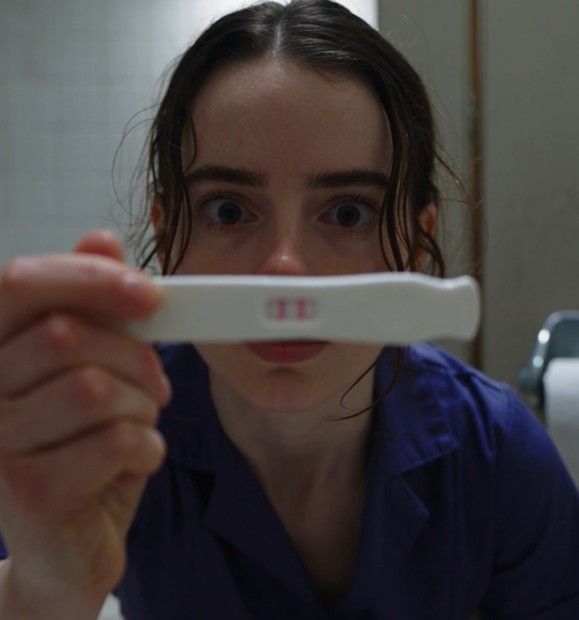
For a long moment, no one moved.
Then Alessandro let go of my hand like he’d forgotten he was holding it, and took a half step back, putting distance between us that felt like a cliff.
“Elizabeth,” he said, and my real name in his mouth now sounded different, heavier. “You should have told me.”
“I know,” I whispered. “I was so scared. I thought if you knew I was Elizabeth, you’d see me as— as damaged, as a liar, as someone who tried to hurt you—”
“I see you,” he interrupted, and his voice cracked. “I have seen you since you stumbled with that tray. Do you know why I sent that envelope?”
I shook my head, tears falling onto my coat.
“Because I knew you weren’t Emma,” he said.
The world stopped.
“What?”
Liam made a small sound behind us.
Alessandro reached into his inner coat pocket and pulled out a folded, worn photograph, creased at the edges. He held it out.
It was a picture of a teenage girl with dark hair and a shy smile, in a hospital volunteer vest, standing next to a younger Alessandro in a wheelchair, his leg in a cast.
“My sister,” he said softly. “Emma Vitali. She died when she was sixteen. Leukemia. She wanted to be a nurse. She volunteered at Mercy every summer.”
I stared at the photo, my hand over my mouth.
“Cross knew about her. He found catering records, saw you were the only girl who fit the age, and told you to use her name because he thought it would make me sentimental, make me careless. He thought I wouldn’t check.” Alessandro’s eyes never left mine. “But I knew the second you said ‘Emma’ that you weren’t her. You don’t look like her. You don’t speak like her. My Emma had a birthmark on her left wrist like a little moon. You don’t.”
He turned my wrist gently, his thumb brushing the clear skin there, and I shivered.
“I sent the key because I wanted to know who you really were,” he whispered. “And then you talked about emergency medicine and porch lights and I forgot to ask. I forgot to care what your name was. I just wanted you to stay.”
He paused, his breath hitching.
“I had my team find you the next day. Not to punish you. To make sure Cross hadn’t hurt you. They found Elizabeth Hayes. Twenty-five. Parents died in a car accident three years ago. Top of her class before she had to drop out. Working two jobs to get back to school. Living with Liam Carter, who calls her Lizzy when he thinks no one’s listening. I told them to leave you alone. I told them if you wanted to come back, you would.”
He looked at Liam, and for the first time, his expression held something like gratitude and apology at once.
“You called me every day for three weeks,” I whispered.
“I didn’t know how else to say I knew and I didn’t care,” he said. His eyes dropped again to my stomach, and this time he didn’t stop himself. He knelt again, and this time his hand, large and warm, hovered just over my coat. “May I?”
I nodded, unable to speak.
He placed his palm, so lightly, over the place where life was just beginning. His hand trembled. A tear slipped down his cheek and caught in his sweater.
“Hi,” he whispered again, to the tiny, invisible future. “It’s me.”
I broke. I sank to my knees too, so we were face to face on the cold floor, stained glass light painting his hair amber and blue, and I pressed my forehead to his.
“I’m so sorry I lied,” I sobbed.
“I’m sorry I let you be scared alone,” he whispered back, his hands coming up to cup my face, thumbs wiping tears as fast as they fell. “I should have come sooner. I should have told you I knew.”
Liam stood by the door, crying openly now, not bothering to hide it.
Detective Monroe cleared her throat gently from the pew, where Marla was signing something. “Mr. Vitali, we’ll need statements from both of you. But it can wait until tomorrow. Go home. All of you.”
Alessandro helped me to my feet like I was made of glass. He kept one arm around me, his hand splayed protectively over my back.
We walked out of the chapel together, past the officers, past the stained glass, into the late afternoon hallway that smelled like coffee and antiseptic and ordinary life.
Outside, Chicago wind hit us. It was cold and bright.
A black SUV waited at the curb, but Alessandro didn’t go to it. He looked at me, at Liam, at the cracked sidewalk and the bus stop where I’d waited after every double shift.
“Where do you want to go?” he asked me.
I looked at Liam. Liam shrugged, smiled wetly. “My spare bedroom has a leaking faucet and a pregnancy test in the trash can that we should probably wrap properly,” he said.
Alessandro laughed, a real sound that surprised all of us.
“I have a place with a working faucet,” he said softly to me. “And a kitchen that no one cooks in. And a porch light that’s been on every night since you left Room 1520, because I didn’t know how else to leave a light on for you.”
My breath caught. “You said you liked quiet mornings.”
“I like you more,” he said.
We didn’t go to his penthouse that night.
We went to Liam’s tiny apartment, all three of us, because I wasn’t ready to leave the only home I’d had since my parents died. Alessandro sat at the chipped kitchen table and drank instant coffee like it was vintage wine, and Liam ordered terrible takeout that we barely ate because we were too busy talking.
We talked about the baby. About doctors. About school. Alessandro listened when I said I wanted to finish my nursing degree, that I didn’t want to be anyone’s secret. He nodded like it was the most natural thing in the world.
“I endowed a scholarship at Mercy two years ago in Emma’s name,” he said quietly, his hands around his mug. “It’s for nursing students who had to pause for family or money. It’s yours if you want it. No strings. No name change. Just Elizabeth.”
I stared at him, tears again. “You would do that?”
“I’ve been trying to do it since the day after we met,” he said. “You just wouldn’t answer my calls.”
Liam snorted. “She thought you’d destroy her.”
“I want to protect her,” Alessandro said, looking at me until I felt seen all the way through. “If she’ll let me.”
Later, after Liam had gone to bed and left us alone in the living room with the lamp low, Alessandro knelt again to talk to my stomach, like it was already a conversation.
He told the baby about old crime novels and black coffee and how his sister Emma used to read to him when his leg was broken.
