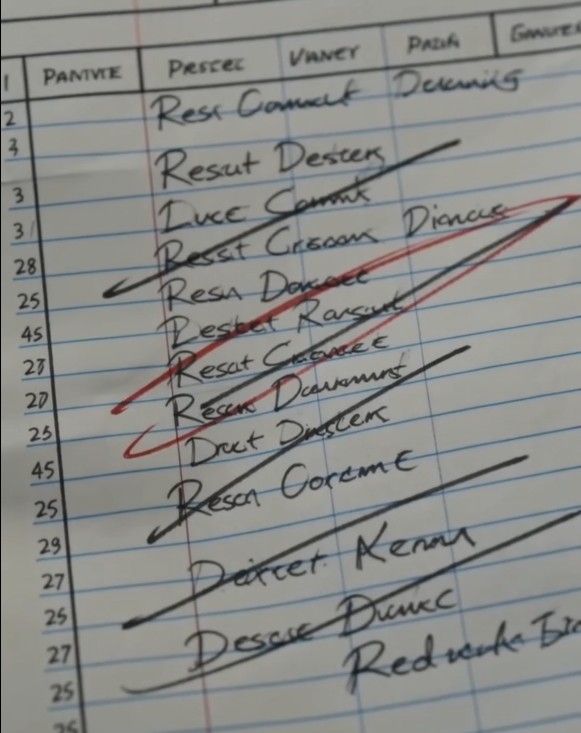
For a moment I felt ashamed of every frightening explanation already forming in my head. Then I reminded myself that a question was allowed to remain a question until someone found the record.
We photographed the notebook pages with his permission. He gave me his daughter’s contact information as well as his own, and I sent her a message while he watched so there would be a reliable way to reach him.
Before landing, he asked whether I could forgive him. I looked out at the small green fields beneath the wing.
“Not as a condition of telling me the truth.”
He accepted that without defending himself. It was the first thing he did that made forgiveness seem possible, though still far away.
At Charlotte, the attendant helped me record the bag damage and gave me the airline’s reporting information. She asked whether someone was meeting me, and waited while I called my neighbor to change our pickup plan.
Daniel’s daughter met us beyond the exit. He told her, in front of me, that he needed help locating Laura and submitting a complete statement about the flood.
I went home with the notebook photographs, my broken bag, and a promise to myself that I would ask for help before grief turned the search into another solitary vigil.
The next morning I called the county records office that now held the evacuation files. I gave the clerk the transport designation and departure time, not a theory about a hidden survivor.
She explained how to request the incident logs and warned that some personal information would be withheld. I wrote down the request number and the expected response window.
Then I called the training center printed on the envelope. An administrator agreed to check its old correspondence register if I sent a photograph of the postmark and reference code.
That afternoon Daniel’s daughter reached Laura through the care home’s former manager. Laura asked for a day before speaking to me; I found that hard to bear, but I gave her the day.
When she called, I sat at my kitchen table with a glass of water. She asked whether I wanted someone beside me, and I knew before she said more that Evan was not waiting somewhere to come home.
“Your brother helped us get six residents onto that truck,” she said. “Then the water rose across the service road.”
She had been holding an oxygen cylinder while Evan and the driver steadied a woman who could not climb the steps. Another current struck the truck, knocking the woman sideways.
Evan pushed her into Laura’s arms. Laura remembered his hand against the woman’s shoulder, a torn sleeve, and then empty space where he had been standing.
The driver searched the beam of his light until the water forced them onward. A later recovery had been recorded farther along the drainage basin, under an incomplete volunteer description that had never been linked properly to the first missing-person file.
Laura did not ask me to accept her memory as proof. She gave me the driver’s name, the receiving shelter, and the name of the resident Evan had lifted.
I wrote each one slowly. When I could no longer hold the pen, Laura stayed on the line and let me cry without filling the silence.
The records arrived in pieces over the following weeks. Some pages repeated what we already knew; others supplied times, movements, and names that finally connected events our family had been told were separate.
The county referred my request about the unidentified recovery to the appropriate office. I spoke with a family liaison, supplied the documents we still had, and followed the identification process she explained.
There was no single dramatic sheet that solved thirteen years. There were calls returned, comparisons reviewed, signatures requested, and several afternoons when I had to walk around the block before opening another envelope.
The training center answered too. Its correspondence register showed that belongings collected from several shelters had been sent there for sorting after the disaster response office relocated.
Evan’s note had been among them. The newer center had forwarded it to our parents using its current stationery; later inquiries had gone to staff who held belongings records rather than the full incident file.
The address had not been a false destination invented to deceive us. It had become the wrong door through a chain of incomplete handoffs, each one small enough for someone to overlook and large enough to cost us years.
I felt anger settle more heavily when it no longer had a mysterious enemy to chase. Ordinary failures could still break a family, and explaining them did not excuse them.
Daniel submitted a signed account and offered his original notebook for examination. His daughter drove him to meet the reviewer because he did not trust himself to postpone it again.
I attended by video. When he described sending Evan to the care home, his voice shook, but he did not turn his choice into a heroic story or blame the dead radio for everything that followed.
“And you never contacted the family?” the reviewer asked.
“No,” Daniel said. “I let fear and embarrassment become an excuse.”
