Samuel apologized to me in writing and in person. I accepted the apology for his delayed notice, but I asked what would change besides personnel. He brought a plan with dates, owners, and a way to check completion. I reviewed it with the same care I would have given an investment.
The complaint route would no longer return automatically to the subject of a complaint. Staff could request a second reviewer for disputed executive instructions. Customer incidents involving intimidation would be documented and assessed independently. The board would receive reports showing patterns, not merely a polished assurance that everything was fine.
Claire’s part in the case remained factual. She had treated me respectfully and tried to intervene. She wasn’t instantly promoted to president for doing so. She received support, training opportunities, and a clear assurance that speaking to the reviewers wouldn’t harm her job.
Months later, she moved into a role helping customers navigate large or complicated transactions. When she told me, she sounded pleased rather than triumphant. She said she liked work that let her explain things properly instead of rushing people away from the counter.
I congratulated her. She thanked me for listening. I told her that listening shouldn’t have required a crisis, and she nodded as if that was the part she would carry forward.
At the rehabilitation building, the contractors continued after the payment arrangements were secured. The opening moved by several weeks while we confirmed the funding schedule. It was disappointing, but manageable. We explained the delay to the families instead of giving them another promise we couldn’t verify.
I visited on a chilly afternoon wearing a different coat. The original one had been cleaned, its faded fabric unharmed, but I wasn’t ready to put it on. A carpenter showed me the widened doorways, and the occupational therapist explained how the rooms would work for people recovering from injury.
A young man practicing with a walker came through the temporary entrance beside his mother. We moved aside so he could take his time. Nobody hurried him to make our tour more efficient. Watching that small courtesy felt like seeing the opposite of the bank lobby built into a place.
My granddaughter encouraged me to talk about how the incident had affected me beyond the paperwork. I resisted at first. At eighty-one, I considered myself accustomed to adversity, as if age should make humiliation stop hurting. Eventually I spoke with a counselor who worked with older adults.
I told her I felt foolish for going into the branch alone. She asked whether the foolishness belonged to the person requesting a lawful transaction or the person pouring water. I knew the answer. Saying it out loud took longer.
We talked about the way people read clothes, age, and hesitation. My hands had been unsteady before the incident because they were sometimes unsteady. That did not make my judgment unreliable. My shoes were worn because they were comfortable. That did not make me less deserving of service.
I began entering ordinary places without rehearsing how to prove I belonged. It wasn’t effortless. The first visit to another bank left me tense until the teller offered a chair and explained the form without condescension. I thanked her, then reminded myself she had simply done her job well.
The borrowed cardigan returned to the bank freshly washed. I included a note to the staff member who had found it, thanking her for an act of care that required no knowledge of my accounts. She wrote back that she hoped I was warm now. The uncomplicated sentence moved me more than many formal apologies.
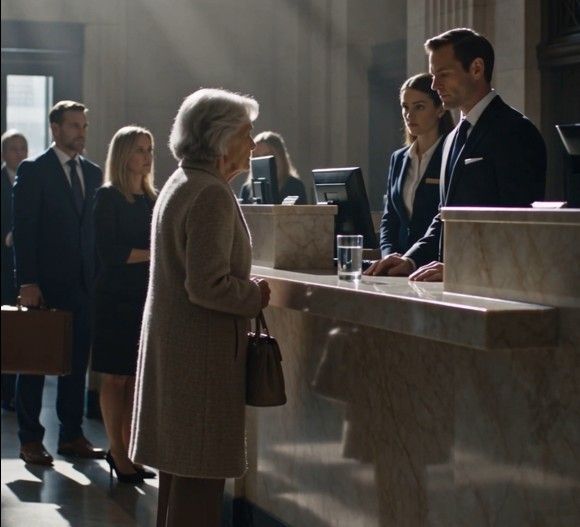
Before the opening, I visited the bank once more for a scheduled review with Priya. The lobby looked much as it had that afternoon: marble, bright counter lights, chairs arranged beneath the large name on the wall. My body remembered the room before my thoughts caught up.
Priya met me without ceremony. We reviewed the corrected statements and the remaining checks on the project accounts. She gave me copies and explained the items still awaiting confirmation. I asked questions until I understood each one. She never suggested my age made the details unnecessary.
On my way out, I noticed an older man having difficulty with a deposit slip. A staff member sat beside him and helped him read the boxes. There was no audience for the kindness and no reason to think his account was large. I watched for a moment, then continued toward the doors.
Outside, I realized my hands were steady. I wasn’t celebrating a bank becoming perfect. I had seen one ordinary interaction handled properly, and ordinary was what I wanted restored. I called my granddaughter and asked whether she wanted lunch. She said yes, and I chose a place where we could sit by the window.
As the project opening approached, Samuel asked whether I wanted the entrance named after me. I declined. The building needed a name that people could use without feeling they were entering someone else’s monument. We chose one connected to the neighborhood’s history.
At the opening, there were no oversized checks or speeches about the water. Edward spoke briefly about the services. Samuel attended as a supporter and stayed afterward to help move chairs. Claire came with her mother, who used a cane and took time examining the handrails.
I stood near the door in my old faded coat. It had returned from the cleaner smelling faintly of soap. Putting it on that morning had felt like recovering something I didn’t want fear to keep. My granddaughter straightened the collar, and I told her it was fine as it was.
Inside, a woman asked whether I could help her find the intake desk. She didn’t recognize me. I walked beside her rather than pointing from across the room. Her husband followed slowly, concentrating on each step. We waited when he needed to rest.
Later, I found a plaque the project team had uncovered during renovation. It had been stored in a cupboard behind a broken cabinet. The brass was tarnished, and the inscription recorded a small neighborhood relief effort decades earlier.
Among the donors was my mother’s name. I stared at it, remembering the faded coat she had worn for years, mended at the cuffs. I had thought of her thrift as necessity. The plaque showed that some of what she saved had gone quietly toward making other people’s lives less difficult.
The project director had traced the name through an old ledger and asked my family to confirm it. The contribution wasn’t enormous. It was several modest payments over time, each carefully recorded. My mother had never told me because she considered helping ordinary, not something that needed an audience.
I touched the edge of the brass. The bank carried my family’s name in letters large enough to command attention. Here was a smaller version of the same history, hidden until people began repairing what had been neglected. One name had frightened a man into respect. The other had helped someone without asking to be recognized.
We cleaned the plaque and placed it beside the entrance, along with the other early donors. I did not ask for hers to be larger. All their choices had contributed to the room around us.
At the end of the day, my granddaughter helped me button my coat. The last visitors were leaving slowly through the widened doorway. Samuel asked whether I was satisfied that the project was safe.
“With the safeguards we can verify,” I said. “And we’ll keep checking.”
He smiled tiredly and nodded. Peace did not require pretending institutions could never fail. It required people willing to notice, speak, repair, and remain accountable after the excitement passed.
Outside, the evening air was cool and dry. I slid my hands into my pockets. My coat was faded, my shoes comfortable, and nobody’s recognition was needed to make the walk to the car feel like it belonged to me.
