And underneath, underlined twice: *I am afraid for her, not just of her.*
My hands went numb.
Helen came back in to get Margaret’s purse and saw me holding the notebook. She read over my shoulder and made a small, wounded sound.
“Oh, Margaret,” Helen whispered. “Oh, my girl.”
That was the twist that broke me open and healed me at the same time. My mother had not been documenting how to destroy Claire. She had been documenting reasons to forgive her. She had been holding onto every scrap of goodness, trying to build a bridge back for a woman who kept burning it. And in the end, she had still protected Claire enough to ask that she leave without punishment, so she could stop being afraid of being seen.
I closed the notebook and held it to my chest.
The blow to Claire was complete and irreversible, but it did not come from my recording alone. It came from the fact that the one person she had hurt most had spent three months praying for her to be better. When Richard and Helen read that notebook in the waiting room at the clinic later that night, Helen wept openly and Richard sat with his head in his hands and said, “We failed her. We taught her that love is performance.” Claire was not arrested that night — Margaret, even in pain, asked me not to call the police if Claire agreed to leave and get help — but she was exiled from the story she had told about herself. The invitations stopped. The dinner party guests left one by one without eating, carrying their wine back to their cars in silence. That silence followed Claire out of the house and, I would later learn, into the therapist’s office Helen drove her to three times a week, the notebook on the passenger seat.
The healing did not happen all at once.
At the clinic, the X-ray showed no new fracture, just severe inflammation and a muscle spasm that made Margaret cry out when they moved her. The doctor, a stern woman with soft eyes, looked at me over Margaret’s head and said, “She should not have been on her feet. She should have been resting. Who was caring for her?” And I had to say, “No one. I thought someone was.”
Margaret reached for my hand on the gurney and squeezed it, absolving me even then.
We stayed there for hours, Helen and I, while Margaret dozed under a warm blanket with an IV finally giving her the pain relief Claire had told her to refuse. Helen told me, quietly, that Claire had been the same as a child — terrified of disappointing Richard, desperate to be perfect, cruel to the nanny when she felt unseen. “We thought it was a phase,” Helen said, staring at her hands. “We were too busy praising the performance to see the child underneath was drowning. Don’t hate her, Andrew. Hold her accountable, but don’t hate her. She learned it.”
“I don’t hate her,” I said, and realized it was true. I felt grief, and anger that would take a long time to soften, but mostly I felt awake for the first time in months.
When we brought Margaret home at midnight, the house smelled faintly of cleaner — Helen had stayed behind and mopped the sauce from the tiles herself — and the garden was dark and dripping outside the windows. I carried my mother to the downstairs guest room that Claire had said was “too good” for her, the one with the heated floors and the wide window looking onto the garden Claire had designed. I had always thought Claire designed it to impress neighbors. Now I remembered Margaret telling me, weeks ago, that Claire had asked her what flowers she liked. Margaret had said peonies. The garden was full of peonies.
I tucked the blanket around her, adjusted the pillow exactly the way the notebook said she liked it — not too high — and sat on the floor beside the bed with my back against the wall, just breathing with her.
“Will Claire be okay?” Margaret whispered, half-asleep, her pain medication finally pulling her under.
“She’ll have to be okay somewhere else for a while,” I said. “Helen will make sure she gets help.”
Margaret hummed, satisfied, and her hand found mine on the blanket. Her grip was weak but warm.
“And you?” she murmured. “Will you be okay?”
I swallowed. “I will if you keep letting me sit here.”
She smiled without opening her eyes.
In the weeks that followed, the house changed shape.
Claire moved into her parents’ guest house and began intensive therapy. She sent one letter, not to me but to Margaret. Helen brought it, unopened, and asked Margaret if she wanted it. Margaret read it alone in the garden. When she came back inside, her eyes were red but calm. She folded the letter and put it in the notebook and said, “She is starting to tell the truth. That’s enough for now.” She never told me what the letter said, and I never asked to read it. Some amends are not mine to witness.
I took a leave from the company. My partner, who had once praised Claire at that dinner party for being “so supportive,” came to the house and apologized to my mother without being asked, bringing soup and sitting awkwardly on the edge of her chair while she told him about her peonies. Diane from the office started coming by on Thursdays to drive Margaret to physical therapy so I could work a half day and not feel I was abandoning her again.
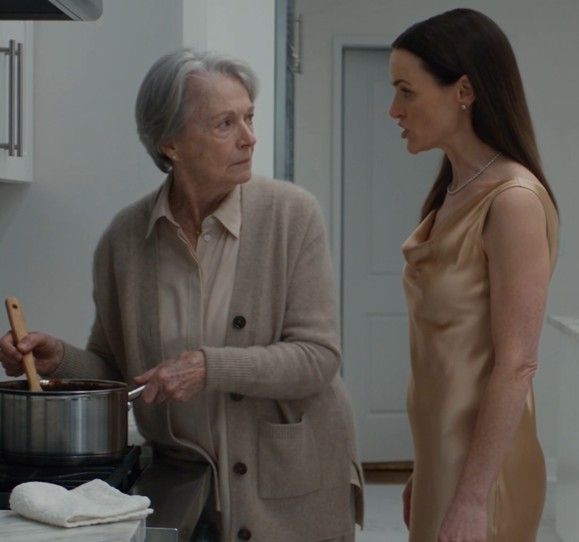
One evening in late August, almost six weeks after the saucepan, I found my mother in the kitchen at sunset. She was standing at the counter — not scrubbing, not polishing — just standing, looking out at the garden where the light was gold and the peonies were heavy and open. She was wearing her own soft cardigan, not an apron. Her hands were less swollen. She was holding a chipped mug of tea with honey, the way Claire had once made it when I was watching.
She turned when she heard me and smiled. Not the tight, protective smile she had given me for three months. A real one, tired and a little crooked.
“I made tea,” she said. “There’s enough.”
I went to her and took the mug from her hands and set it down, and then I put my arms around her very carefully, mindful of her back, and she leaned into me. We stood there a long time while the kitchen filled with evening light and the garden glowed outside the window. The marble counter was clean. No sauce. No performance. Just the quiet hum of a house that was finally safe.
Outside, the peonies Claire had planted because my mother once mentioned she loved them nodded in the warm wind, impossibly pink and alive, as if they had been waiting all summer to be seen.
And for the first time since she moved in, my mother let herself be fully at home.
