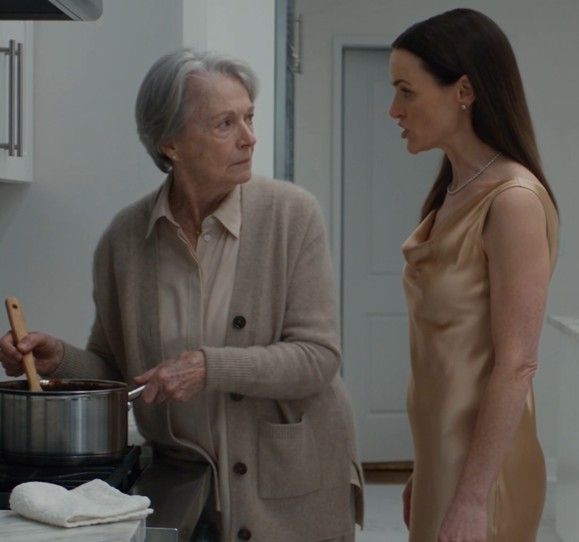
My mother-in-law’s hip hit the marble counter so hard the saucepan crashed to the floor.
Dark sauce spread across the white tile in steaming ribbons.
And my wife stood over her and said:
“Look what you did.”
Margaret is 68 years old. She had spinal surgery three months ago. The surgeon told her she could not lift, bend, or stand for long periods.
So I asked her to move into our house.
Eight bedrooms. Heated floors. A garden my wife Claire designed herself.
There was space for my mother.
Space and welcome should have been the same thing.
Claire was perfect when I was home. She brought my mother tea. She asked about pillows and whether the sheets were soft enough. At dinner parties she touched Margaret’s shoulder and told friends, “We’re so lucky to have her here.”
People praised Claire.
She loved that.
But the moment my car pulled out of the driveway each morning, the woman who remained behind barely resembled the one I knew.
The tea stopped. The questions stopped.
What replaced them were instructions.
Fold these towels. Polish this silver. Carry this basket.
“Maybe you’d recover faster if you stopped feeling sorry for yourself.”
“Andrew worries when you act fragile.”
One sentence at a time. Patient. Controlled. Invisible to anyone who wasn’t living it.
My mother told herself not to create problems. She saw me leave before sunrise and come home so exhausted I fell asleep with my laptop open. She saw how hard I was building my company. She saw how much I loved Claire.
So she stayed quiet. She folded towels while her stitches pulled. She wiped counters when her spine screamed.
Every evening, when I asked how her day went, Claire would smile and say “Great.”
My mother would smile too.
That smile was her mistake.
Then came the dinner party. Twenty-two guests. Fresh flowers. Imported wine. Claire dismissed the catering assistants that morning and told my mother, “You can help me.”
By seven that evening, my mother’s back was in agony. Her fingers were swollen. She had started dropping things.
Claire noticed. Not the pain.
The drops.
At 7:30, the sauce caught. My mother reached for the towel. Claire stepped in.
“You had one job.”
“I’ve been doing more than one job since noon.”
Claire went still. She stepped closer. She grabbed my mother’s arm.
My mother whispered, “Please—my back.”
Claire shoved her.
That was the moment I walked through the kitchen door in my rain-darkened coat, briefcase hanging from one hand.
Claire froze.
“Andrew. Your mother slipped. I was just helping her.”
I looked at the overturned saucepan. The sauce across the floor. My mother bent against the counter, barely able to stand.
And the red marks already forming beneath Claire’s fingers on her arm.
Then I lifted my phone.
The screen was still recording.
Claire’s own voice filled the kitchen. Clear. Cold. Impossible to deny.
“If Andrew hears about this, I’ll tell him you slipped. And he’ll believe me.”
Every trace of color left her face.
I looked at my wife. “How long?”
“Andrew—”
“How long have you been treating her like this?”
Her gaze flickered toward my mother. And I understood something I will never forget. Claire wasn’t only afraid of what I had recorded tonight.
She was afraid of what my mother might say next.
I turned.
