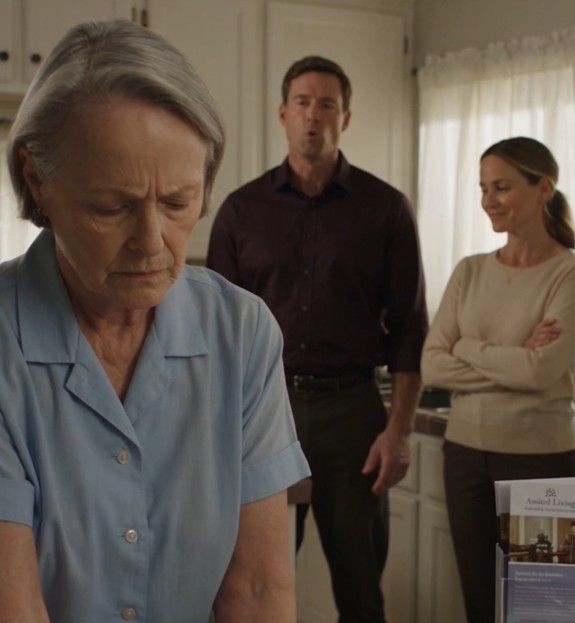
He turned toward her. “I didn’t.”
I watched their version of the story split at the first direct question. They had spent years presenting themselves as a united couple when they wanted something from me. Now they each looked for the person who would carry the blame.
Detective Alvarez asked Emily the same questions. Emily said she had not forged anything. She said she had helped organize documents because David was busy, and that he had asked her to submit them. She claimed she believed I had given verbal consent. Oliver asked when I had given that consent. She said she could not remember the exact conversation.
I had never discussed transferring my company shares, changing my power of attorney, or giving David ownership of the house. I told the investigator that. I also told her about the missing jewelry and the photograph from Cancún. I could not prove who had taken every piece, but I could identify the bracelet on Emily’s wrist. Detective Alvarez asked me to provide the original photo file and the date it had been posted. I agreed.
Henry remained quiet until the investigator asked why Albert had placed company shares in a trust. He explained that Albert had sold part of his interest years earlier but kept enough to protect the business and provide for me. The trust’s terms gave me voting control while I was alive and named a successor trustee only if I became unable to manage my affairs. It was not a device for punishing David. It was a safeguard Albert had created after a former partner’s family dispute left the company vulnerable.
Oliver confirmed the documents did not give Henry power to take the house or control my choices. Henry’s role was to help me find counsel and understand what Albert had left. The investigator was handling the suspected forged filings. A separate civil attorney would need to review the house and my contribution.
That distinction mattered. Until then, I had heard the word “protection” as though it meant a shield that would appear whenever I needed one. In reality, it meant careful records, decisions made in my name, and people willing to testify to what they knew. It did not undo the years I had trusted David or erase the fact that I lived under a deed he controlled.
Oliver asked for a recess. In the hallway, I leaned against the wall and felt my knees shake. Henry offered his arm. I took it, then let go when I was steady.
“Did Albert know David would do this?” I asked.
“He knew money could change people,” Henry said. “He hoped the safeguards would never be needed.”
“Did he know I was giving David my savings?”
“He knew you wanted to help. He advised you to document it.” Henry hesitated. “You told him you had.”
I remembered. I had told Albert that the improvements and David’s promise were enough. I had believed documentation would make a gift feel suspicious. Now the record could not tell us whether my money had been a loan, a purchase, or a gift. My memory said family investment. David had called it that too, but the details were missing.
The question made my grief sharper. I had thought the danger was my son’s sudden cruelty. The deeper truth was that I had silenced my own doubts whenever a written agreement seemed unkind.
When we returned, the investigator requested that David and Emily provide devices and financial records through their attorneys. She asked me not to contact either of them about the case. Oliver said the financial institution had already placed a temporary hold on the disputed transfer while it verified the trust documents. That hold protected the shares from being moved during review; it did not mean anyone had been found guilty.
David’s attorney asked for time to review the material. The meeting ended without a dramatic resolution. Detective Alvarez gave us a case number and explained how to send additional evidence. She said she would contact us after comparing the documents, not before.
David approached me in the corridor. “Mom, I never wanted you on the street.”
“You told me to leave.”
“I was angry.”
“You were prepared. Emily knew what room she wanted. You had the paperwork ready.”
He looked down. “I thought you would be better off somewhere with care.”
“Did a doctor tell you I needed assisted living?”
“No.”
“Did I ask you to arrange it?”
“No.”
“Then don’t call it care.”
He began to cry, quietly. I felt the familiar pull to comfort him, to turn his shame into something bearable for him. I stayed still. “You can be sorry and still be responsible,” I said.
Emily passed us with her attorney. She did not look at me. I didn’t call after her. My hands were shaking again, but it was no longer because I wondered whether I was imagining what had happened.
Over the next several weeks, the case moved at the speed of records. The detective obtained copies of submission logs and spoke to the notary whose stamp appeared on one document. That notary said she had witnessed a signature from a video call but could not verify the person had been me; the identification shown was a scanned image. She provided the session record. The company that processed the forms preserved its emails and upload metadata.
A handwriting examiner compared the signatures with documents I had signed in person over many years. The report did not claim certainty beyond its method, but it found significant differences in the pressure and letter joins. The investigation also showed that the file had been uploaded from an account Emily used for household finances. That did not, by itself, establish who had written the signature or what David knew.
