The bakeries kept operating. Robert met with the managers and reviewed access controls. We added a second approval for large transfers, rotated passwords, and required monthly statements to be reviewed by someone other than the person who entered payments. These were ordinary safeguards, not accusations against every employee. The staff had worked too hard for me to let one person’s betrayal make me suspicious of all of them.
In spring, my foot healed enough for me to return to yoga. The first class back was gentle. I sat on a mat near the door, afraid of falling and annoyed at myself for being afraid. When the instructor asked whether I wanted help, I accepted without hearing weakness in the question. That was how small the changes were: I could receive assistance and still remain in charge of my life.
Jeffrey wrote me a letter in June. He did not ask for money or forgiveness. He described how he had used his access, how each unauthorized transfer had become easier to justify, and how he had convinced himself that my generosity meant he could borrow without asking. He admitted that when Melanie shoved me, he had chosen the easier lie because defending me might have meant confronting his marriage and his own actions.
I read it twice. I replied that I appreciated the honesty and that contact would remain limited while I healed. I said I would consider a future conversation when I felt ready. I did not promise when that would be.
That autumn, I invited the grandchildren to visit with their parents for a Saturday afternoon. My attorney had confirmed that the no-contact restriction on Melanie had ended after she completed the required conditions, though the boundary between us remained clear. She and Jeffrey arrived separately enough that I could speak to each of them before we sat down.
Melanie apologized without explaining that she had been stressed or that I had provoked her. “I pushed you. I hurt you. It was wrong. I am sorry.”
I believed she knew the words she needed to say. Whether she understood their full weight would be shown by what she did next, not by the sentence itself. I told her I accepted the apology as an acknowledgment. I did not say that everything was forgiven.
Jeffrey did not ask whether the trust had changed. He asked if I wanted help carrying the pie to the kitchen. I said yes, and he carried it where I pointed. The children filled the house with noise. For a while, the table held food, not arguments.
After they left, I found a folded paper beneath the centerpiece. My youngest grandchild had drawn our family around a table: four people at one end, me at the other, my cast rendered as a purple boot. At the top, in careful block letters, the child had written, GRANDMA’S HOUSE, GRANDMA’S RULES.
I laughed, and then I cried. It was not an elegant drawing. One of the people had three arms, and the dog looked like a cloud. But the child had understood something the adults had needed months to learn: love could bring people together without giving them ownership of one another.
I put the picture beside Richard’s photograph on the mantel. The fracture had healed, the investigation had ended, and the businesses had a safer system. My son was still my son, but he was no longer the person who controlled my accounts or defined what I deserved. I could love him while keeping the door open only as wide as safety allowed.
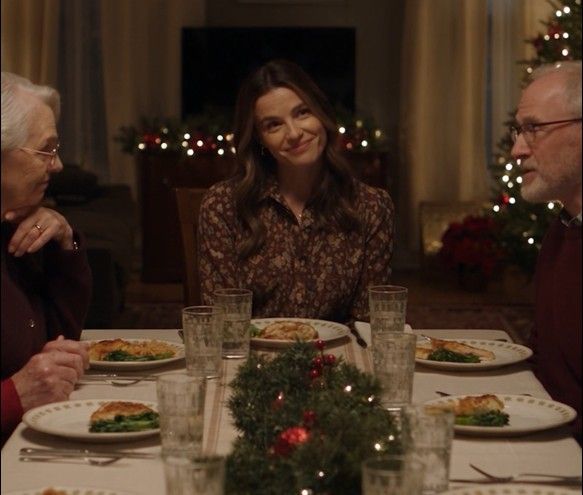
On Christmas Eve, I set one place for myself at the head of the table. I put Richard’s old recipe for cranberry bread beside my plate and lit a candle for him. The cast was gone. My foot rested flat on the floor. When the doorbell rang, it was Ellen carrying a pie, invited for dinner.
She asked, “Are you safe?”
I looked around the room I had reclaimed and smiled. “Yes. And I’m home.”
