Henry had always refused to let strangers use the dock when there wasn’t a qualified supervisor present.
He’d taught our children why weather and water demanded respect.
Now our son was promising privileges he hadn’t bothered to check.
I told Megan to refund the guests.
She said the deposits had been invested and could not be returned immediately.
Robert looked sick.
For the first time, he seemed to understand that we were discussing other people’s money, not merely my irritation.
A woman carrying a child asked where the life jackets were.
I told her the dock was off-limits.
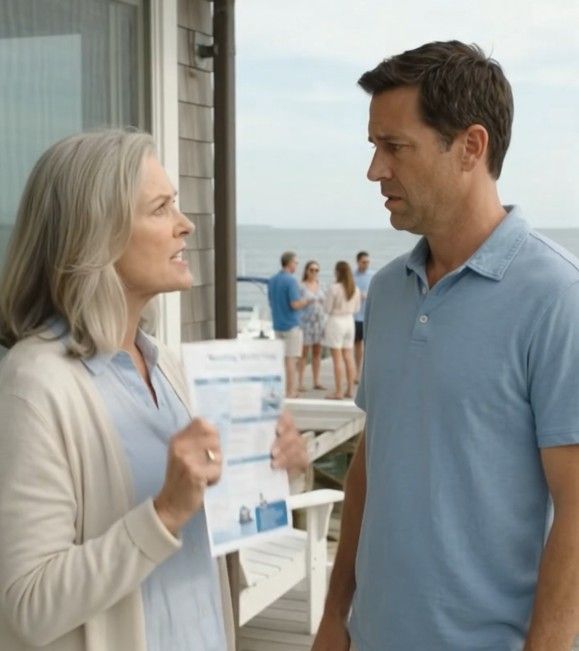
She showed me the activity schedule she’d received that morning.
It listed a sunset boat tour organized by an instructor I didn’t recognize.
Then I noticed the instructor’s last name.
It was my husband’s.
Megan had apparently invented a guide called Henry Collins Jr., although Henry and I had never had a son by that name.
“Who is this person?” I asked Robert.
He looked at the brochure, then at the water.
“Mom,” he whispered, “Megan told me Dad’s old boating license was still valid.”
I looked toward the dock.
A group of guests was already gathering there, waiting for someone to lead them onto the water.
I started running before Robert finished speaking. The deck boards were damp beneath my shoes, and the music from the house thudded behind me as if another party were happening in another world. At the end of the path, seven guests stood on the closed dock beside a white motorboat I had never seen before. A little girl was leaning over the loose railing to look into the water. Beyond her, a young man in a navy cap was checking the boat’s fuel line. He wore a badge that read HENRY COLLINS JR.
“Everyone back on shore,” I called. My voice disappeared into the wind. I shouted again, louder, and moved straight toward the girl. Her mother lifted her away from the railing. The young man raised a hand. “We’re almost ready for the tour.” I pointed to the rotting board beneath his feet. “This dock is closed. There is no tour. And you are not Henry Collins’s son.” The man stared at me. The music cut off behind us. Robert had finally turned it down.
Megan came hurrying across the grass. She told the guests there was a last-minute scheduling issue. The man in the cap took off his badge and said he had been hired through an online events listing. He believed the house was an established private club and that the boat’s owner had approved the route. He showed me a digital contract. The name on the organizer’s line was Henry Collins Jr., and the attached qualification document contained a photograph of my husband, who had been dead for three years. My knees nearly gave way. Megan reached for the screen. The young man stepped back.
A gust moved across the water. The boat surged against its rope, and one of the weakened cleats pulled halfway out of the wood. The sound was unmistakable: a dry, brutal crack. I ordered everyone off the dock immediately. Robert ran forward and helped the guests onto solid ground, one at a time. The little girl’s sandal fell between two planks. Her mother started to reach for it. “Leave it,” I said. “Nothing out there is worth your life.” When the last guest stepped onto the path, the cleat tore loose and struck the railing. The boat swung sideways. We watched it move without a single person speaking.
I called the harbor safety office and the marina that serviced the area. The young man called the boat’s rental operator. Nobody sailed that evening. The boat was secured by a qualified crew after the authorities checked the situation. For an hour I stood near the path explaining that no one had permission to use the dock, no one had permission to sell access to the house, and no child should have been promised a sunset tour from a structure visibly under repair. Each explanation made my chest feel tighter. I had come for an ordinary weekend beside the ocean. I was now trying to keep strangers safe from a business built on my grief.
The little girl’s mother approached after the officials arrived. Her name was Leila, and her daughter was Sophie. Leila said she had purchased a family membership because the brochure promised supervised coastal activities. “I trusted the safety information,” she told me. She wasn’t accusing me. That made the shame sharper. I showed her the repair warning taped to the gate, which someone had removed and stuffed behind a flowerpot. “I would never have invited you here under these conditions,” I said. She squeezed Sophie’s hand. “Then help me make sure whoever did knows what they almost caused.”
Megan was furious that I had involved the authorities. She said I had destroyed Robert’s opportunity and made their guests suspicious. I looked at the railing swinging against a single bolt. “They have a right to be suspicious.” Robert stood beside us with a splinter lodged in his palm. He had scraped it while helping people across the dock. He didn’t mention the pain. “How many memberships?” he asked Megan. She said that was not a conversation for the lawn. He repeated the question. Finally she whispered, “Twenty-eight.” The party had only thirty guests. I understood that most of the strangers in my house had not come to celebrate anything.
We moved into the dining room after the harbor officer had documented the danger and confirmed the dock would remain closed. Megan produced a laptop. Her membership page advertised an exclusive coastal network with scheduled retreats, a private marina experience, and priority use of the family home. Robert’s name appeared as a founding partner. My husband’s name appeared beneath a photograph taken the summer before his illness. The page called him the club’s original maritime director. My throat tightened. She had not simply borrowed his credentials. She had turned a dead man’s reputation into a sales feature.
Robert said he had approved a promotional dinner, not paid reservations or boat excursions. Megan said he was lying to save himself. She showed him a message in which he agreed the property could be described as the project’s “base.” He stared at it. “I meant people could meet me here,” he said. “You knew I didn’t have Mom’s permission.” I raised a hand. I wanted them to stop arguing about which of their misunderstandings was most convenient. Neither of them had the authority to offer access. Robert had known that before the first deposit arrived, and Megan had known it when she printed the brochure.
I asked to see the accounts. Megan refused. Robert looked at her and said that if she had taken money using my address, the guests would need a clear record for refunds. She opened a spreadsheet. The amounts made the room tilt: deposits, introductory fees, private booking supplements, and a costly promise of future boating lessons. Some payments had been spent on advertising, catering, and a consultant Robert had never met. Others had gone toward his failing business. Robert put his hand on the table as if he needed it to remain upright. “You told me those were investor advances,” he said.
Megan said she had only done what was necessary because nobody believed in Robert’s ideas. “Your mother sits on a beautiful house and won’t use it,” she snapped. “Do you know what people would pay for this place?” I thought of Henry kneeling in the sand to repair the porch after a storm, of our children tracking wet footprints down the hallway, of the days I had barely been able to breathe after his funeral. “I know what it costs to care for it,” I said. “And it costs more than admission.”
