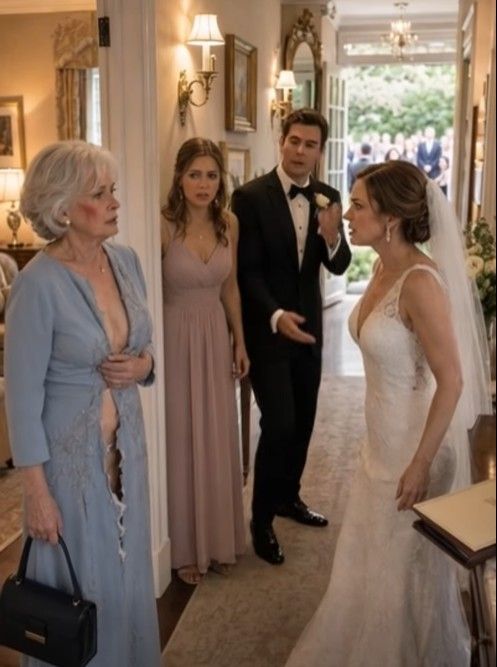
Then came the silence the story needed. For a few breaths, nothing moved. Everyone understood that the old arrangement had ended and could not be restored simply by pretending the confrontation had been a family misunderstanding.
A later review forced everyone to revisit the facts without the heat of the original confrontation. Claire arrived with notes and did not rely on memory alone. Ethan, Lauren, and Natalie Greene from Bellamy House came prepared to answer for what each person had seen or done. The central evidence—the cream Bellamy House contract showing Claire was the only person authorized to approve the wedding—was examined alongside the surrounding record. No one was permitted to replace a document, timestamp, message, account entry, or witnessed action with a vague claim that intentions had been good.
Madison tried once more to reduce the conflict to a family disagreement. This time the language did not work. The question was no longer whether people loved one another. The question was whether consent had been respected and whether the facts had been manipulated. Those are narrower questions, and narrow questions are difficult to escape.
Claire answered only what was asked. When emotion rose, Claire paused instead of apologizing. That pause became a form of strength. By the end of the review, even people who had been reluctant to take sides could see that neutrality had never meant pretending nothing happened. It meant being willing to follow the evidence wherever it led.
Afterward, Claire discovered that justice and relief were not the same sensation. Relief arrived first as exhaustion. The body released what it had held through the confrontation, and ordinary tasks became strangely difficult. Claire sat alone at times and replayed sentences that no longer required an answer. Anger returned unexpectedly. So did grief for the version of a mother-son relationship that had existed before trust became conditional.
Ethan apologized for telling Claire not to make a scene after she reported being hit. Lauren admitted she had stayed silent near the bridal suite because she feared ruining the wedding. Claire made clear that preserving a ceremony was never more important than stopping violence
Those conversations were slower than the confrontation. People paused before touching. Apologies had to include details. “I am sorry you felt hurt” was not enough. The healing words were the ones that named behavior: I believed the wrong person. I stayed silent. I let you stand alone. I treated access as permission. I should have asked you directly.
Claire accepted some apologies and declined others. Forgiveness, where it became possible, was separated from access. Reconciliation, where it happened, came with conditions strong enough to protect the future rather than romanticize the past.
One private conversation became more important than any public consequence. Claire sat across from someone whose silence or hesitation had hurt during the original event and asked a question that had been avoided: “When did you first know something was wrong?” The answer came slowly. It included fear, excuses, and the uncomfortable admission that noticing harm is not the same as stopping it.
Claire listened without rescuing the speaker from shame. Healing required room for remorse, but it did not require Claire to pretend the delay had been harmless. They talked about the exact moment help should have arrived, the sentence that should have been challenged, and the choice that would have made the scene safer. Naming those specifics turned apology into something usable.
Before they separated, Claire set one concrete rule for the future: concerns would be brought directly, not discussed around Claire; decisions would be requested, not assumed; and any person who ignored a clear no would lose access until trust was rebuilt. The rule sounded simple. That simplicity was what made it powerful.
Weeks turned into a more stable rhythm. Claire repaired the dress later for herself, limited contact with Madison, and required Ethan to rebuild trust without using family events as pressure. The first peaceful days felt almost suspicious because no one was demanding an immediate response. Claire had to relearn that a ringing phone could remain unanswered, that a closed door could stay closed, that a financial or legal document could be read twice before signing, and that “no” did not require a paragraph of justification.
The supporting people found their own closure too. Lauren apologized for silence. Natalie kept the venue decision professional. Ethan eventually acknowledged that asking Claire to absorb violence for the ceremony had been a betrayal of his role as her son. No one was allowed to disappear conveniently after helping create the harm. Those who had been complicit had to face what they had enabled; those who had tried to help were finally able to stop carrying secrets alone.
That mattered because Claire did not want a victory built on another person being silently erased. The new peace had to be honest enough to include what everyone had done.
Peace was tested before it could be trusted. A new invitation, request, or practical decision arrived carrying just enough resemblance to the old pattern to make Claire tense. This time nobody rushed the answer. Claire asked for the details in writing, took time to think, and spoke to a person who had no stake in the outcome.
When Claire finally responded, the answer was respected the first time. No one grabbed a phone, changed a story, raised a voice, or produced an audience. The absence of pressure felt almost surreal. Claire noticed the old instinct to prepare a defense and then realized a defense was not necessary.
That ordinary moment became proof of recovery. The crisis had changed procedures, but more importantly it had changed expectations. People around Claire were learning that access was not ownership, help was not authority, and love did not turn consent into a technicality. Claire went home from that small test with less adrenaline than before and more confidence that safety could become normal rather than temporary.
The final beautiful twist came when months later, Ethan returned the pearl earrings David had given Claire after she had left them in the sitting room. He had repaired the clasp himself. Claire wore them to a quiet family dinner—not a wedding—where no one asked her to sacrifice dignity for a photograph
For a moment, Claire could not speak. The surprise did not create a new danger or reopen the old conflict. It reached backward and illuminated something that had been present all along: a gesture, document, object, promise, or quiet act that had seemed small before the truth changed its meaning.
Claire laughed through tears, not because everything had become perfect, but because the future suddenly contained something besides defense. After so much time spent proving what had happened, Claire was being offered a chance to build something.
The gift of the twist was not money, property, or vindication by itself. It was agency. Someone had finally left room for Claire to choose.
The last months of the year settled the story into ordinary life. Claire and Ethan met in neutral places for months. Reconciliation developed only when he stopped explaining Madison’s behavior and began naming it accurately. There were meals where nobody fought. Mornings when the most important decision was whether to open the curtains. Evenings when the phone stayed silent and the silence felt kind.
Claire still remembered what happened. Healing did not require amnesia. A particular phrase, object, doorway, or date could still tighten the chest. But the memory no longer dictated the next action. Claire could notice fear and then continue. Could miss someone without inviting the old danger back. Could love a person and still require distance.
That was the emotional release nobody had been able to promise at the beginning: not a life without scars, but a life in which scars were no longer instructions.
Claire fastened the repaired pearls, smoothed an intact dress, and walked into a room where her son stood up to greet her instead of asking her to disappear
Claire paused there for a moment and listened. No one was arguing in another room. No document waited for a secret signature. No one was reaching for a phone, key, chair, account, door, or decision that belonged to Claire. The world had become small in the best way: light, breath, familiar objects, the presence of people who had earned the right to stay.
Claire let the shoulders drop. The next breath came without permission. And when Claire finally moved, it was toward a life that felt less like something survived and more like somewhere home could begin again.
There was one more test before Claire trusted the peace. A new request arrived that resembled the old pattern just enough to make the body tense. This time Claire did not answer immediately. The request was written down, checked against the record, and discussed only with people who had no interest in the outcome. When the facts were clear, Claire answered in one sentence and did not apologize for taking time.
That small episode showed how much had changed. Before, urgency had been a weapon. Now time belonged to Claire. Before, other people defined what counted as reasonable. Now reasonableness included safety, consent, and the right to verify. The result itself mattered less than the method: no pressure, no hidden audience, no punishment for asking questions.
Later, Claire realized this was what rebuilding actually looked like. It was not one grand speech after the villain fell. It was a hundred ordinary moments in which the old reflex appeared and a new choice followed. Each new choice made the next one easier. Each calm boundary turned survival into habit, and habit into peace.
