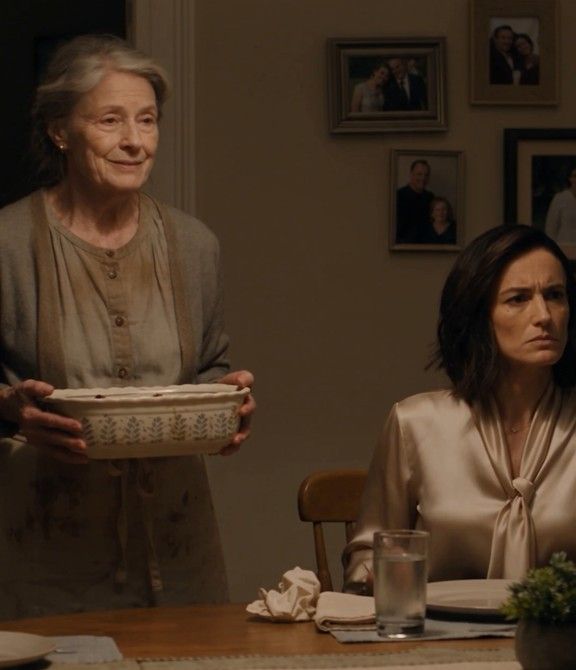
“Grandma’s hands are dirty. I want Mommy to peel my shrimp.” My grandson pushed his plate away as my sixtieth birthday dinner went cold in front of me.
My son Ryan barely looked up. His wife Megan smiled, pulled on disposable gloves, and agreed that old people carried too many germs. I sat at the table after cooking all morning, my fingers resting on the pocket that held my late husband Arthur’s old voice recorder.
It had been my birthday since five o’clock that morning. Nobody had mentioned it.
Before sunrise I made pancakes for Ryan, a green smoothie for Megan, and breakfast for Leo. Megan stormed downstairs wearing a white face mask, furious that the pan was making noise. When I tried to tell her what day it was, she cut me off.
“Being sixty doesn’t mean you can stop doing your share.”
I had spent forty years serving meals to people I loved. Since Arthur died, that familiar work had become something else. The chores expanded. Gratitude vanished. Invitations to sit down became instructions to hurry up.
Later that morning I took Arthur’s photograph from the closet. He was forever fifty-five in that picture, smiling as if the world still had time for us. The fleece robe he bought me was thin now, but I wore it because it was the only thing in that house that seemed to remember I mattered.
I found his small digital recorder in a drawer. He had once used it to leave personal messages when illness made speaking difficult. I never erased them. I slipped the device into my pocket and pressed record, not to punish anyone, but because I had begun doubting my own memory of what happened in our home.
When relatives arrived for dinner, Megan demanded to know why I had not finished cooking. Ryan told me to hurry if I was still capable. I tied on my apron and served the dishes anyway.
Nobody asked whether I had eaten. Nobody noticed I had spent the day standing.
And now Leo was repeating what he heard at home: that I was unclean, burdensome, something to be kept at a distance. The sentence hurt almost as much as watching Ryan accept it with a shrug.
I looked at the recorder under the table. Its tiny red light was still on.
“Ryan,” I said, “do you remember what today is?”
He frowned. Megan reached for another shrimp.
Then Leo announced, “Mommy said Grandma has to leave soon anyway.”
Every spoon at the table seemed to stop. Megan stared at him. Ryan put down his glass too quickly.
“Leave?” I whispered.
Leo pointed toward the hallway closet where Arthur’s photograph had been kept. “She said the papers are ready.”
I did not move my hand toward the recorder. I looked instead at Leo, who had returned to peeling the label from his juice bottle as though he had mentioned the weather. Across the table Megan was holding a shrimp between gloved fingers. Ryan’s wineglass hovered halfway to his mouth. For years I had learned to recognize the moment before a family argument swallowed my words. This time I let the silence stay until someone else could no longer bear it. “What papers?” I asked my son, not the child.
Ryan set the glass down. “Mom, Leo doesn’t understand what he’s talking about.” Megan said the same thing half a second later, too quickly. I looked at them both. “Then tell me what he misunderstood.” They exchanged a glance. Leo pushed his chair back and asked whether he could watch television. I told him yes. I wanted him out of a conversation his parents should never have forced him to carry. He slid from his chair, leaving a little smear of sauce on the tablecloth. Nobody told him to clean it up.
When the room was quiet, Megan folded her gloves into a ball. She said they had been researching options for older people who needed more support. She used phrases like appropriate environment and professional care. I asked what help she believed I needed when I had spent the entire day preparing food for twelve people. Her expression tightened. “That’s exactly the problem. You get tired and then make everyone feel guilty.” Ryan stared at the table. I heard the tiny internal click of Arthur’s recorder against my skirt and reminded myself to breathe.
The papers, it turned out, were brochures and an unsigned inquiry form for a low-cost senior residence nearly two hours away. Megan had marked possible moving dates. Ryan had written my name on a family contact section but had not obtained my signature or arranged an assessment. They believed that, because I had been living under their roof, they could choose where I should go next. There was no legal order and no authority transferring my decisions to them. Their certainty came entirely from the assumption that I would do whatever they demanded.
I asked Ryan why he had not spoken to me. He said he did not want to upset me until everything was settled. “Everything about whose life?” I asked. He kept turning his napkin in his hands. I had spent forty years ironing his school shirts, saving receipts, filling lunchboxes, and smoothing the way when he disappointed himself. Even now I wanted to make his discomfort smaller. That instinct was so deep it felt like love. I stayed in my chair and refused to do it.
“Today is my sixtieth birthday,” I said. Megan raised her eyebrows, as though age were a point in her argument. Ryan looked startled. The time he took to remember was painful. I pulled the recorder from my pocket and laid it on the table. Its little red indicator shone between the dishes. “I started recording this morning because I was beginning to wonder whether the things you said were really happening,” I told them. “I don’t intend to publish anybody’s voice. But I will not be told I imagined how you treat me.”
Megan stood so abruptly her chair struck the wall. She accused me of spying, threatening, and trying to embarrass them. I told her she could have a different opinion about recording and that I would handle the file responsibly. But her discomfort did not erase the words she had spoken to me. I switched the recorder off and put it back in my pocket. I did not play it for the guests or turn my birthday into a spectacle. I asked the relatives still at the table to take dessert home. Most left quietly, confused and uncomfortable. My sister held my shoulder briefly before she went.
Ryan followed me into the kitchen. “Mom, can’t we talk tomorrow?” he asked. I looked at the sink full of pans. For one wild second I wanted to tell him that he could wash them himself. Then I realized I didn’t need the sarcasm. I took off my apron, folded it, and placed it beside the stove. “We can talk tomorrow,” I said. “Tonight I’m going to my room. I am not cleaning up. And you will not make arrangements about where I live without speaking to me.” Ryan opened his mouth. Nothing came out.
I sat on the edge of my bed holding Arthur’s photograph. In the picture he was fifty-five, smiling at the camera from an ordinary summer afternoon. His old fleece robe lay across my knees. When illness took him, I had promised to keep the family together. For years I interpreted that promise as an instruction to give away every useful hour I had. What if he had meant something gentler? I took out the recorder, rewound the newest file to confirm it had saved, and placed it in the drawer rather than listening again. I did not want to hear my own humiliation for entertainment.
The next morning I called my sister. She arrived with coffee and a small box of pastries, set them on the bedroom dresser, and said, “Happy birthday, a day late. I should have come sooner.” I laughed, then cried hard enough that she sat beside me. She listened while I explained the residence brochures and the missing cake. She didn’t tell me to forgive or run away. She asked what I wanted. I had no quick answer. So many years had been spent meeting other people’s needs that the question felt like a foreign language.
I began with something small. I wanted a place where I could wake up without being frightened of making noise. I wanted to eat meals while they were hot. I wanted to see Leo because I loved him, but not as an unpaid obligation. I wanted to keep Arthur’s photograph where I could reach it. My sister repeated these wishes in a calm voice. None sounded extravagant. Hearing them together made me realize how little I had been allowed to ask for and how much energy I had spent pretending it was enough.
We reviewed my finances that afternoon. After Arthur’s death I had sold our modest townhouse and contributed part of the proceeds toward Ryan’s family home, with the understanding I could live there and share expenses. My contribution was documented in bank statements but had not been converted into any promise of ownership or a clear occupancy agreement. I had kept the rest of the money in accounts under my name. Ryan sometimes implied that he had rescued me by offering a room. I had never challenged the story because I was grateful to be near my grandson.
