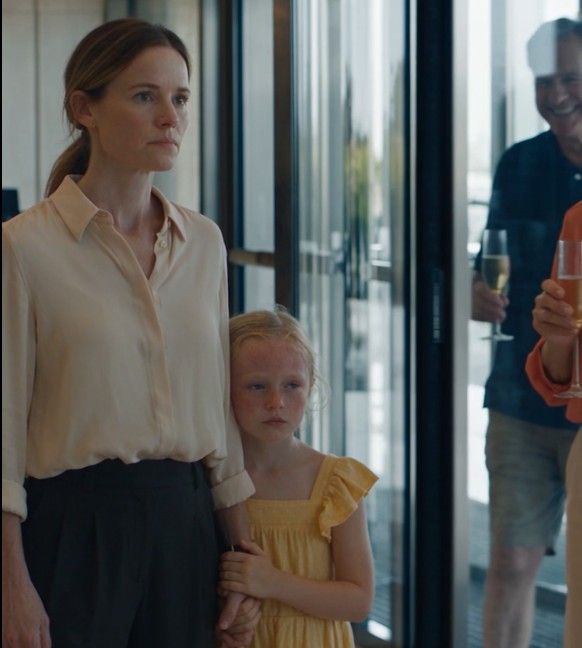
“I have seen the footage, Mom.”
Silence.
“I have seen the footage,” I repeated. “I watched you close that door. I watched you slide the latch. I watched you adjust your sunglasses and walk away like nothing happened. Like she was nothing.”
“I didn’t—”
“She’s not nothing.” My voice was steady. Calmer than I expected. “She is everything. She is the best thing I have ever done. And you will never be alone with her again. Not for a minute. Not for a second. Not for the rest of your life.”
“You’re being dramatic,” my mother hissed, and the word landed like a slap. There it was. The same word. The same weapon. The one she had used on me when I was small. The one she had used on Lily through that locked door.
“No,” I said. “I’m being clear. For the first time, I’m being completely clear.”
I hung up.
I didn’t shake. I didn’t cry. I felt something settle inside me — not anger, not sadness, but a quiet, solid certainty. The kind of certainty that comes when you finally stop asking someone to love you the right way and start protecting the people who need you.
Emily came to the hotel that afternoon. She knocked softly and stood in the doorway with red-rimmed eyes and a box of Lily’s favorite cookies from the bakery down the street.
“Can I come in?” she asked.
I looked at her for a long moment. Emily, who had always been the peacekeeper. Emily, who had always told me to let things go, to keep the family together, to not make waves. Emily, who had sat on that boat while her niece was locked in a room.
But Emily, who had also stood in that lobby and broken. Who had looked at our mother and said what I had spent thirty-four years unable to say. Who was here now, holding a box of cookies, looking at me with a rawness I had never seen in her face.
“Yeah,” I said. “Come in.”
Lily was sitting on the bed coloring. She looked up when Emily walked in.
“Hey, bug,” Emily said, her voice catching on the nickname.
“Hey, Aunt Em.” Lily studied her face. “Are you okay?”
Emily pressed her lips together hard. She blinked several times. Then she walked over and sat on the bed and opened the box of cookies.
“I’m getting there,” she said. “Are you?”
Lily considered this with the serious, thoughtful expression that always made my heart ache. “Mom kept me safe,” she said finally. “So yeah. I think so.”
Emily looked at me. Her eyes were full of something enormous and broken and rebuilding.
“I’m so sorry,” she whispered. “I should have checked. I should have asked. I should have known. I will never forgive myself for not knowing.”
“I know,” I said.
“Can I—” She stopped. Tried again. “Can I do better? Can I be someone she can trust?”
“That’s not up to me,” I said. “That’s up to you. Every day.”
She nodded. She wiped her face with the back of her hand. Then she turned to Lily and held out a cookie.
“Double chocolate chip,” she said. “Your favorite.”
Lily took it. She took a bite. Then she leaned against Emily’s side, just slightly, and Emily went very still, like she was holding a baby bird, terrified of doing the wrong thing, and then very carefully she put her arm around my daughter.
I sat in the chair by the window and watched them. The last of the afternoon light came through the curtains and laid itself across the bed like a golden blanket. Lily’s eyelids grew heavy. The cookie slipped from her fingers. Emily kept her arm around her, gentle and still, and I could see the shape of a promise forming in the way she held her — not the flimsy promises of our childhood, the ones that dissolved the moment they were tested, but something heavier and truer. Something that would cost her. Something she would pay gladly.
The hearing was three weeks later.
