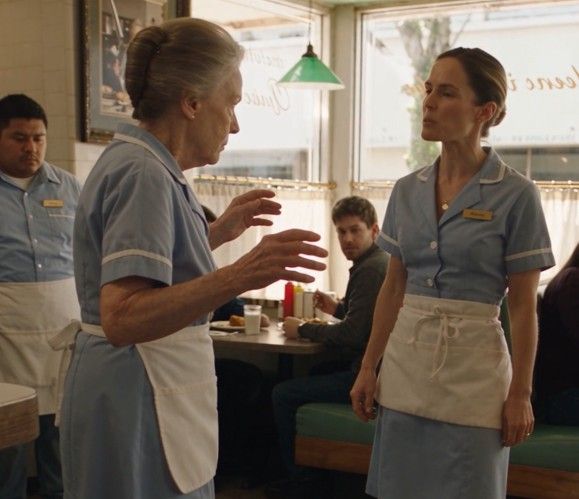
The tray hit the floor before Margaret Collins could finish saying lunch was ready. “Take that garbage somewhere else,” Vanessa snapped. Plates shattered across the restaurant. Rice scattered beneath a booth. A bowl spun once, struck a chair leg, and cracked. Someone in the kitchen dropped a metal spoon. Then everything went still. Margaret stood beside the ruined food with both hands raised as though the tray were still between them. Vanessa seemed almost pleased by the silence. “This is a restaurant,” she said. “Not your personal charity kitchen.” Margaret slowly lowered her hands. Three servers stared at the floor. Luis, one of the dishwashers, stepped forward. Vanessa pointed at him. “Don’t.” He stopped immediately. Margaret saw the tension in his face. She saw it in everyone else too. They all knew her. That was what made their silence hurt. Margaret crouched beside the broken dishes. “What are you doing?” Vanessa asked. “Picking up what you threw.” “Leave it.” Margaret lifted one unbroken plate. Vanessa nudged it away with the toe of her shoe. The ceramic scraped across the tile. A teenage busser flinched. Margaret’s jaw tightened. She said nothing. Only two lunch customers remained near the windows. Both had stopped eating. One looked embarrassed. The other watched openly. Vanessa smiled toward them. “Sorry about the disruption.” Then she turned back to Margaret. “You can go now.” Margaret rose carefully. At seventy-two, she moved slowly, but there was nothing defeated about her. Vanessa had spent months mistaking restraint for weakness. Margaret brushed rice from her sleeve. “I brought lunch for the staff.” “I know.” “They’ve been working since six.” “I know that too.” Vanessa laughed. “That doesn’t make them your children.” “No.” Margaret looked toward the kitchen. “It makes them people.” Something changed in the room. Vanessa felt it too. Her smile disappeared. “You don’t get to undermine me in my own restaurant.” Several employees lowered their eyes. Margaret studied her. “Your restaurant?” Vanessa stepped closer. “You heard me.” Margaret did not argue. The silence irritated Vanessa more than any answer could have. She pulled a napkin from a nearby table, wiped an invisible mark from her hand, then tossed it onto the scattered food. “Starting tomorrow, don’t come here anymore.” Luis looked up. So did Megan, the morning manager. Margaret noticed both reactions. Vanessa did too. “What?” she demanded. Nobody answered. “I said, what?” Megan swallowed. “Nothing.” Vanessa faced Margaret again. “You confuse people when you walk in here.” “How?” “You act like you still run the place.” Margaret glanced toward the framed photographs beside the register. One showed the restaurant sixteen years earlier. The walls had been pale green. The sign outside had been hand-painted. Margaret stood in the photograph wearing an apron, holding oversized scissors. Vanessa followed her gaze. “That was a long time ago.” “Yes.” “You retired.” “I stepped back.” “Same thing.” “No.” Vanessa’s eyes narrowed. Margaret looked down at the ruined lunch. “I made the chicken soup myself.” Vanessa exhaled sharply. “That’s exactly what I mean. You come here with soup, pies, casseroles, advice, stories.” She pointed toward the employees. “Then they look at you instead of me.” Margaret’s brow lifted slightly. “That bothers you?” “It causes confusion.” Margaret finally looked directly at her. “No.” Her voice remained calm. “It causes comparison.” Vanessa stared at her. Around them, nobody moved. Not Luis. Not Megan. Not the servers who had spent the entire confrontation looking at the floor. And for the first time since the tray crashed, every pair of eyes in the restaurant was on Vanessa.👇
Margaret let the silence remain exactly where it was. Then she bent, picked up the napkin Vanessa had tossed onto the food, and placed it on the nearest table as neatly as if she were resetting a place setting.
Vanessa was the first to break eye contact. “Everyone back to work,” she said. Nobody moved quickly enough to satisfy her. Margaret looked at Megan. “Please close the dining room for ten minutes after our last two customers leave. They should not have to eat in the middle of this.” Vanessa snapped, “You do not give orders here.”
Margaret’s gaze returned to the old photograph. “That is the question, isn’t it?” she said. She took out her phone and called the restaurant’s accountant, not on speaker, not theatrically. “Paul, I need you here this afternoon with the current operating agreement and ownership ledger. Yes, today.” Vanessa’s face changed before Margaret ended the call.
“You are unbelievable,” Vanessa said. Margaret answered, “No. I have been absent.” That distinction quieted Megan more than any threat could have. Margaret turned to the staff. “Finish service. Nobody is being asked to choose sides. Nobody loses a shift for what they saw today.” Vanessa started to object. Margaret raised one hand. “Not another word about their schedules until the review is complete.”
Luis crouched to gather the broken ceramic. This time Margaret crouched beside him. Vanessa watched the two of them work. “You are doing this to humiliate me,” she said. Margaret placed a shard in the bus tub. “No. I am cleaning the floor. The humiliation came from throwing food at someone in front of employees and customers.”
Megan waited until Vanessa walked into the office before approaching. Her voice was low. “There are things you should see.” Margaret felt a cold weight settle beneath her ribs. “About today?” Megan shook her head. “About months.” She had dates, altered schedules, messages sent after midnight, and notes from employees who had been afraid to complain.
Margaret did not ask Megan to hand everything over in the dining room. “Make copies. Keep the originals where they are. We will do this properly.” It was the first decision of the afternoon that made Megan’s shoulders lower instead of rise.
The next decision was Margaret’s. She chose to stop protecting Vanessa from the consequences of speaking as though ownership and authority were the same thing. She did it without a speech designed to wound Vanessa. That mattered to her. Boundaries, she was beginning to understand, did not need cruelty in order to be real. They needed consequences that remained in place after the emotion of the room had faded.
Megan and Luis became important not as a rescuer, but as a witness to what was already true. Margaret refused to let anyone turn the conflict into gossip or a public spectacle. She asked for facts, dates, copies, and quiet. The more carefully she moved, the less room there was for Vanessa to claim that everything had been caused by a misunderstanding.
What emerged was specific: Margaret still owned the controlling share of the restaurant company; she had stepped back from daily management but had never transferred her ownership, and Vanessa’s role was operating manager under an agreement that required respectful treatment of staff and compliance with company policies. Nothing about that fact magically erased the emotional injury. It simply removed the fog that had allowed pressure to masquerade as entitlement. The relevant record was equally concrete: the operating agreement, payroll records, staff complaints Megan had documented, and the ownership ledger kept by the restaurant’s accountant.
Margaret read every page and message before making another decision. She did not want revenge assembled from anger. She wanted a future that could survive being examined the next morning. That was the standard she had failed to apply earlier, when keeping family peace had seemed more urgent than naming a pattern.
Vanessa reacted first with disbelief, then with argument. The language shifted quickly: intent, misunderstanding, gratitude, family, embarrassment. Margaret listened until the words began circling back on themselves. Then she said, “I am not asking what you meant to feel. I am telling you what you chose to do.” The distinction stopped the conversation more effectively than shouting would have.
The practical consequence followed: Vanessa was removed from day-to-day management after a formal review, while Margaret refused to turn the restaurant into a revenge stage and instead appointed Megan interim manager with clear safeguards for the staff. It was not clean. There were tears, angry pauses, doors closed too firmly, and long stretches when nobody knew what to say. But the old arrangement—where Margaret absorbed the discomfort so everyone else could call the family peaceful—was over.
For the first several days, Margaret slept badly. Her mind replayed tiny details more often than the obvious insult: a lowered gaze, a hand on an object, a sentence delivered as if her compliance had already been decided. She had spent years believing that maturity meant being the person who could endure the most without making trouble. Now she wondered how often that belief had trained other people to expect endurance from her.
She wrote down what she needed before the next conversation. No insults disguised as jokes. No decisions about her property, body, room, money, labor, or place in the family made without her. No asking her to protect another adult from the consequences of that adult’s behavior. The list looked almost embarrassingly basic. That was what made it painful.
When the next family conversation happened, Margaret brought the list but did not read it like an indictment. She put it on the table and said, “These are the conditions under which I can stay connected without disappearing.” Nobody was asked to agree that she had been perfect. They were asked to agree that respect was not a reward for obedience.
The hardest part was not dealing with Vanessa. It was allowing the people she loved to sit inside their own discomfort. Margaret had always rushed to soften apologies, to say she understood, to rescue a guilty face with a reassuring touch. This time she let silence do honest work.
Luis and the younger employees finally spoke about how often they had stayed quiet because they feared losing shifts, and Margaret apologized for mistaking her own distance from daily operations for proof that everything was fine. The admission did not restore trust by itself. Margaret said so. “Trust is not a sentence you say. It is a pattern I get to observe.” That became the rule for the months that followed.
There were practical repairs. Access was clarified. Expectations were written down where writing was useful. Family visits were shorter at first. Conversations ended when voices turned contemptuous. Nobody was allowed to recruit a child, employee, spouse, or bystander to carry messages between adults. The new structure felt formal only because the old one had depended so heavily on assumptions.
Margaret also examined her own part without accepting blame for someone else’s choices. She had often known when a boundary was being crossed and had waited for a larger offense before speaking. She had hoped patience would teach gratitude. Sometimes it had only taught people that she would remain available after being diminished.
One afternoon, alone, she took out the opening-day photograph. The object had seemed small during the confrontation, almost incidental beside the larger argument. Now it held the shape of the entire problem: who was allowed to decide where she belonged, what she owed, and how much of herself she had to surrender to keep a place near people she loved.
She did not throw it away. She cleaned it, folded it, framed it, stored it, or placed it somewhere visible according to what the object required. Keeping it was not about preserving humiliation. It was evidence of the moment she had stopped negotiating against herself.
Time did what dramatic confrontations cannot. It revealed which apologies were performances and which were beginnings. Some mornings brought no progress at all. Then came small acts: a question asked instead of an assumption, a pause before touching something that belonged to her, an invitation that included a real choice, a correction made without being demanded.
Vanessa did not transform overnight. Accountability was uneven and uncomfortable. There were moments of defensiveness and attempts to explain. Margaret learned to answer explanations with the same calm sentence: “I can understand why you felt something without agreeing that it gave you the right to do what you did.” Eventually the conversations became less about winning the old argument and more about preventing its return.
The people around Margaret changed too. Those who had watched quietly began to understand that neutrality can protect the person with more power. They stopped praising themselves merely for not causing conflict. They began asking what they had allowed while trying to avoid it.
By the third month, the family could spend an afternoon together without every silence feeling like a trap. That did not mean the past had vanished. It meant nobody needed to deny it in order to stay in the same room. The difference was enormous.
The most meaningful repair came through ordinary choices. Someone called before arriving. Someone returned an item to the place Margaret preferred. Someone asked, “Would you like help?” and accepted “no” without offense. These gestures would once have seemed too small to notice. After months of having choices made around her, they felt like architecture.
Then came the detail that changed the emotional meaning of an earlier moment: the chicken soup Vanessa had called charity was the same recipe served free to the construction crew on the restaurant’s opening week sixteen years earlier; Megan proposed making one staff meal each month under a simple name: The First Pot. Margaret sat with that discovery for a long time. It did not make the hurt necessary. It did not turn cruelty into a gift. Instead, it reminded her that the life surrounding the conflict contained older, kinder truths that nobody’s worst behavior could erase.
She allowed herself to grieve what she had wanted the family to be. That grief was different from despair. It made room for a more honest version of belonging—one in which love could include disappointment, distance, repair, and the possibility that some relationships might become smaller without becoming meaningless.
There was no grand ceremony when Margaret finally realized she felt safe again. It happened on an ordinary day. She noticed that she had gone several hours without rehearsing a defense in her head. Her shoulders were not raised. Her phone could ring without making her stomach tighten. Peace had stopped meaning silence. It had started meaning the absence of fear.
When another family gathering eventually came, Margaret arrived on her own terms. She knew where she would sit, how long she would stay, and that she could leave without asking permission. Nobody joked about the old conflict. Nobody demanded that she prove forgiveness by pretending it had never happened.
At the next conversation, Margaret asked one question at a time. She had learned that crowded arguments make escape routes for people who do not want to answer. “What did you know before that day?” she asked. Then she waited. “What did you decide without me?” Another wait. “What will you do differently when the same pressure appears again?” She did not accept promises that depended on everyone staying calm. Real change, she said, had to work precisely when people were upset.
The answer was imperfect. There were admissions followed by qualifications, apologies followed by the instinct to explain. Margaret stopped each qualification gently. “You can explain later. Finish the apology first.” It felt almost strange to insist on complete sentences after years of accepting fragments. Yet every complete sentence returned a little clarity to the room.
Outside the immediate conflict, daily life continued. Groceries still had to be bought. Bills arrived. Workdays ended. Weather changed. That ordinary continuity helped Margaret. It reminded her that the confrontation, enormous as it had felt, was not the whole of her life. She began making plans that had nothing to do with repairing anyone else.
She called friends she had neglected while trying to remain endlessly available to family. She returned to routines that belonged only to her. Some were small enough to sound silly when described aloud: coffee before checking messages, a walk without explaining where she was going, an afternoon spent reading with the phone in another room. Independence returned through minutes before it returned through major decisions.
People sometimes asked whether she was ready to forgive. Margaret disliked the question because it made forgiveness sound like a door she was rudely refusing to open. “I am not carrying revenge,” she said. “I am carrying information.” The information mattered. It told her which promises required proof and which situations required an exit.
That distinction made her softer in some ways, not harder. She no longer needed to win every disagreement because she no longer believed disagreement threatened her place in the family. She could say no without composing a courtroom argument. She could hear disappointment without rushing to cure it. She could love someone and still leave the room.
Gradually, the people who wanted a relationship with her adjusted. They learned that asking worked better than announcing. They learned that gratitude could not be demanded in exchange for basic decency. Most of all, they learned that Margaret’s calm voice was not evidence that nothing serious had happened.
One evening, a conversation drifted toward the original incident. For a moment everyone became careful. Margaret surprised herself by not needing to change the subject. She described one detail she remembered and then stopped. Nobody corrected her memory. Nobody told her she was too sensitive. The absence of denial felt more healing than any dramatic declaration.
She understood then that closure was not a final conversation in which every person agreed on every feeling. Closure was the end of compulsory confusion. The facts could remain facts. Her hurt did not need unanimous approval to have been real. Her boundary did not need a villain’s permission to be valid.
With that certainty, the future became less theatrical. There was no need for a triumphant last word. Margaret preferred evidence accumulated quietly: months without another humiliation, choices respected without punishment, and apologies that were followed by different behavior when nobody was watching.
There was laughter, but it was not forced. There were pauses, but they did not require anyone to disappear. At one point Margaret looked around and understood that reconciliation was not the restoration of the old arrangement. The old arrangement had been the problem. What they were building was smaller, slower, and far more real.
Before leaving, she touched the object that had come to symbolize the turning point—the opening-day photograph—and felt no rush of humiliation. Memory had changed its weight. It was no longer proof that someone had tried to reduce her. It was proof that she had finally refused the reduction.
On the next staff-meal afternoon, Margaret set the first bowl on the counter beneath the old photograph, and Luis slid a spoon beside it without anyone needing permission.
Margaret looked at the scene for a long moment before smiling. Nothing about the gesture erased what had happened. That was why it mattered. It belonged to a life that had made room for truth instead of requiring amnesia.
She had once believed peace was what remained when nobody objected. Now she knew better. Peace was being able to speak and still belong to yourself. It was a door you could close without terror and open without surrender. It was a chair, a room, a meal, a signature, a pair of hands—ordinary things returned to their proper size after someone had tried to use them as measures of worth.
And in the quiet that followed, Margaret did not need anyone to tell her where she belonged. She knew.
The restaurant changed after that day, but not because Margaret demanded loyalty from the staff. She asked for something harder: honesty. Megan documented the incidents employees had been afraid to report. Luis described the way Vanessa spoke to kitchen workers when no customers were nearby. Others added schedules, messages, and examples of decisions that had driven experienced people toward the door. Margaret listened without turning their frustration into a campaign. She wanted the business protected, and that meant separating personal anger from evidence.
Vanessa continued insisting that authority required toughness. What she could not explain was why toughness had so often meant humiliation. Once the records were reviewed, the consequences became unavoidable. Her management authority was removed. The restaurant adopted clear workplace procedures, and Megan was given responsibility for day-to-day operations while Margaret remained in the background as an owner who expected standards without demanding worship. Vanessa could no longer use the dining room as a stage on which everyone else had to prove obedience.
Margaret returned to the kitchen only occasionally. The first time, Luis asked whether she had brought soup. She laughed and said she had brought herself, which was enough work for one afternoon. Nobody treated her like a mascot or a rescuer. That mattered. The staff began rebuilding a culture in which meals shared after a long shift were kindness, not evidence of divided loyalties.
Several months later, Megan found the old grand-opening photograph beside the register and asked Margaret whether she wanted it moved to a more prominent wall. Margaret shook her head. The photograph did not need a spotlight. Instead, she asked Megan to hang a new staff picture beside it. In the new image, cooks, servers, dishwashers, hosts, and managers crowded together in front of the same hand-painted sign, laughing because Luis had blinked during the first three attempts.
Margaret studied the two photographs side by side. One showed how the restaurant had begun. The other showed why it had survived. She realized then that the lunch Vanessa had thrown to the floor had not been important because Margaret had cooked it. It mattered because it had been meant for people whose work deserved to be seen. On the next busy morning, Margaret arrived with no tray at all. She sat in a corner booth, ordered coffee, and watched the staff move through the room with confidence. For the first time in months, nobody looked toward her for permission. Margaret smiled. That was exactly what she had wanted.
