We were both afraid of the same emptiness. We had just chosen opposite ways to fill it.
“Vanessa,” I said.
She looked up.
“What you did was wrong.”
She nodded. The tears kept falling.
“You lied to your husband. You lied to your father. You tried to take my home. You stole money. You opened accounts in my son’s name. You erased me from my own life.”
She nodded again.
“And I understand why.”
Her face crumpled.
“That doesn’t make it acceptable,” I continued. “It makes it human. And being human doesn’t mean there aren’t consequences.”
Robert nodded slowly.
I turned to my son. “Eric. I love you. That has never changed and it will never change. But you need to decide what kind of life you want. Not with her. For you.”
He looked at me with those red eyes, and I watched him stand up straighter. I watched something harden in him — not cruelty, not bitterness, but the quiet, irreversible decision of a man who had spent too long being led.
“I want an honest one,” he said.
He looked at Vanessa.
“I think we need to separate.”
Vanessa’s breath caught. “Eric, please—”
“I need time. I need space. I need to figure out how much of the last two years was real and how much was — this.” He gestured at the dining room, the boxes, the stolen furniture, the rearranged life.
“It was all real,” she said. “I love you. I love Lily. I just—”
“You love the idea of what our life could be. You don’t love what it actually is. And you were willing to destroy my mother to get there.”
She opened her mouth, but nothing came out.
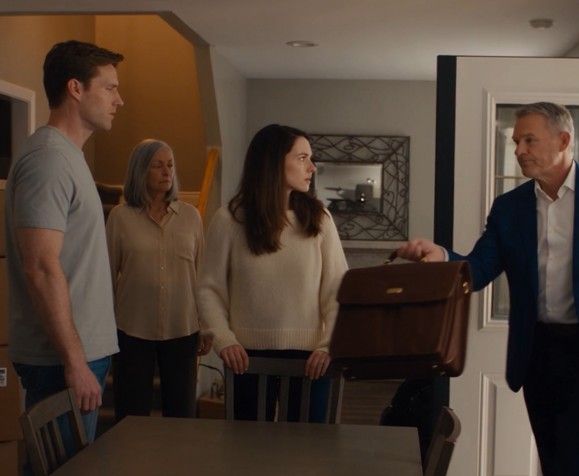
Robert closed his briefcase with a soft click.
“I’ll be staying at the Holiday Inn on Route 9 tonight,” he said to Vanessa. “You can call me if you need to talk. But I’m not giving you any more money. Not now. Not for a long time.”
He looked at me and extended his hand. I took it. His grip was firm and warm and slightly trembling.
“Thank you, Margaret. For giving me the chance to see what she’d become.”
“Thank you for bringing the truth,” I said.
He nodded to Eric, then walked out through the front door — the door that still had my nameplate missing from it. I heard his car start, the gravel crunch, and then silence.
Vanessa sat at the table for another ten minutes. Eric didn’t sit down again. Neither did I. The three of us existed in that room like strangers sharing a waiting room, bound together by something none of us had chosen.
Finally, Vanessa stood. She pulled her phone from her pocket, typed something, and set it on the table.
“I’ve transferred the eleven thousand back to your father’s account,” she said to Eric. “It’s all I have right now.”
He didn’t respond.
She picked up her purse from the counter. Walked to the door. Stopped.
“Lily is at your mother’s friend Diane’s house,” she said without turning around. “Diane is expecting you to pick her up at seven.”
Then she left.
The door closed behind her, and Eric and I stood in the wreckage of what she had built and what I had dismantled, and for a long moment, neither of us spoke.
Then my son did something he hadn’t done since he was a small boy.
He walked across the room and put his arms around me and held on.
I held him back.
“I’m sorry, Mom.”
“Don’t be sorry. You didn’t do this.”
“I should have seen it.”
“You saw what she wanted you to see. That’s not the same as being blind.”
He pulled back and looked at me. His face was wet, and he wiped it roughly with his sleeve, the way men do when they think no one is watching.
“What are you going to do with the house?” he asked.
I looked around. At the bare walls. The missing curtains. The boxes against the wall that held thirty-two years of my life with Arthur. The artificial scent in the air. The new carpet over the hardwood. The crib standing where his photograph had stood.
“I’m going to live in it,” I said.
He nodded. Then he picked up the fallen dining chair and set it upright. We stood there together in the quiet house, and I felt something I hadn’t felt in a very long time.
Not peace. Not yet.
But the beginning of it.
Three months later, on a cool October morning, I sat on the front porch with a cup of tea and watched Lily chase a butterfly across the lawn. She was two and a half now, with Arthur’s brown eyes and Eric’s stubborn chin, and when she laughed — really laughed — it sounded like someone shaking bells in a distant room.
