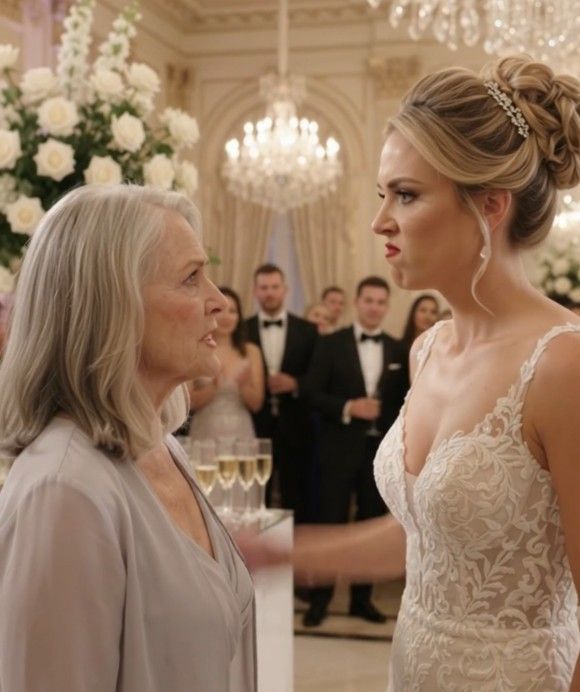
“Do you want to report the assault?” Evelyn asked. I stared at the photograph on my phone. “I want it documented,” I said. She explained the available options and helped me arrange to give a factual statement without turning it into a public spectacle. I didn’t know whether Tiffany would face a charge. That decision was not mine alone, and I refused to turn accountability into a promise of revenge.
What I did know was that I would not pay another bill for my son’s marriage. When the vendors sent their final statements, I checked them against the contracts. I settled what I actually owed, disputed a duplicate transportation charge, and closed the event account. The numbers were not magically transformed by my decision. A large part of my savings was gone. The cancellation stopped further harm; it did not erase the cost of my earlier choices.
Three days later, Daniel came to my porch alone. He looked exhausted, the careful shine of his wedding suit replaced by a wrinkled shirt. “They’re telling everyone you humiliated Tiffany on purpose,” he said. I handed him a glass of water. “Do you believe that?” He hesitated. That hesitation was an answer, though not the one he intended.
“I don’t know how to talk to her when she’s angry,” he admitted. Then he told me she had been furious that her father couldn’t make his toast with the imported champagne. She had spent the night insisting that the wedding was a disaster caused by me, and her parents had agreed. Daniel had tried to explain the expenses, but when she turned toward him, he stopped.
“You let her hurt me because you were afraid she’d be angry with you,” I said. He nodded once. “I kept thinking I’d deal with it later.” I had heard those words all through the planning: later, after the next deposit, after the honeymoon, after the wedding. I said, “Later came, Daniel. It was standing in the ballroom with a red mark on its face.”
He cried then, and I cried too. I did not invite him to move back home. I didn’t promise that every mistake could be repaired. I asked him to tell me exactly what he had seen, without excuses. He did. When he reached the part where Tiffany had pointed toward the door, his voice broke. “I should have stood beside you.”
A week afterward, I learned something that turned my grief into anger all over again. The venue manager forwarded a chain of messages because Daniel’s name appeared as the wedding contact. In one, Tiffany had asked him to make sure I didn’t see the revised champagne request until the reception. In another, Daniel had written that I would probably agree once everyone was already there. He had not ordered the bottle himself, but he had knowingly helped arrange the ambush.
When I confronted him with the messages, he didn’t try to blame Tiffany. “I thought if they put you on the spot, you’d say yes,” he said. “I knew you were uncomfortable. I told myself you’d get over it.” The worst truth arrived without shouting: he had counted on my love making me unable to refuse. I set the phone down between us and asked him to leave.
He waited at the door. “Mom, I am sorry.” I believed that he felt sorry. I didn’t yet know whether he understood what he had done. “Then learn to live differently,” I said. “An apology is not another bill you can hand me and expect me to pay.” He left without arguing, and I shut the door carefully because slamming it would not make me feel stronger.
Tiffany tried a different approach. She posted photographs of herself crying beside the unfinished wedding cake, claiming my sudden cruelty had deprived her of the day she deserved. I did not respond online. Instead I preserved the messages and spoke privately with relatives who asked. Some believed her. Some had witnessed the slap and would not be persuaded otherwise. The story spread because a public humiliation had already made privacy impossible.
Her father called me and said families should keep unpleasant matters among themselves. I reminded him that he had watched his daughter strike me and had said nothing. “I didn’t want to spoil the wedding,” he replied. “And what did you think it did to me?” I asked. There was a long silence. He ended the call without an apology.
Two months later, the official consequence of Tiffany’s conduct arrived. After reviewing statements and the available evidence, authorities required her to answer for the assault through the applicable legal process. She admitted striking me. The resulting penalty was modest compared with what I had lost, but the acknowledgement mattered. She could no longer insist, without contradiction, that nothing had happened or that I had imagined it.
The marriage began to fray in the same place it had begun: at the question of who was expected to give in. Daniel moved into a short-term rental after Tiffany demanded that he cut off contact with me as proof of loyalty. He called before coming over and told me what he had done without asking me to applaud him. “I don’t know if the marriage can survive,” he said. “That’s for you to decide with her,” I answered. “But it cannot be built on somebody else’s silence.”
I started rebuilding my own life in smaller amounts than the invoices I’d once signed. I reopened the savings account I had nearly emptied and set up an automatic monthly deposit. I sold nothing else. Nora insisted we visit a small garden center, where I bought two young apple trees. They were not replacements for the meadow, but planting them helped me remember that a loss could be mourned without controlling the rest of my life.
One Saturday, Helen arrived carrying a folder from the buyer of that meadow. I had avoided learning much about the sale beyond the price. The purchaser was a local family who planned to maintain the old orchard and protect the creek from development. Helen had spoken to them after hearing what happened. They wanted me to know that they had no intention of cutting down the two apple trees my husband planted.
I drove out to see them with the new owner’s permission. The grass was high, and the path had changed, but the trees stood where I remembered. One leaned slightly toward the creek. I touched its bark and thought of my husband steadying Daniel’s bicycle with one hand. Grief was still there; so was relief. Losing ownership had not erased every trace of the life we’d made.
The new owner showed me a small wooden sign he’d found among the trees. My husband had carved it decades earlier and nailed it to a post now fallen in the grass. It read, “Room to grow.” I laughed through tears. That was what he called the meadow when Daniel was little. The owner offered to return the sign, and I took it home like something rescued from water.
That evening Daniel called. He had begun counseling on his own after recognizing how often he avoided conflict and let others suffer for it. He told me he was working more hours and paying off his share of expenses from the marriage. He also wanted to start repaying me, although we both understood he could never recreate the land or the years of saving.
“I don’t want you to give me money you need for rent,” I said. “I want you to stop treating other people’s resources as a substitute for making choices.” He said he understood. Then he asked if I would meet him for breakfast the following week. It was the first invitation he’d offered in months that came without a request attached.
Tiffany sent a brief letter around that time. She said she was sorry she’d struck me but also wrote that I had embarrassed her before her family. I read the sentence twice. I returned no demand of my own. I wrote that I accepted her acknowledgement of what she did, that I would not finance her plans or participate in further arguments, and that any future contact would require respect. I did not pretend the letter was the warm reconciliation she’d imagined it might buy.
She and Daniel eventually separated permanently. The details belonged to them. I knew only that their differences were not caused by a missing bottle of champagne. The night in the ballroom had exposed a way of living in which Tiffany demanded and Daniel yielded, with me expected to absorb whatever the two of them could not resolve. Once that arrangement ended, neither could pretend the same marriage still existed.
My son began visiting every other Sunday. Sometimes we spoke about his father, sometimes about work or the new apartment where he was learning to live within his means. One morning he brought a box of old photographs he’d found in storage. We sat on the floor matching dates to faces, remembering things that had nothing to do with a wedding. Forgiveness, I discovered, was less like a door opening than a path being cleared slowly after a storm.
At the end of summer, Nora encouraged me to take the vacation I’d canceled for the wedding. The original trip was beyond what I wanted to spend now, so we rented a modest cabin by a lake for four days. I swam badly, slept late, and ate sandwiches outside. Nobody asked whether the napkins matched the flowers. I found I liked a celebration that didn’t depend on impressing anyone.
On the last evening we sat by the water as the sun turned the surface copper. I told Nora I felt guilty for enjoying myself while Daniel was struggling. She gave me the kind of look a friend earns after decades. “He is learning to carry his own life,” she said. “Don’t take the lesson away from him by being miserable on his behalf.” I watched two children skip stones and let the words settle.
When I returned, Daniel was waiting with a small envelope. For an instant my stomach tightened, remembering how often an envelope meant another bill. Inside was a receipt for a payment he’d made toward an expense I’d covered during the wedding, along with a note. “I cannot give you back the meadow,” he’d written. “I can stop asking you to give away the rest of yourself.”
The payment was not large. It was not enough to settle anything important. But the note was the first thing he’d given me in years that seemed to be about what I needed, not what he hoped I would provide. I placed it beside my husband’s carved sign. I would not erase what had happened; I could make room for evidence that people sometimes changed.
That autumn I invited my closest friends to dinner under the apple trees we’d planted behind the house. The tablecloth didn’t match the plates. The dessert leaned sideways. We laughed at the weather forecast and carried everything inside when rain began to fall. Daniel came early and helped me move chairs without being asked, then stayed to wash dishes while Nora told stories about his childhood.
After everyone left, he noticed the old sign hanging near the back door. “Room to grow,” he read. “Dad made that.” I nodded. He traced the letters carefully. “I thought he meant land.” I looked at the young trees outside, bending in the wind but holding their roots. “Maybe he meant all of us,” I said.
A year earlier I would have believed the finest gift I could give my son was the biggest wedding I could buy. Now I knew that love without limits could become another kind of harm, to him and to me. I had lost money and a piece of land; I had not lost the right to decide what happened next. I closed the kitchen window against the rain and turned out the light, grateful for an evening that belonged to no one else’s demands.
